Difference Between PVC and ABS Plastic Cards Explained
Table of Contents []
- The Real Difference Between PVC and ABS Plastic Cards - What Every Business Needs to Know
- Understanding PVC: The Workhorse of the Card Industry
- Understanding ABS: The Specialized Alternative
- Key Technical Differences That Drive Real-World Decisions
- Which Material Is Right for Your Card Program?
- Buyer's Guide: Choosing Cards With Confidence
- Why Plastic Card ID Is the Strategic Partner Your Card Program Deserves
The Real Difference Between PVC and ABS Plastic Cards - What Every Business Needs to Know
 Walk into any business that issues cards - loyalty programs, membership clubs, employee badge programs, hotel key systems - and somewhere in the background, someone made a choice. Not just about design or color or magnetic stripe versus chip. They made a material choice. And that choice, surprisingly, matters more than most people realize. The difference between PVC and ABS plastic cards affects durability, printability, cost, flexibility, and real-world performance in ways that can make or break a card program.
This page exists because that question - PVC or ABS? - comes up constantly among organizations setting up or scaling card programs. The answer is not always obvious. Both are rigid thermoplastics. Both come in credit-card dimensions. Both get used in real programs around the country. But they behave differently, encode differently, and serve different purposes in ways that matter deeply once you understand them.
| Feature | PVC Cards | ABS Cards |
|---|---|---|
| Full Name | Polyvinyl Chloride | Acrylonitrile Butadiene Styrene |
| Flexibility | Slightly flexible | More rigid and brittle |
| Print Quality | Excellent, vibrant | Good, slightly matte |
| Magnetic Stripe Compatibility | Excellent (HiCo and LoCo) | Compatible but less common |
| Cost | Lower per-unit cost at volume | Can be higher |
| ISO 7810 Compliance | Standard CR80 format | Available in CR80 |
| Best For | ID, loyalty, access, hotel keys | Specialty, industrial, gaming |
Understanding PVC: The Workhorse of the Card Industry
 Polyvinyl Chloride - PVC - is the material that built the modern card industry. Nearly every credit card, ID card, loyalty card, hotel key, and employee badge you have ever handled was made from PVC or a PVC composite. Its dominance is not accidental. PVC offers a combination of printability, dimensional stability, flexibility, and magnetic stripe adhesion that no competing material has consistently matched at scale.
What makes PVC particularly effective in card programs is its behavior under heat and pressure during lamination. Standard PVC cards used in ID programs are built in layers - typically a core layer with printed or pre-printed artwork and protective overlaminates - all fused together to create a card that resists delamination under normal use. The result is a card that holds up in wallets, badge holders, and readers without cracking or warping under typical daily stress.
PVC Card Construction and Layering
Most professional-grade PVC cards are not a single sheet of material. They are laminated composites - typically two or more layers bonded under heat and pressure. This construction is what allows a card to carry embedded features like magnetic stripes, signature panels, holograms, and even embedded chip modules without compromising structural integrity.
Blank PVC CR80 cards - the standard 3.375 x 2.125 inch, 30 mil format governed by ISO 7810 - are what CPE supplies in quantity to businesses running in-house card programs. The blank card is essentially a blank canvas waiting to be transformed by a card printer into an employee badge, event pass, loyalty card, or access credential. That versatility is part of what makes PVC so compelling.
Printability and Color Fidelity in PVC
Ask any card printer operator and they will tell you that PVC prints beautifully. Dye sublimation printing - the method used by Evolis, Zebra, Fargo, and similar card printer brands - bonds dye into the surface of the card rather than sitting on top of it. This creates vivid, continuous-tone images that do not peel, scratch off easily, or fade quickly under normal conditions.
The smooth, slightly glossy surface of standard PVC cards is specifically suited to dye sublimation's heat-transfer process. Color gradients, photographic portraits, fine text, barcodes, and QR codes all reproduce with excellent fidelity on PVC. This is why employee ID programs, college campus cards, and loyalty card programs with sophisticated branding rely almost exclusively on PVC as their base material.
Magnetic Stripe Performance on PVC
One of PVC's most important technical advantages is how reliably magnetic stripes bond to and perform on its surface. Both High-Coercivity (HiCo) and Low-Coercivity (LoCo) magnetic stripes are available on PVC cards, and the material supports consistent read reliability across the wide range of magnetic stripe readers used in retail, hospitality, and access control environments.
HiCo magnetic stripe cards require more energy to encode but resist accidental erasure, making them ideal for hotel key cards, gift cards, and loyalty programs where the card may be exposed to everyday magnetic fields. LoCo cards encode more easily and work well in controlled environments. Both formats adhere reliably to PVC's surface chemistry, which is one reason the material remains the industry standard.
Understanding ABS: The Specialized Alternative
Acrylonitrile Butadiene Styrene - ABS - is a different class of thermoplastic. If PVC is the industry standard, ABS is the specialized player. It has genuine strengths: exceptional rigidity, excellent impact resistance, and a hard surface that resists scratching in certain contexts. ABS is the material of choice in industrial housings, consumer electronics enclosures, and LEGO bricks. Its application in plastic cards is more focused and often more situational.
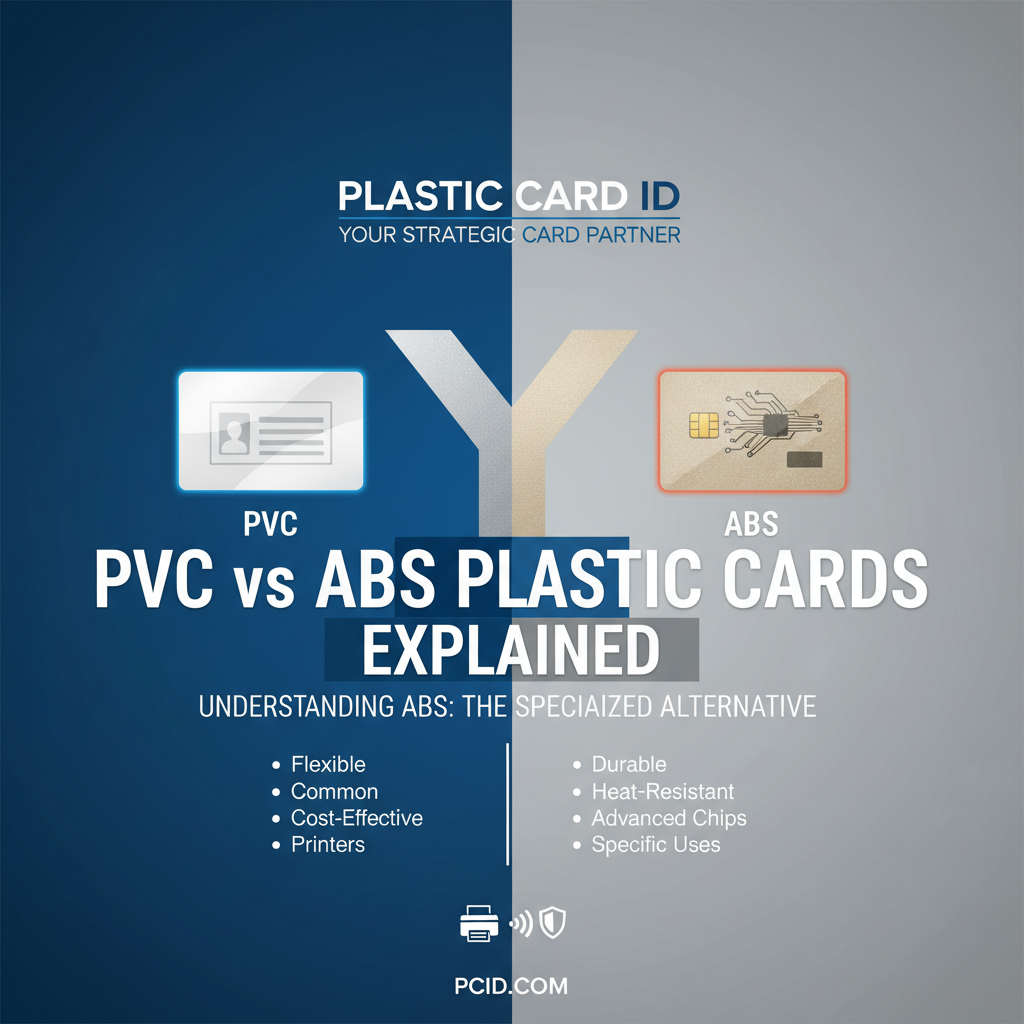
ABS cards tend to be stiffer and less flexible than their PVC counterparts. In some applications this is a benefit - a card that must maintain precise dimensional tolerances in a mechanical reader may perform consistently well in ABS. In everyday wallet-carry scenarios, however, that rigidity can become a liability. ABS cards subjected to repeated bending stress - the kind of stress a card in a tight wallet experiences dozens of times per day - are more prone to cracking than PVC.
Where ABS Cards Have a Legitimate Role
ABS has carved out a real niche in specific card applications. Casino player cards, for example, have historically been produced in ABS because the material's surface properties interact well with certain printing and over-coating processes used in gaming environments. Some specialty access control tokens and industrial ID badges have also used ABS for its hardness and chemical resistance.
Gaming industry applications are one area where the ABS-versus-PVC conversation becomes genuinely interesting. The surface texture of ABS can accept certain inks and coatings differently than PVC, and for organizations that need a specific tactile or visual result, ABS may be worth evaluating. CPE works with clients across gaming, hospitality, and specialty industries to match the right card material to the right application.
ABS Printing Considerations
ABS surfaces can be printed on, but the material does not behave identically to PVC under dye sublimation conditions. The slightly different surface chemistry and thermal response of ABS means that color reproduction, while perfectly acceptable for many applications, may not achieve the same photographic-quality vibrancy that PVC delivers. This is a practical consideration for programs where brand color accuracy matters.
Offset printing and screen printing on ABS can produce very good results, particularly for high-volume runs where the cards are pre-printed rather than personalized individually in-house. For organizations printing in batches on desktop card printers, PVC will generally deliver more predictable, vibrant results without requiring adjustments to printing profiles or settings.
Cost Dynamics: ABS Versus PVC at Volume
Cost is always part of the conversation. At comparable quantities, ABS cards can run meaningfully higher than PVC cards, especially once you factor in the narrower range of suppliers and the less standardized production pipeline for ABS in card formats. PVC card manufacturing is highly optimized globally, which drives per-unit costs down substantially at volume.
For organizations ordering in the tens of thousands - or even the tens of millions, as some national retail loyalty programs do - the cost difference between PVC and ABS compounds significantly. PVC's lower per-unit cost at volume is one of the reasons it dominates the mainstream card market. ABS tends to earn its premium only when specific material properties genuinely justify the added expense.
Key Technical Differences That Drive Real-World Decisions
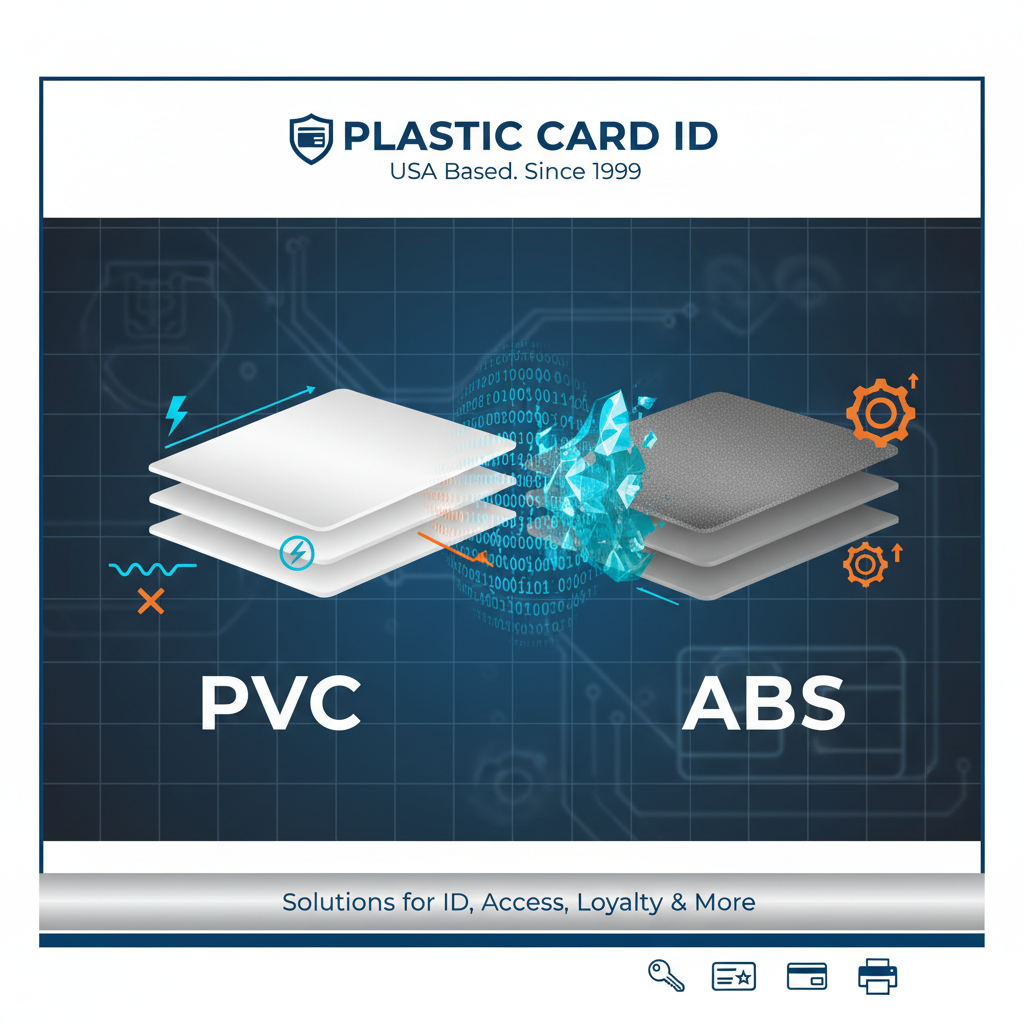 Strip away the chemistry and what you are left with are practical, operational differences that determine which material actually belongs in your card program. Flexibility, temperature tolerance, magnetic stripe compatibility, RFID integration, and printer compatibility - these are the factors that matter when you are ordering cards that need to work reliably for the next three to five years across thousands of daily swipes, taps, and scans.
PVC, being slightly flexible, absorbs mechanical stress better over time. A card that bends slightly in a pocket springs back to shape rather than cracking. ABS, being more rigid, can tolerate more surface abrasion in some contexts but is more susceptible to fracture under repeated flexion. Understanding this distinction helps organizations make informed decisions about which material suits their users' real-world behavior.
Temperature and Environmental Tolerance
Both PVC and ABS are thermoplastics - they respond to heat. PVC begins to soften at higher temperatures than typical daily environments produce, but prolonged exposure to intense heat (like a car interior in summer) can warp either material. In practice, PVC's formulation for card applications includes plasticizers that give it a slightly broader operational temperature range in everyday use.
ABS can become more brittle in very cold conditions, an important consideration for card programs in outdoor environments like ski resorts, outdoor event venues, or facilities in northern climates. PVC maintains flexibility across a wider temperature range, which is part of why it performs more consistently in environments where cards move between indoor and outdoor conditions regularly.
RFID and Smart Chip Integration
Both PVC and ABS can host RFID antennas and smart chip modules, but PVC is by far the more common substrate for these technologies. The layered lamination construction of PVC composites allows RFID antenna coils and chip modules to be embedded with precision and protected effectively. Technologies like MIFARE DESFire - used in high-security access control and transit applications - are almost universally deployed on PVC-based card substrates.
Hotel key cards, proximity access cards, and contactless smart cards in loyalty and transit programs rely on PVC construction for its combination of dimensional stability and lamination reliability. When your card program requires contactless technology, PVC is the established, proven platform with the broadest compatibility across reader systems and encoding equipment.
Printer and Ribbon Compatibility
This is a practical point that card program managers sometimes overlook. Desktop card printers from Evolis, Zebra, and Fargo are calibrated and optimized for PVC card substrates. Ribbon formulations, temperature profiles, and retransfer film specifications used in these systems are developed with PVC in mind. Running ABS cards through a system configured for PVC may require adjustment and can produce inconsistent results.
- Dye sublimation ribbons bond most effectively to standard PVC surfaces
- Retransfer printers can print on ABS, but require proper configuration
- Cleaning kits and card transport systems are optimized for CR80 PVC dimensions
- YMCKO and YMCKOK ribbons perform predictably on PVC without custom calibration
- Printer warranty considerations may apply when using non-standard card materials
Working with a supplier who understands both the card material and the printing hardware side of the equation matters. CPE supplies not just cards but the full printing ecosystem - ribbons, cleaning kits, and printer hardware - which means clients get consistent recommendations across the entire card production chain.
Which Material Is Right for Your Card Program?
 The honest answer is: for most business card programs in the United States, PVC is the right choice. It prints better, encodes more reliably, integrates with more hardware, and costs less at volume than ABS. The cases where ABS genuinely earns its place are specific, and outside of those contexts, choosing ABS over PVC is rarely a decision that improves outcomes.
That said, the decision deserves a real evaluation against your specific program requirements. What readers will the cards pass through? Will cards be carried daily in wallets? Do you need embedded technology? How large is your print volume? What printer hardware do you own or plan to purchase? These questions frame the material decision correctly - not as a matter of preference, but as a matter of operational fit.
Loyalty and Gift Card Programs
Retailers and restaurants that have moved loyalty and gift card programs from paper to plastic report sales increases in the 35-50% range - a figure that reflects how powerfully a physical card drives repeat engagement. For these programs, PVC is the unambiguous choice. Vibrant color printing, magnetic stripe encoding, and wallet-friendly flexibility make PVC the material that delivers the customer experience loyalty programs depend on.
Paper punch cards sit in a drawer and get lost. A well-designed PVC loyalty card lives in a wallet, gets seen every time the customer reaches for payment, and serves as a continuous brand impression. The durability of PVC means the card holds up through the full lifecycle of a loyalty relationship without cracking, fading, or delaminating at the edges.
Employee ID and Access Control Programs
Employee badge and access control programs are among the highest-volume, most demanding card applications in any organization. Cards get swiped, tapped, clipped to lanyards, and tucked into badge holders hundreds of times over months or years of use. PVC composite cards with RFID or magnetic stripe encoding handle this daily stress consistently in ways that make them the material of choice for HR and security professionals.
Blank PVC CR80 cards allow in-house printing teams to produce personalized employee IDs on demand - critical for onboarding, contractor programs, and event credentialing. The ability to print, encode, and issue a card the same day an employee starts work is a meaningful operational advantage that blank PVC stock enables directly.
Membership, Event, and Specialty Card Programs
Membership organizations - gyms, clubs, professional associations, libraries, healthcare networks - depend on cards that signal legitimacy and permanence. A laminated PVC membership card with a professional printed design communicates institutional credibility in a way that a paper card or digital alternative simply cannot replicate for many audiences.
Event credentials, VIP passes, conference badges, and festival access cards all benefit from PVC's printability and durability. For higher-end programs, specialty options like clear PVC, frosted cards, custom die-cut shapes, and luxury metal cards in stainless steel or brass elevate the experience further. The range of available formats in PVC is simply broader than what ABS can offer, which gives program designers more creative latitude.
Buyer's Guide: Choosing Cards With Confidence
Purchasing cards for a business program - whether you are ordering 500 or 50,000 - should not feel like navigating a technical minefield. The fundamentals are straightforward once the key variables are understood. Material, format, encoding, quantity, and printing method are the five levers that determine what kind of card is right for your program and at what price point.
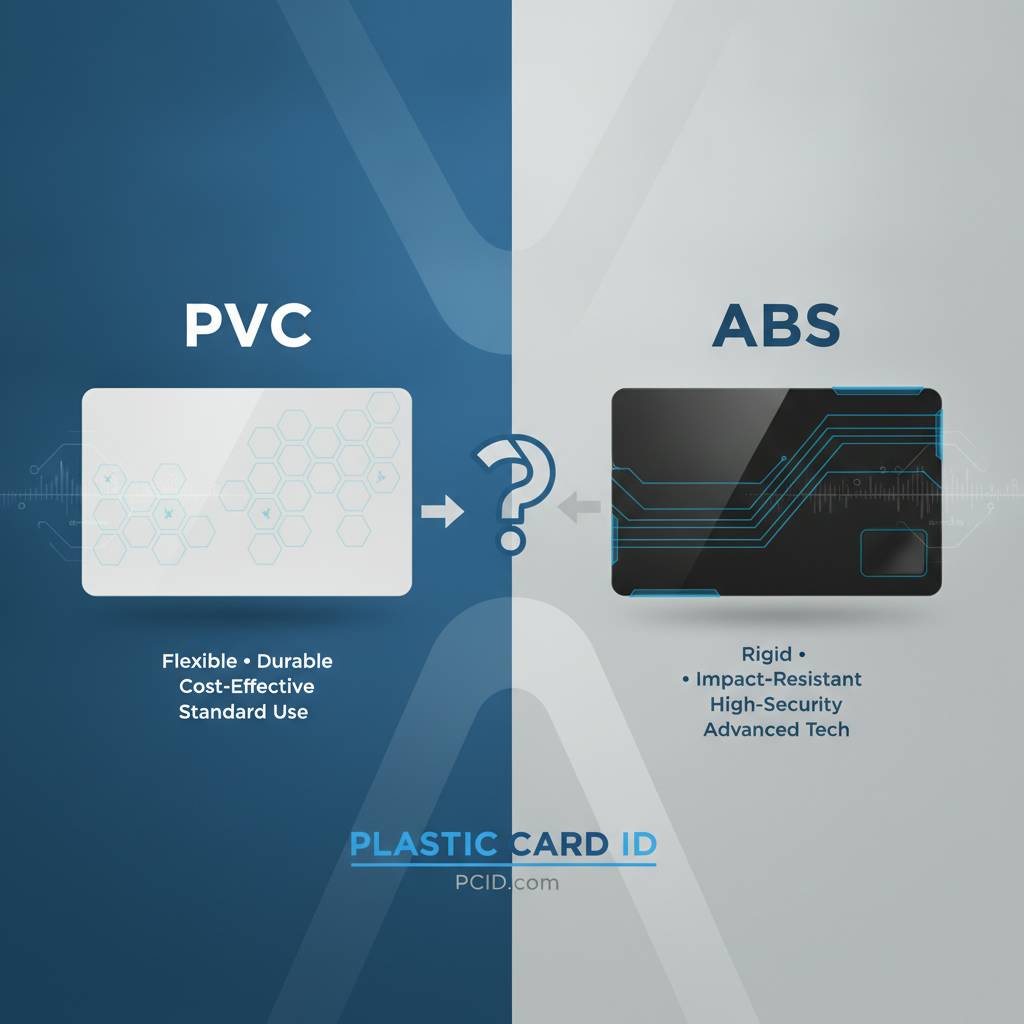
Most organizations are better served by starting with their use case and working backward to the material and features, rather than starting with the material and trying to fit a program around it. PVC blank CR80 cards with a HiCo magnetic stripe are the right starting point for an enormous percentage of business card programs in the United States. From there, encoding technology, specialty finishes, and advanced features layer in as genuine requirements emerge.
Frequently Asked Questions About PVC and ABS Cards
Buyers often arrive with variations of the same core questions. Understanding what drives the differences between these materials makes those questions easy to answer with confidence.
- Can I print on ABS cards with my existing card printer? Possibly, but check with your printer manufacturer - most desktop card printers are calibrated for PVC substrates.
- Are PVC cards the same as credit card material? Yes - standard credit and debit cards are PVC composite in CR80 format, the same as business loyalty and ID cards.
- Do ABS cards work in magnetic stripe readers? Generally yes, but the adhesion and read consistency of magnetic stripes on ABS may vary by supplier.
- Which material is better for outdoor or high-humidity environments? PVC's flexibility gives it an edge in environments with temperature and humidity variation.
- Can I get custom shapes in PVC? Yes - custom die-cut PVC cards in virtually any shape are available for specialty programs.
These are the kinds of questions CPE fields every day from program managers, purchasing officers, HR teams, and operations directors across the country. Having a knowledgeable supplier in your corner is not just about getting cards shipped - it is about getting the right cards for the right application the first time.
Volume Tiers and What to Expect at Each Level
Card programs exist at every scale. A small gym might order 200 membership cards per year. A regional retail chain might need 20,000 loyalty cards per quarter. A national hospitality brand might require hotel key cards in the hundreds of thousands annually. PVC scales beautifully across all of these tiers - the per-unit cost drops meaningfully as volume increases, and quality remains consistent from the smallest order to the largest.
For organizations just starting a card program, blank PVC stock plus an in-house desktop printer from Evolis, Zebra, or Fargo provides complete control over issuance with a relatively modest upfront investment. For programs at higher volumes where pre-printed cards make more sense, professional offset-printed PVC cards offer exceptional quality and cost efficiency. The flexibility of the PVC format accommodates both models.
Reach Out to Discuss Your Program Requirements
Getting the material selection right before you order saves time, money, and operational headaches down the road. Call Plastic Card ID at 800.835.7919 to speak with a card program specialist who can walk through your specific requirements and recommend the right material, format, encoding, and quantity for your program.
Why Plastic Card ID Is the Strategic Partner Your Card Program Deserves
 Over 25 years. More than 100,000 customers. More than 50 million cards shipped across the United States. These are not just numbers - they represent the accumulated knowledge of what works in real card programs across real industries. Plastic Card ID does not just sell cards; it helps organizations build card programs that perform - consistently, cost-effectively, and at whatever scale the program demands.
The full catalog spans blank PVC cards, magnetic stripe cards in HiCo and LoCo, RFID and proximity cards, smart chip cards including MIFARE DESFire, clear and frosted specialty cards, colored stock, custom die-cut formats, and luxury metal cards in stainless steel, brass, and gold. Card printers from Evolis, Zebra, and Fargo, complete with ribbons, cleaning kits, and card carriers, round out a genuinely end-to-end offering. Everything a card program needs, from the blank stock to the finished credential, in one place.
Ready to make the right choice for your card program? Contact Plastic Card ID today at 800.835.7919 and put 25 years of card program expertise to work for your organization.