Are Blank Plastic Cards Recyclable? PVC Limitations Explained
Table of Contents []
- What Happens to Blank Plastic Cards at End of Life? Plastic Card ID Explains PVC Realities
- Are Blank Plastic Cards Recyclable? The Honest Answer About PVC Limitations
- The Practical Case for Blank PVC Cards Despite End-of-Life Limitations
- PVC Card Recycling: What Organizations Can Do Right Now
- The Plastic Card ID Card Catalog: Built for Programs That Run on Reliability
- Frequently Asked Questions About PVC Cards and Recycling
- Make Your Next Card Order Count with Plastic Card ID
What Happens to Blank Plastic Cards at End of Life? Plastic Card ID Explains PVC Realities
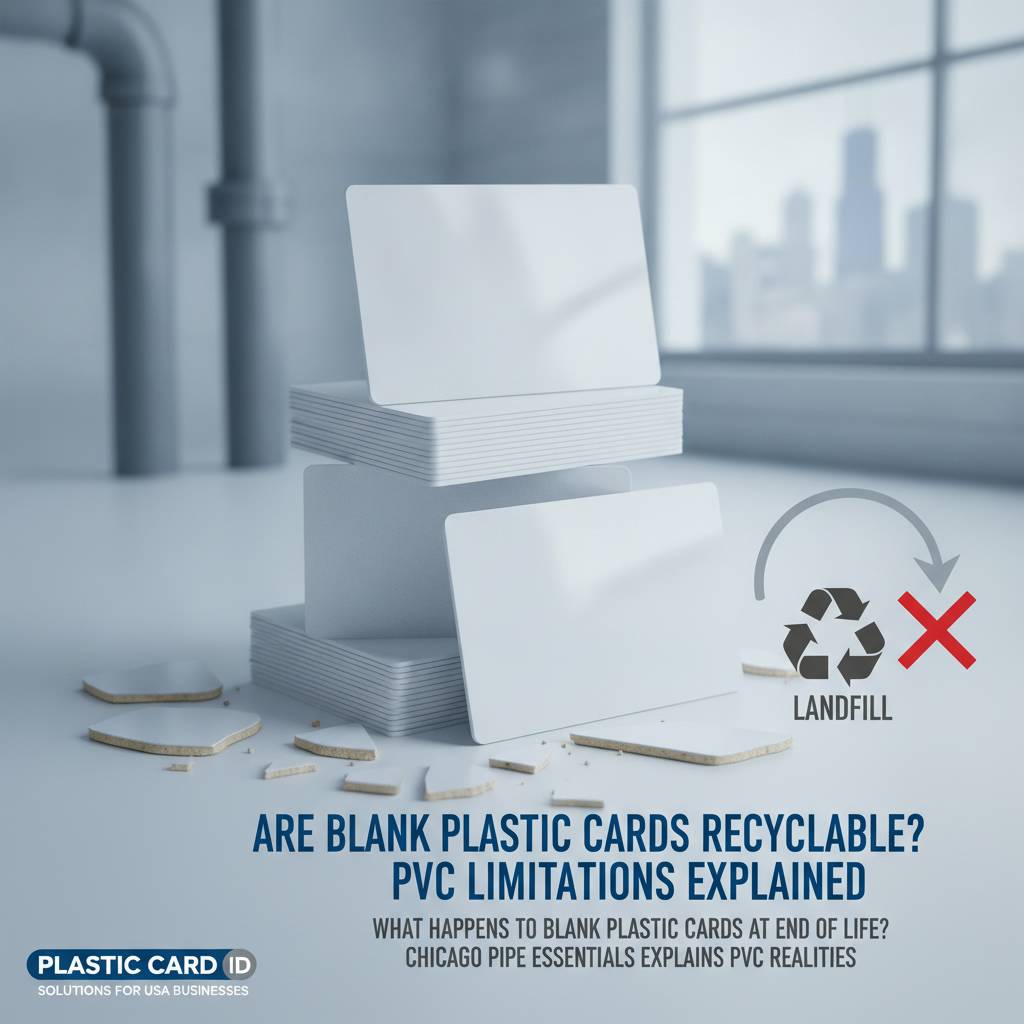 Most conversations about plastic cards start with what they can do - open doors, reward loyal customers, identify employees, grant access to events. Rarely does anyone pause to ask what happens when the card's useful life is over. That question matters, and it deserves an honest, straightforward answer rather than vague reassurances.
Blank PVC plastic cards are built for durability. That is precisely their strength and, at end of life, their limitation. Understanding both sides of that equation helps businesses make smarter purchasing decisions and manage their card programs responsibly. Plastic Card ID has spent over 25 years helping organizations across the United States do exactly that.
| Property | Detail |
|---|---|
| Material | Polyvinyl chloride (PVC) |
| Standard Size | CR80, 3.375" x 2.125" (ISO 7810) |
| Thickness | 30 mil standard |
| Durability | Highly resistant to moisture, flex, and wear |
| Recyclability | Not accepted in standard curbside recycling |
| Specialty Recycling | Available through select facilities and card takeback programs |
| Magnetic Stripe Options | HiCo (2750 Oe) and LoCo (300 Oe) |
| Common Uses | Employee ID, loyalty, membership, access control, gift cards |
Are Blank Plastic Cards Recyclable? The Honest Answer About PVC Limitations
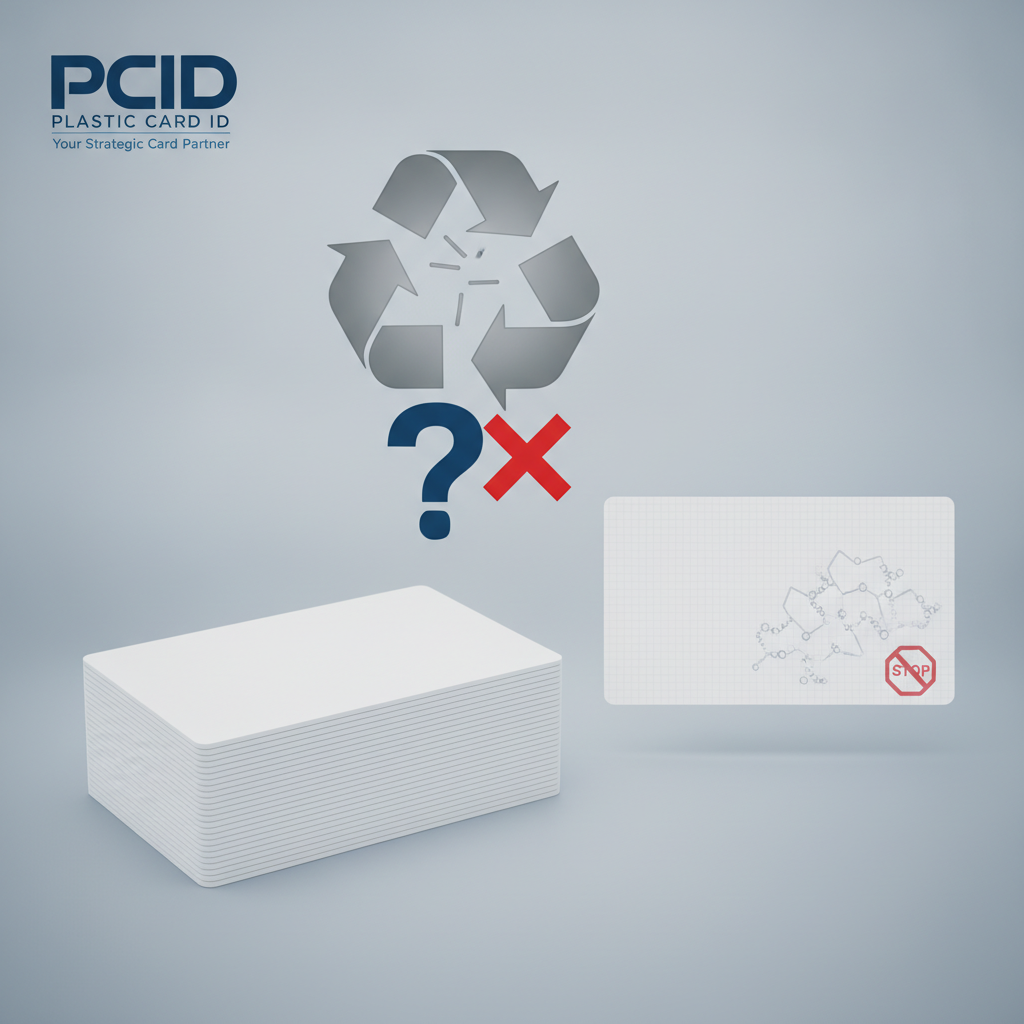 The short answer is: not through your curbside bin. PVC - polyvinyl chloride - is a resin-coded plastic that most municipal recycling programs simply do not process. Standard recycling facilities are equipped for plastics like PET and HDPE, which have established collection and processing infrastructure. PVC is a different animal entirely, and that distinction trips up a lot of well-meaning businesses.
That said, recyclability is not binary. Specialty recyclers do accept PVC cards, and some card manufacturers and distributors operate takeback programs that consolidate used cards for proper processing. The practical takeaway is that responsible disposal requires a bit more intention than tossing cards in the blue bin - but it is absolutely achievable for organizations that build it into their card program lifecycle from the start.
Why PVC Is Not Accepted in Standard Recycling Streams
PVC contains chlorine-based compounds and often incorporates plasticizers, stabilizers, and additives that create challenges at standard recycling facilities. When mixed with other plastics during processing, PVC can contaminate entire batches, releasing harmful byproducts and damaging processing equipment. This is why most municipalities exclude it from curbside collection programs regardless of the recycling symbol printed on the item.
For plastic cards specifically, the challenge is compounded. Cards often include magnetic stripes, embedded chips, RFID antennas, printed inks, and laminate overlaminates - each of which may require separation before any base material can be recovered. The composite nature of feature-rich cards makes mechanical recycling genuinely complex. Blank PVC cards are simpler, but they still carry the base-material limitations of the resin class.
What Specialty Recyclers Actually Do With PVC Cards
Facilities that specialize in PVC processing use chemical and mechanical methods to break down and recover usable material. Some recover the PVC resin itself for use in lower-grade applications like construction materials and piping compounds. Others focus on recovering metals and electronic components embedded in smart or magnetic stripe cards before processing the remaining plastic substrate.
Organizations running large card programs - hotels with thousands of key cards cycling annually, casinos managing player card fleets, or healthcare systems rotating ID badges - often have the volume to make a formal partnership with a specialty recycler cost-effective. Volume creates leverage. Smaller programs can explore mail-in recycling options or coordinate with industry-specific takeback services that aggregate cards across multiple organizations.
Secure Destruction Before Disposal
Before any card reaches a recycler, secure destruction is essential - especially for cards carrying encoded data, access credentials, or personally identifiable information. Magnetic stripe cards can be degaussed. Smart chip cards and proximity cards should be physically destroyed to render them non-functional. Data security and responsible disposal go hand in hand.
Many organizations already have document shredding programs in place. Industrial shredders capable of handling hard drives can typically handle plastic cards as well. Check with your shredding vendor about including card destruction in your existing contract. The shredded material can then be sent to a specialty PVC recycler rather than landfill, closing the loop more effectively than most people expect.
The Practical Case for Blank PVC Cards Despite End-of-Life Limitations
Understanding PVC's recycling limitations does not diminish the practical value of blank plastic cards - it contextualizes it. Every material choice involves tradeoffs. Paper cards carry their own production footprint. Metal cards require far more energy-intensive manufacturing and are not broadly recyclable either. PVC cards, when used thoughtfully, deliver exceptional longevity that reduces total volume over time.
Consider the math: a loyalty card program running paper punch cards might issue three to five cards per customer per year due to wear, loss, and damage. A single well-printed PVC loyalty card can serve the same customer for two to five years. Fewer cards produced means fewer cards disposed of - a straightforward lifecycle calculation that organizations running serious card programs understand intuitively.
Longevity as a Functional Asset
Blank CR80 cards printed and issued through an in-house card printer system last significantly longer than alternatives because their owners invest in them intentionally. A laminated employee ID card with a holographic overlaminate might remain functional for three to five years under daily use. A gift card that lives in a wallet next to credit cards needs to withstand the same mechanical stress as those cards - and PVC handles it.
CPE works with businesses across retail, healthcare, hospitality, education, and security-sensitive sectors where card reliability directly affects operational performance. A badge that fails the reader, a loyalty card that cracks, or a hotel key that stops working mid-stay are not just inconveniences - they are service failures. PVC's durability profile addresses these failure points head-on.
Comparing Blank Card Materials for Real-World Use
- Standard PVC (30 mil CR80): Widest compatibility with card printers, most cost-effective at scale, available with magnetic stripe, RFID, and smart chip options.
- Composite PVC/PET cards: Slightly more rigid, used when enhanced durability is required; compatible with most desktop card printers.
- Clear and frosted PVC cards: Specialty aesthetic applications; same base material, different optical properties.
- Metal cards (stainless steel, brass, gold): Premium tier; extremely long functional life; higher upfront cost and weight; not printer-compatible without specialized processes.
- Paper or cardstock cards: Lowest upfront cost; highest replacement frequency; not compatible with magnetic stripe or chip encoding without specialty lamination.
For most organizations running active card programs, standard PVC remains the workhorse. Its combination of encoding compatibility, print quality, and durability at scale is genuinely hard to beat. CPE keeps an extensive inventory of blank stock across all major card types so programs of any size can move fast without supply bottlenecks.
Volume Considerations and Per-Card Cost
One of the least-discussed factors in responsible card program management is how volume affects both economics and material impact. Ordering blank PVC cards in quantity - 500, 1,000, or 5,000 units - reduces per-card cost substantially while ensuring consistency across the batch. Programs that under-order and reorder frequently tend to accumulate more waste through mismatched batches, printing errors on smaller test runs, and inconsistent card stock.
Planning card order volume intelligently is both a cost strategy and a waste-reduction strategy. Plastic Card ID helps clients calculate realistic order volumes based on program scale, expected card turnover, and encoding requirements - so organizations are not over-stocked or scrambling for cards mid-program.
PVC Card Recycling: What Organizations Can Do Right Now
 Actionable steps matter more than abstract commitments. If your organization issues plastic cards - employee IDs, loyalty cards, membership cards, gift cards, access credentials - and you want to manage end-of-life responsibly, the path forward is practical and accessible. It starts with knowing where your current cards end up.
Many organizations have no formal process for retired cards. Expired employee badges pile up in supply closets. Outdated gift cards are discarded loosely. Hotel key cards are tossed en masse at the end of a property renovation cycle. Establishing a simple collection protocol costs nothing and immediately improves your program's responsibility profile.
Building a Card Return and Collection Program
The most effective approach is a structured return process built into your card issuance workflow. For employee ID programs, exit interviews or offboarding processes are natural collection points. For hotel key programs, front desk return bins already exist - the question is where those cards go next. For loyalty and gift card programs, consider in-store drop boxes that collect retired cards for consolidated disposal.
Consolidated collection creates volume, and volume makes specialty recycling feasible. A box of 500 retired cards is a shipping cost. A box of 5,000 is a program. CPE can discuss what card types you're running and point you toward appropriate recycling or destruction partners as part of broader card program support.
Mail-In and Takeback Options
Several specialty recycling organizations accept PVC cards through mail-in programs. These services typically charge a nominal fee per pound or per lot of cards, and they provide certificates of destruction upon processing - useful documentation for organizations with compliance obligations. Search specifically for PVC or vinyl plastic recyclers, not general plastic recycling services, to ensure proper handling.
Some card industry associations and printer manufacturers have developed or partnered with takeback programs that accept spent ribbons, cleaning kits, and cards together. Bundling your card consumables disposal into a single program simplifies administration and reduces the chance that any one category gets overlooked.
Data Security During Card Disposal
Contact 800.835.7919 to discuss which card types in your program carry encoded data and require secure destruction prior to disposal. Magnetic stripe cards, proximity cards, and smart chip cards each carry data that must be rendered unreadable before cards leave your facility. This is a compliance matter, not just a best practice, for many regulated industries including healthcare, finance, and government.
Physical destruction followed by specialty recycler transfer is the gold standard. Degaussing alone does not physically destroy the card substrate, and shredding alone does not guarantee data erasure from active chips. A two-step process - destroy data, then recycle material - covers both bases cleanly. Treating card disposal with the same seriousness as document disposal is the right mindset for any organization running a serious card program.
The Plastic Card ID Card Catalog: Built for Programs That Run on Reliability
 Whatever your card program requires, CPE stocks it. The catalog spans decades of development, refined through relationships with over 100,000 customers and more than 50 million cards shipped across the United States. That scale of experience translates directly into the quality and reliability that clients in demanding sectors depend on.
Blank PVC cards are the foundation - but the catalog extends well beyond white CR80 stock. Magnetic stripe cards in both HiCo and LoCo formats, RFID and proximity cards, MIFARE DESFire smart cards, clear and frosted specialty stock, colored PVC, and high-end metal cards in stainless steel, brass, and gold are all available. Programs evolve, and CPE evolves with them.
Magnetic Stripe Cards: HiCo vs. LoCo
High-coercivity (HiCo) magnetic stripe cards are encoded at 2750 Oe, making them highly resistant to accidental erasure from everyday magnetic fields. They are the preferred choice for access control, loyalty programs, and any application where card longevity is critical. Low-coercivity (LoCo) cards at 300 Oe are easier to encode and work well for short-duration applications like hotel room keys or event credentials where periodic re-encoding is routine.
Choosing the wrong stripe type is a common and costly mistake for new card programs. Matching stripe coercivity to your encoder and use case is one of the first decisions CPE helps clients navigate - before a single card is ordered. Get it right at the start and avoid expensive reprints or compatibility failures down the line.
RFID, Proximity, and Smart Chip Cards
Contactless card technology has expanded significantly, and the options can be overwhelming without the right guide. Proximity cards (125 kHz) remain the standard for basic access control in commercial buildings and institutions. RFID smart cards operating at 13.56 MHz - including MIFARE DESFire variants - support encrypted, multi-application use cases ideal for secure facilities, transit, campus ID, and casino player programs.
Smart chip cards add contact-based intelligence to the card's capability set, enabling applications that require secure, interactive data exchange at point of use. Selecting the right technology tier for your specific use case determines both the functional success and the total cost of your program over time. Plastic Card ID carries the full range and can help you match technology to application precisely.
Card Printers, Ribbons, and Program Supplies
A card program without the right printer is a card program that underperforms. Plastic Card ID carries card printers from Evolis, Zebra, and Fargo - three of the most respected names in desktop and mid-volume card printing. Each brand has specific strengths, and the right choice depends on your monthly print volume, encoding requirements, and card stock type.
Printer ribbons, cleaning kits, card sleeves, card carriers, and affixing and mailing services round out the full program supply chain. Everything a card program needs, from blank card stock to finished, mailed card, is available through a single source. That simplicity of supply chain is worth more than most clients realize until they have experienced the alternative.
Frequently Asked Questions About PVC Cards and Recycling
These questions come up consistently when organizations are setting up or reviewing their card programs. Honest answers help buyers make confident, informed decisions.
Can I put PVC cards in my office recycling bin?
No. Standard office and curbside recycling programs do not accept PVC plastic cards. Placing them in general recycling bins contaminates the recycling stream and does not result in the material being recovered. Cards dropped in standard bins are sorted out and sent to landfill anyway - so the effort is wasted without the right specialty channel.
The correct route is collection, secure data destruction if applicable, and then transfer to a specialty PVC recycler or a card industry takeback program. Intentional disposal beats wishful recycling every time. Setting up a simple internal collection process is the first and most impactful step any organization can take.
How long do blank PVC cards last in active use?
Under normal use conditions, a 30 mil CR80 blank PVC card printed with a dye-sublimation card printer and protected by a laminate overlaminate will typically last three to five years in wallet or badge holder use. Cards exposed to harsh environments - extreme temperatures, UV exposure, industrial chemicals - will have shorter functional lives depending on exposure intensity.
Card longevity is directly tied to print quality and overlaminate selection. Cards printed without an overlaminate wear significantly faster. Cards stored in badge holders or card sleeves last longer than cards carried loose in pockets or wallets. Simple handling practices extend functional life meaningfully and reduce total card consumption over time.
Does Plastic Card ID offer any guidance on responsible card disposal?
Yes. As a strategic partner to card programs across the United States, CPE supports clients through the full card program lifecycle - including end-of-life planning. Call 800.835.7919 to speak with a card program specialist about your specific card types, volumes, and disposal options. Guidance is part of the relationship, not an add-on service.
Whether you are running a 50-card-per-month employee badge program or managing tens of thousands of loyalty cards across a retail network, responsible card management is a conversation worth having before disposal becomes an afterthought. A well-planned card program includes an exit strategy for every card it issues.
Make Your Next Card Order Count with Plastic Card ID
 Blank plastic cards are not just supply items - they are the foundation of programs that drive real business results. Retailers switching from paper to plastic gift cards see sales increases of 35-50%. Loyalty cards that live in wallets outperform paper punch cards month after month. Employee ID cards and access credentials signal the kind of organizational seriousness that builds institutional trust. These are not marginal gains. They are structural advantages.
CPE has built its reputation across more than 25 years and over 100,000 client relationships by treating every card program as worth getting right. From the first blank card order to printer selection, ribbon supply, encoding decisions, and responsible end-of-life planning, the full-program perspective is what separates a strategic partner from a commodity supplier. That distinction matters when your program depends on consistency and reliability at scale.
Ready to Start or Upgrade Your Card Program?
Whether you need 50 blank PVC cards for a small business loyalty program or tens of thousands of encoded smart cards for a multi-location enterprise deployment, Plastic Card ID has the stock, expertise, and support infrastructure to make your program succeed. The catalog is comprehensive, the team is experienced, and the relationship is built to last.
Call Plastic Card ID today at 800.835.7919 and speak with a card program specialist who can guide your next order with confidence.
Plastic Card ID - your long-term partner in plastic card solutions across the United States, built on 25 years of expertise and over 50 million cards delivered.
Previous Page