Blank White PVC Cards vs Printed Cards: Key Differences
Table of Contents []
- Blank White PVC Cards vs Printed Cards: Which Option Does Plastic Card ID Recommend for Your Program?
- Understanding the CR80 Standard and Why It Matters
- Blank Cards for In-House Printing: The Real Cost Analysis
- Magnetic Stripe, RFID, and Smart Chip: Encoding Options for Both Card Types
- Specialty Cards: When Standard Blank White PVC Is Not the Right Answer
- Card Printers, Ribbons, and the Complete In-House Printing Setup
- Frequently Asked Questions: Blank White PVC Cards vs Printed Cards
- Partner with Plastic Card ID for Your Complete Card Program Solution
Blank White PVC Cards vs Printed Cards: Which Option Does Plastic Card ID Recommend for Your Program?
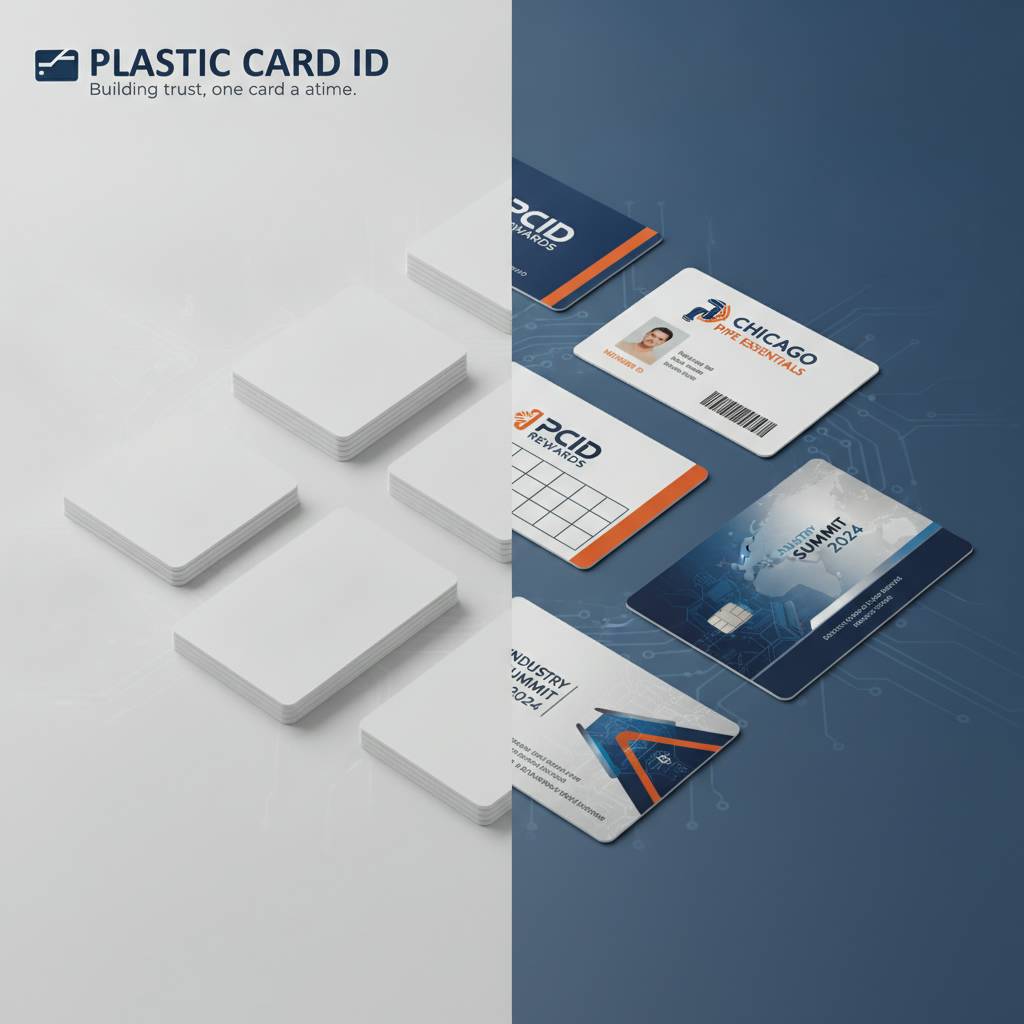 The decision sounds deceptively simple. You need plastic cards - maybe a few hundred, maybe tens of thousands - and somewhere along the way, someone asks: should we order them blank and print in-house, or order them fully printed? That question carries more weight than most buyers realize. The answer depends on your volume, your timeline, your design flexibility needs, and how much control you want over the finished product.
At Plastic Card ID, this conversation happens every single day. With over 25 years in the industry and more than 50 million cards shipped to businesses across the United States, the team has seen every scenario imaginable. Small nonprofits printing 50 membership cards per month. Regional retailers producing gift card runs in the tens of thousands. Corporate HR departments badging employees at multiple sites simultaneously. There is no universal answer - but there is almost always a clearly better option for your specific situation.
This guide breaks down the real differences between blank white PVC cards and fully printed cards, covering cost structures, production control, encoding options, printer compatibility, and the scenarios where one approach dramatically outperforms the other.
| Feature | Blank White PVC Cards | Custom Printed Cards |
|---|---|---|
| Design Flexibility | Full in-house control | Fixed at order time |
| Per-Card Cost at Scale | Lower long-term | Competitive in bulk |
| Personalization | Names, photos, barcodes | Uniform batch design |
| Turnaround Speed | Print on demand | Production lead time |
| Encoding Options | Mag stripe, chip, RFID | Available at order |
| Minimum Order | Very low | Varies by complexity |
Understanding the CR80 Standard and Why It Matters
 Every credit card in your wallet, every employee badge clipped to a lanyard, every hotel key slipped into a door lock - they all share the same physical dimensions. The CR80 standard (ISO 7810 compliant) defines a card measuring 3.375 inches by 2.125 inches at 30 mil thickness. This is not arbitrary. This uniformity is what makes the entire plastic card ecosystem function.
When you order blank white PVC cards from CPE, you are ordering CR80 cards. They feed through desktop card printers from Evolis, Zebra, and Fargo without adjustment. They slide into cardholders, lanyards, and wallets without modification. They accept magnetic stripe encoding, smart chip embedding, and RFID antenna integration - all within that standardized footprint. The blank card is, in a very real sense, a canvas that can become almost anything.
What Makes Blank PVC the Workhorse Option
Organizations running ongoing card programs - employee badging, loyalty programs, access control, membership management - repeatedly return to blank white PVC as the backbone of their operation. Why? Because the economics compound favorably. You pay for cards once, you print what you need when you need it, and you never sit on obsolete inventory with last season's branding on it.
A retail chain updating its loyalty card design, for example, does not need to throw out boxes of pre-printed cards. With a blank card inventory and an in-house printer, a design update is a software change, not a restocking crisis. Control over your card program is control over your brand timeline.
The 30 Mil Thickness Advantage
Thickness matters more than people initially expect. The 30 mil standard is not just an industry convention - it is the sweet spot between durability and printability. Cards printed at this thickness resist the bending and cracking that thinner stock develops after weeks in a wallet. They feel substantial in hand, which signals quality to the person receiving them.
Thinner cards at 20 mil or lower are available and have specific use cases - short-term event credentials, for instance - but for any card program where longevity and perceived value matter, 30 mil is the professional standard. Plastic Card ID stocks CR80 cards at the 30 mil thickness across all blank card product lines.
ISO Standards and Printer Compatibility
One underappreciated benefit of ISO-compliant CR80 cards is universal printer compatibility. Evolis, Zebra, and Fargo card printers - the three major professional desktop card printer brands CPE carries - are all calibrated for CR80 dimensions. Non-standard cards, including off-brand or improperly manufactured blanks, can jam print heads, cause roller wear, and void printer warranties.
This is not a hypothetical risk. It happens regularly with low-cost cards sourced from non-verified suppliers. The cost savings evaporate quickly when a print head replacement runs $200-$400 and downtime halts your card production entirely. Sourcing certified ISO-compliant blanks from a trusted supplier is part of protecting your total investment in card infrastructure.
Blank Cards for In-House Printing: The Real Cost Analysis
The conversation about blank versus printed cards almost always comes back to money. And the math is more nuanced than a simple per-card comparison. Total cost of ownership for an in-house card program includes the card stock, the printer, the ribbon consumption, and the labor involved. For custom-printed orders, it includes production minimums, shipping timelines, and the risk of design lock-in.
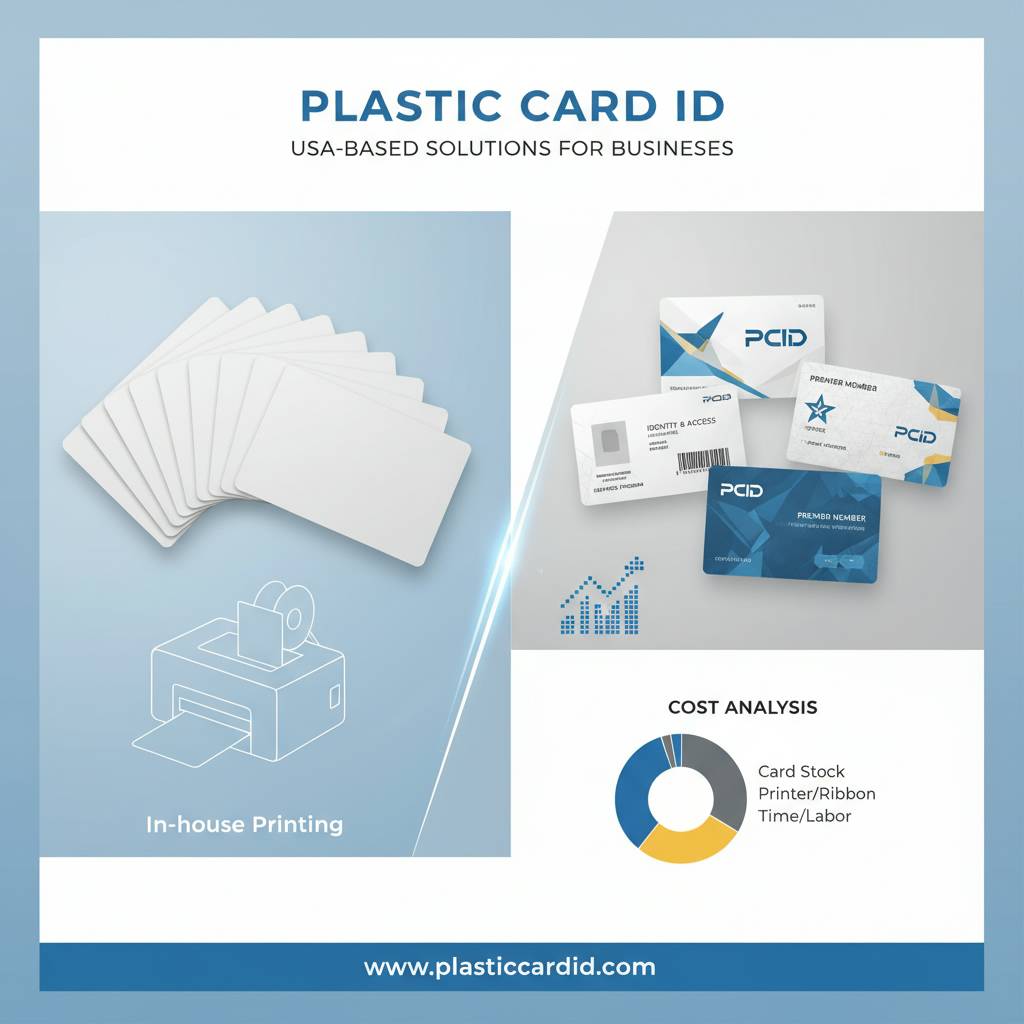
Here is what the numbers typically look like for organizations printing 100-500 cards per month: blank CR80 cards in quantity run at very competitive per-card rates. A quality dye-sublimation ribbon from Evolis or Fargo prints a full-color card for roughly $0.75-$1.50 in consumable cost. Pre-printed full-color cards from outside vendors at low quantities can easily run $2.00-$5.00 per card with setup fees factored in. The crossover point where in-house printing becomes clearly economical is often lower than buyers expect.
Calculating Your Break-Even Point
The break-even calculation for a card printer investment is straightforward. Take the printer cost - a capable desktop card printer from Evolis or Zebra runs $500-$1,500 for most business applications. Add your annual ribbon and cleaning kit costs. Divide by your projected monthly card volume. Most organizations printing 50 or more cards per month recover their printer investment within 12-18 months, sometimes faster.
Beyond break-even, the in-house model generates compounding savings. Every card printed in-house at lower cost versus outsourced printing contributes to program profitability. For loyalty programs especially, where card replacement and new member enrollment are ongoing, in-house production is the financially disciplined choice.
Volume Pricing on Blank Card Stock
Blank white PVC cards are sold in cases, and case pricing rewards volume commitment. Smaller quantities of 100-500 cards carry a higher per-card price than case quantities of 500-1,000 or more. Organizations that can forecast their 6-12 month card volume and order accordingly see the most favorable unit economics.
Contact 800.835.7919 to discuss volume pricing tiers for blank card stock. The CPE team can model your program's card consumption and recommend the order quantity that optimizes your per-card cost without tying up unnecessary capital in excess inventory.
Hidden Costs in the Custom Printed Card Model
Pre-printed cards look attractive in a per-card quote until the full picture emerges. Setup fees, plate charges, and minimum order quantities are standard in the custom printing world. A design revision - even a minor one like a phone number change or updated logo - triggers a new setup charge and a new minimum run. Organizations with dynamic branding or frequent updates absorb these costs repeatedly.
Shipping timelines compound the issue. Custom card production typically runs 5-15 business days depending on complexity and volume. If you run out of membership cards during a peak enrollment period and cannot wait two weeks for a reorder, the customer experience suffers. Blank cards with in-house printing give you same-day production capability - a strategic advantage that pure dollar comparisons do not fully capture.
| Scenario | Estimated Monthly Cards | Recommended Approach |
|---|---|---|
| Small gym membership | 25-75 | Blank in-house printer |
| Regional retail gift cards | 500-5,000 | Custom printed batch |
| Corporate employee badges | 50-300 | Blank in-house printer |
| Hotel key card program | 200-2,000 | Pre-encoded blank or printed |
Magnetic Stripe, RFID, and Smart Chip: Encoding Options for Both Card Types
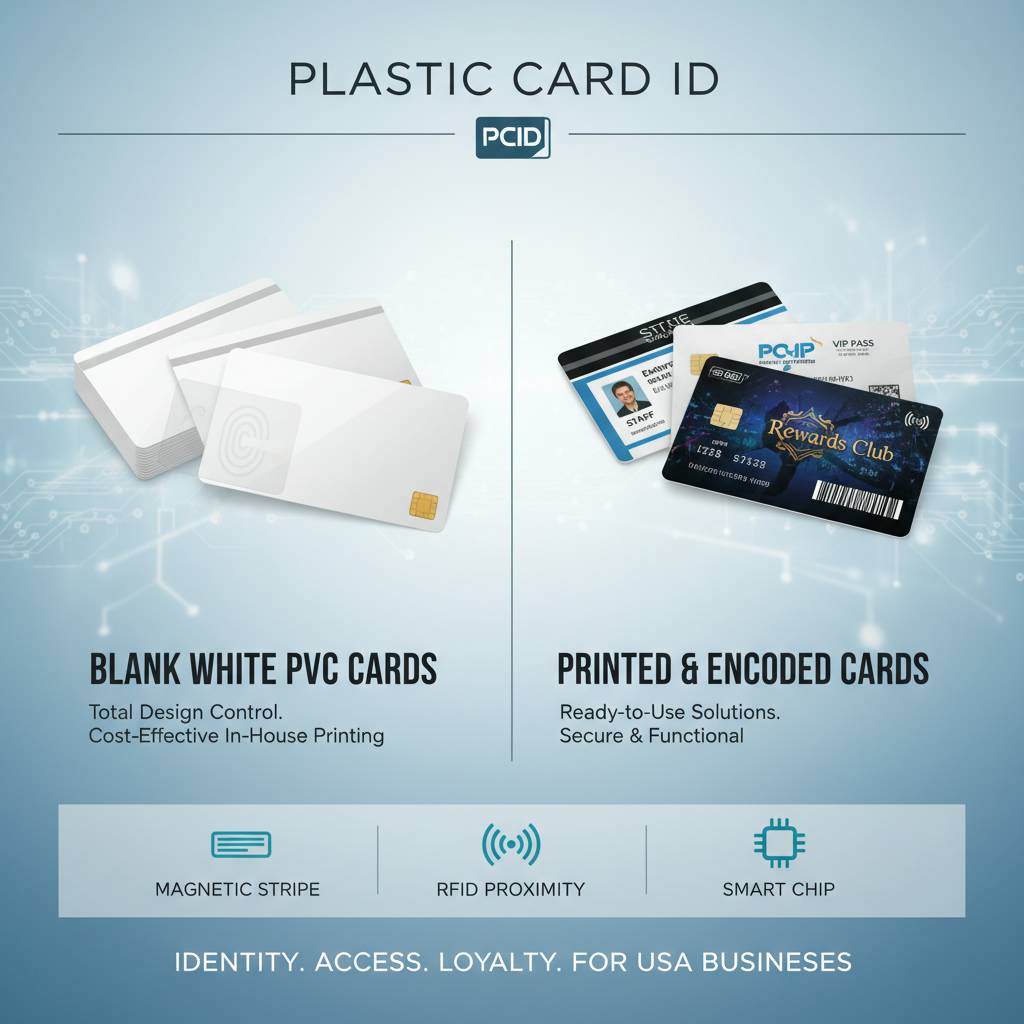 Whether you choose blank cards or custom printed cards, the encoding question is separate - and equally important. A card's visual appearance is independent of its functional capabilities. You can have a beautifully printed loyalty card with no encoding at all. You can have a plain white card with a HiCo magnetic stripe, an embedded RFID chip, or a contact smart chip. The encoding is the intelligence; the printing is the identity.
Plastic Card ID supplies blank and printed cards across the full encoding spectrum. Understanding which technology fits your application is foundational to building a card program that actually works at the access control terminal, POS system, or reader it is intended for.
HiCo vs LoCo Magnetic Stripe Cards
Magnetic stripe cards come in two coercivity grades: High Coercivity (HiCo) and Low Coercivity (LoCo). HiCo cards resist data corruption from proximity to other magnetic sources - competing cards in a wallet, store security systems, near-field magnetic interference. They are the standard for any card that needs to retain encoded data reliably over months or years of use.
LoCo cards encode at lower field strength and are suitable for short-term applications: event badges, temporary access credentials, limited-use hotel keys. Most professional card programs default to HiCo for its superior data retention, accepting the marginally higher cost as worthwhile insurance against card failures that damage customer experience.
RFID and Proximity Cards for Access Control
RFID technology enables contactless card transactions - tap-to-enter access control, proximity time-and-attendance, contactless loyalty scanning. CPE carries proximity cards in 125 kHz and 13.56 MHz frequencies, including MIFARE DESFire, one of the most secure contactless smart card standards available for enterprise access control.
These cards are available in blank white format for in-house printing or with custom printed graphics already applied. For access control deployments where cards are primarily functional rather than branded, blank RFID cards are extremely popular. Security teams printing their own badge layouts directly onto RFID blanks maintain full control over both the credential and the visual identity simultaneously.
Call 800.835.7919 to speak with the CPE team about RFID card frequencies and compatibility with your existing reader infrastructure before placing an order. Frequency mismatch is a common and entirely avoidable sourcing mistake.
Smart Chip Cards and Contact Technology
Contact smart chip cards carry an embedded microprocessor and are read by inserting the card into a reader slot. They are used in applications requiring higher security and data storage than magnetic stripe can provide - casino player tracking, secure facility access, healthcare identification, and loyalty programs with complex tier structures.
Blank white smart chip cards are available for organizations that print card holder information directly onto the card surface while leveraging the chip for backend data management. Custom printed smart chip cards serve programs where brand presentation and chip functionality must coexist on a finished card delivered ready for distribution.
Specialty Cards: When Standard Blank White PVC Is Not the Right Answer
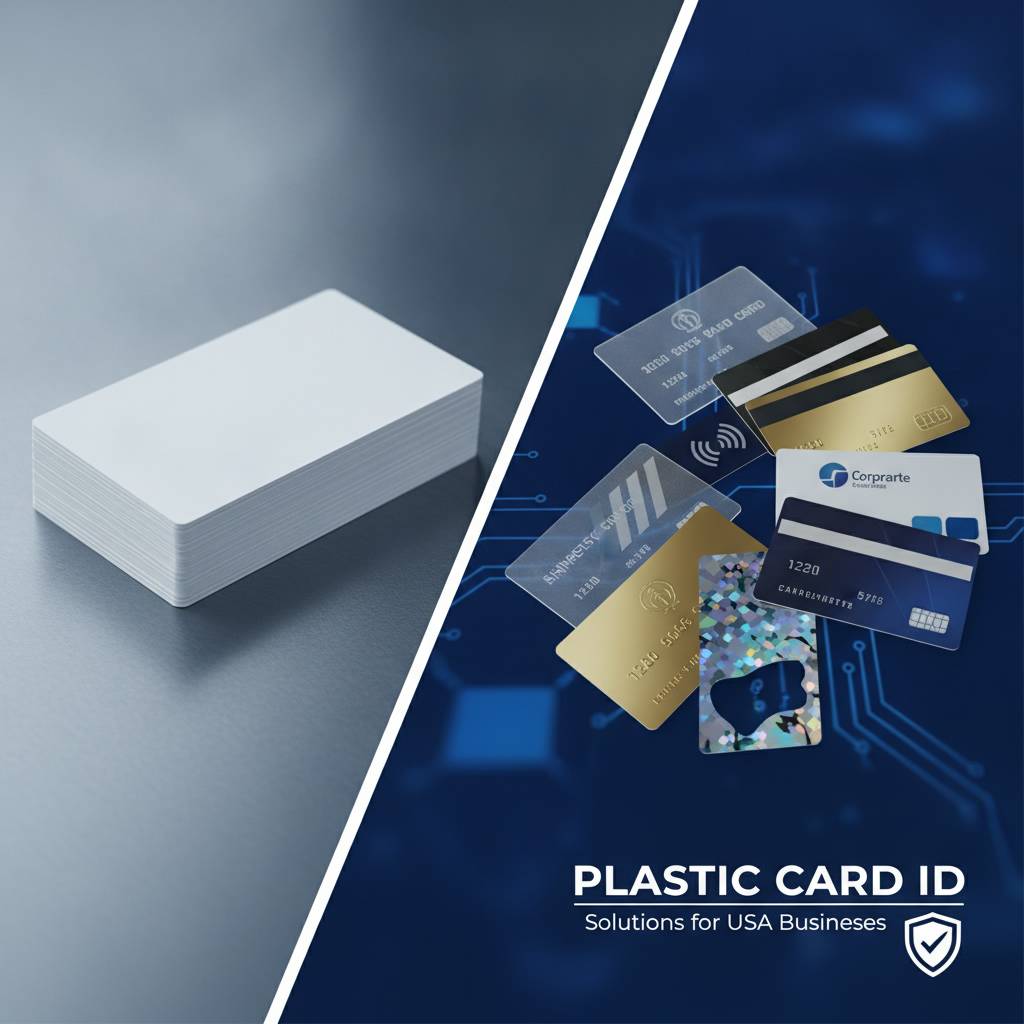 Standard blank white CR80 PVC cards cover the vast majority of card program needs. But the scenarios where specialty card stock earns its premium are worth knowing. Clear plastic cards, frosted translucent cards, custom die-cut shapes, and luxury metal cards each serve specific program objectives that white PVC simply cannot replicate.
Retailers launching premium gift card lines, hospitality brands issuing VIP membership cards, and organizations using cards as marketing instruments rather than purely functional credentials often find that specialty stock pays for itself in perceived value and response rates. A frosted clear card with foil printing does not just look different - it communicates a different message entirely about the brand behind it.
Clear and Frosted PVC Cards
Clear PVC cards are fully transparent, allowing printed graphics to float on a see-through surface. The visual effect is distinctive and immediately memorable. Frosted cards split the difference - a translucent matte finish that softens the transparency while still creating a premium feel that white PVC cannot match. Both formats print beautifully on standard desktop card printers.
For gift card programs, loyalty programs, and membership cards where brand differentiation matters, clear and frosted cards are a cost-effective upgrade that visually elevates the entire program. The per-card price premium over standard white PVC is modest relative to the impression they make.
Luxury Metal Cards: Stainless Steel, Brass, and Gold
Metal cards occupy the apex of card program prestige. Stainless steel, brass, and gold-finish cards carry a weight and tactile quality that no plastic card can replicate. When someone receives a metal membership card or VIP credential, they know immediately that the issuing organization takes its program seriously. Metal cards are kept far longer than plastic - they rarely end up discarded in a junk drawer.
They are ideal for high-value loyalty tiers, exclusive club memberships, premium hotel programs, and any situation where the card itself is part of the brand promise. Plastic Card ID offers metal card options alongside its full plastic card catalog, making it possible to run tiered programs where standard members receive premium PVC and top-tier members receive metal.
Custom Die-Cut Shapes and Colored Stock
Standard CR80 dimensions work for most applications, but not all. Loyalty key tags, mini cards for keychain attachment, and custom-shaped promotional cards are available for programs where the form factor is part of the marketing strategy. Die-cut shapes stand out in a wallet or on a retail counter in ways that rectangular cards simply do not.
Colored PVC stock - yellow, blue, red, black, and other options - gives organizations a quick visual differentiation tool. Different colored cards for different membership tiers, access levels, or departments is a practical organizational tool that also adds a layer of visual brand identity. The combination of card color, shape, and encoding creates a remarkably versatile identity system within a relatively simple product category.
Card Printers, Ribbons, and the Complete In-House Printing Setup
A blank card program needs more than cards. It needs the printer to bring those cards to life. Plastic Card ID carries the three professional desktop card printer brands that dominate the US market: Evolis, Zebra, and Fargo. Each has distinct strengths depending on print volume, image quality requirements, encoding integration, and budget.
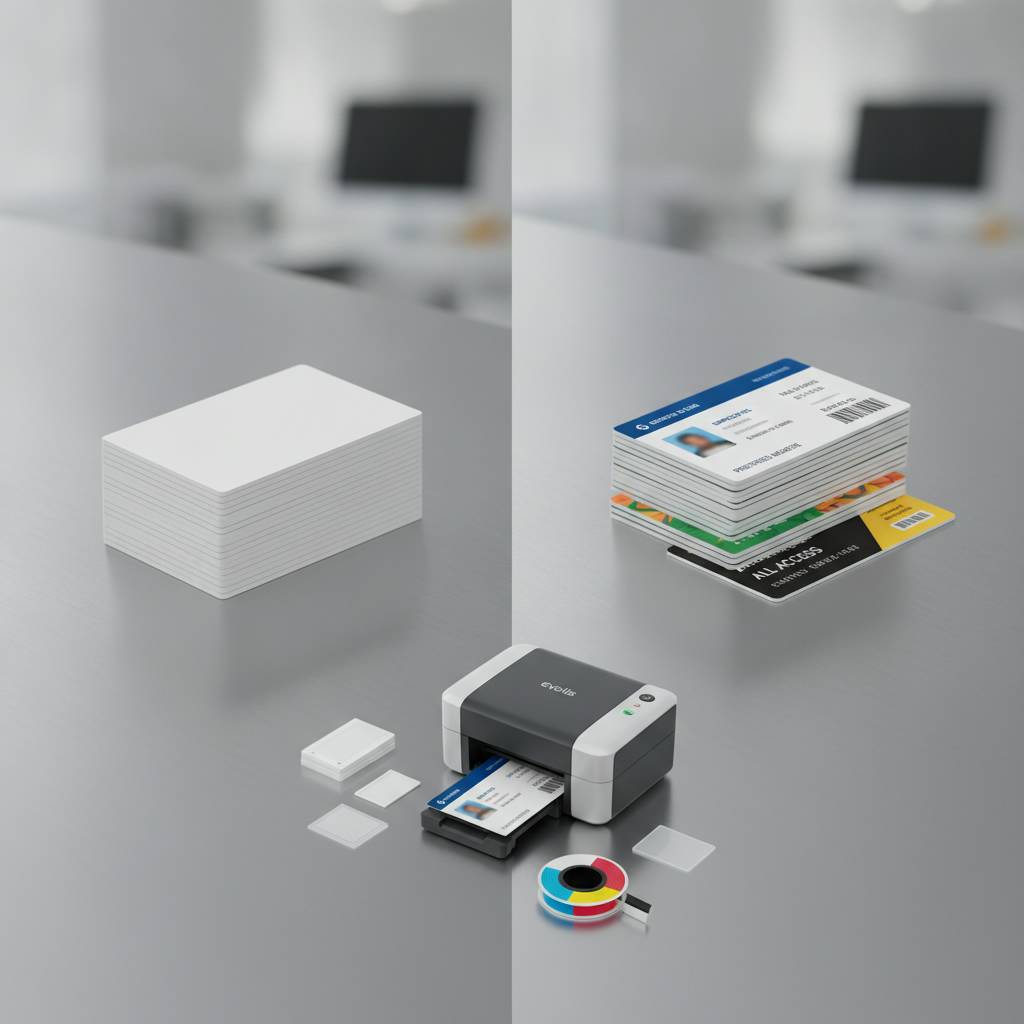
Evolis printers are widely favored for their reliability, ease of use, and strong color output at entry to mid-range price points. Zebra printers excel in high-volume production environments and integrate smoothly with enterprise ID software. Fargo printers are known for industrial-grade build quality and advanced security printing features including holographic overlay options. Matching the printer to the program requirements is one of the most consequential decisions in setting up an in-house card program.
Choosing the Right Printer for Your Volume
Print volume is the primary selection criterion. A small organization printing 25-50 cards per month operates comfortably on an entry-level single-sided Evolis Badgy or Primacy. A corporate HR department badging 200-400 employees across multiple locations needs a faster, more robust machine with a higher-capacity hopper and more durable print head.
Dual-sided printing capability matters for any program printing information on both card faces. Most professional card printer models are available in single-sided and dual-sided configurations; the dual-sided version typically costs $150-$400 more but is almost always worth it for programs that use both card surfaces. Buying the right printer from the start avoids the costly mistake of upgrading prematurely.
Call 800.835.7919 and the CPE team will assess your volume, encoding requirements, and budget to recommend the specific printer model that fits your program - not the most expensive option, but the right one.
Ribbons, Cleaning Kits, and Consumables
Card printer ribbons are consumables that significantly affect both print quality and per-card cost. Full-color YMCKO ribbons produce photographic-quality card prints with a protective overlay. Monochrome ribbons print at a fraction of the cost for single-color applications like black text and barcodes on pre-colored card stock. Selecting the correct ribbon for each use case meaningfully reduces operating costs.
Cleaning kits are not optional maintenance - they are essential. Dust and debris accumulate on print heads and rollers, causing streaks, voids, and eventually hardware damage. Plastic Card ID supplies manufacturer-approved cleaning kits for all printer brands in its lineup. Regular cleaning extends print head life by thousands of cards and maintains the image quality that makes your card program look professional.
Card Carriers, Sleeves, and Mailing Services
Once cards are produced, they need to reach their recipients. Card carriers - the folded paper sleeves that present a card with activation instructions or welcoming messaging - are available from CPE alongside card sleeves for individual protection during mailing or storage. These accessories complete the presentation, transforming a card into a proper credential package.
For high-volume distribution programs, Plastic Card ID offers card affixing and mailing services. Rather than managing bulk card distribution internally, organizations can have cards affixed to carriers and mailed directly to recipients as a managed fulfillment service. This is the true one-stop shop advantage - cards, printers, supplies, and distribution all sourced from a single strategic partner who understands every step of the program.
Frequently Asked Questions: Blank White PVC Cards vs Printed Cards
 After 25 years and over 100,000 customers, certain questions come up again and again. Here are the most common ones, answered directly.
Common Questions About Blank PVC Cards
- What printer do I need to print on blank white PVC cards? Any CR80-compatible desktop card printer from Evolis, Zebra, or Fargo will print directly on blank PVC cards using dye-sublimation or thermal transfer technology. Standard inkjet or laser printers are not suitable for PVC card printing.
- Can blank PVC cards be encoded after printing? Yes. Magnetic stripe encoding, smart chip programming, and RFID encoding can all be performed either at the time of card ordering or on-site with appropriate encoding equipment. Many card printers include built-in magnetic stripe encoders.
- What is the minimum order quantity for blank cards? Plastic Card ID accommodates small orders as well as large bulk purchases. Organizations printing as few as 50 cards per month can source blank card stock economically.
- Are blank PVC cards the same thickness as credit cards? Yes. Standard CR80 cards at 30 mil thickness match the dimensions and feel of a standard credit card precisely, complying with ISO 7810 specifications.
- Do pre-printed cards take longer to receive than blank cards? Custom printed cards require production time - typically 5-15 business days depending on the order. Blank card stock ships much faster, often within 1-3 business days, making in-house printing the faster path from order to card-in-hand.
Questions About Custom Printed Cards
Buyers often ask whether small quantities of custom printed cards are economical. At very low quantities - under 100 cards - the setup costs in custom printing make per-card costs high enough that in-house printing on blanks frequently wins on total cost. At quantities above 1,000 cards with a stable design, custom printing becomes more competitive, particularly for programs where in-house printing infrastructure does not already exist.
Another frequent question: can custom printed cards include encoding? Absolutely. Magnetic stripe, RFID, and smart chip encoding are all available on custom printed card orders. Many organizations order fully finished cards - printed graphics plus magnetic stripe encoding - ready for immediate distribution without any in-house processing required. This turnkey option is ideal for programs launching without existing card printer infrastructure.
Which Option Is Better for Gift Card Programs?
Gift cards present an interesting case. Retailers with established brands and stable designs who distribute cards in high volumes - seasonal campaigns, new store launches, wholesale distribution - typically benefit from custom printed card orders at scale. The economics favor production runs in the thousands when the design is locked and volume is high.
Retailers switching from paper gift certificates to plastic consistently report sales increases in the 35-50% range. The physical card stays in wallets, prompting additional visits and top-ups that paper certificates rarely generate. Whether those cards arrive custom printed or are produced in-house on blank stock, the move to plastic gift cards is one of the highest-ROI decisions in retail card program management.
Partner with Plastic Card ID for Your Complete Card Program Solution
 After more than a quarter century supplying plastic cards to businesses across every industry in the United States, Plastic Card ID brings something that generic online card vendors cannot match: genuine strategic perspective. The team has seen which programs succeed, where organizations overcomplicate their card procurement, and precisely which combination of card stock, printer, and supplies delivers the best outcomes for programs at every scale.
Whether your next step is ordering blank white PVC cards to pair with an in-house printer, sourcing custom printed cards for a seasonal campaign, or building a fully integrated card program spanning access control, loyalty, and employee credentialing - CPE has the product depth and the program knowledge to make it happen right.
The catalog covers blank PVC cards, magnetic stripe cards in HiCo and LoCo, RFID and proximity cards, smart chip cards, clear and frosted specialty stock, die-cut custom shapes, luxury metal cards, Evolis and Zebra and Fargo card printers, ribbons, cleaning kits, card carriers, and affixing and mailing services. Everything your card program requires, from a single partner who has delivered results for over 100,000 US businesses.
Reach out to Plastic Card ID today at 800.835.7919 and speak with a card program specialist who will help you determine whether blank white PVC cards, custom printed cards, or a combination of both is the right foundation for your program - then build it right, from day one.