Smart Chip vs Magnetic Stripe Security Comparison: Key Differences
Table of Contents []
- Smart Chip vs Magnetic Stripe Security: What Every Business Needs to Know - From Plastic Card ID
- Understanding Magnetic Stripe Technology
- Smart Chip Cards: A Fundamentally Different Security Architecture
- Head-to-Head Security Comparison: The Details That Matter
- Choosing the Right Technology for Your Card Program
- Frequently Asked Questions: Smart Chip vs Magnetic Stripe
- Partner With Plastic Card ID to Build Your Card Program Right
Smart Chip vs Magnetic Stripe Security: What Every Business Needs to Know - From Plastic Card ID
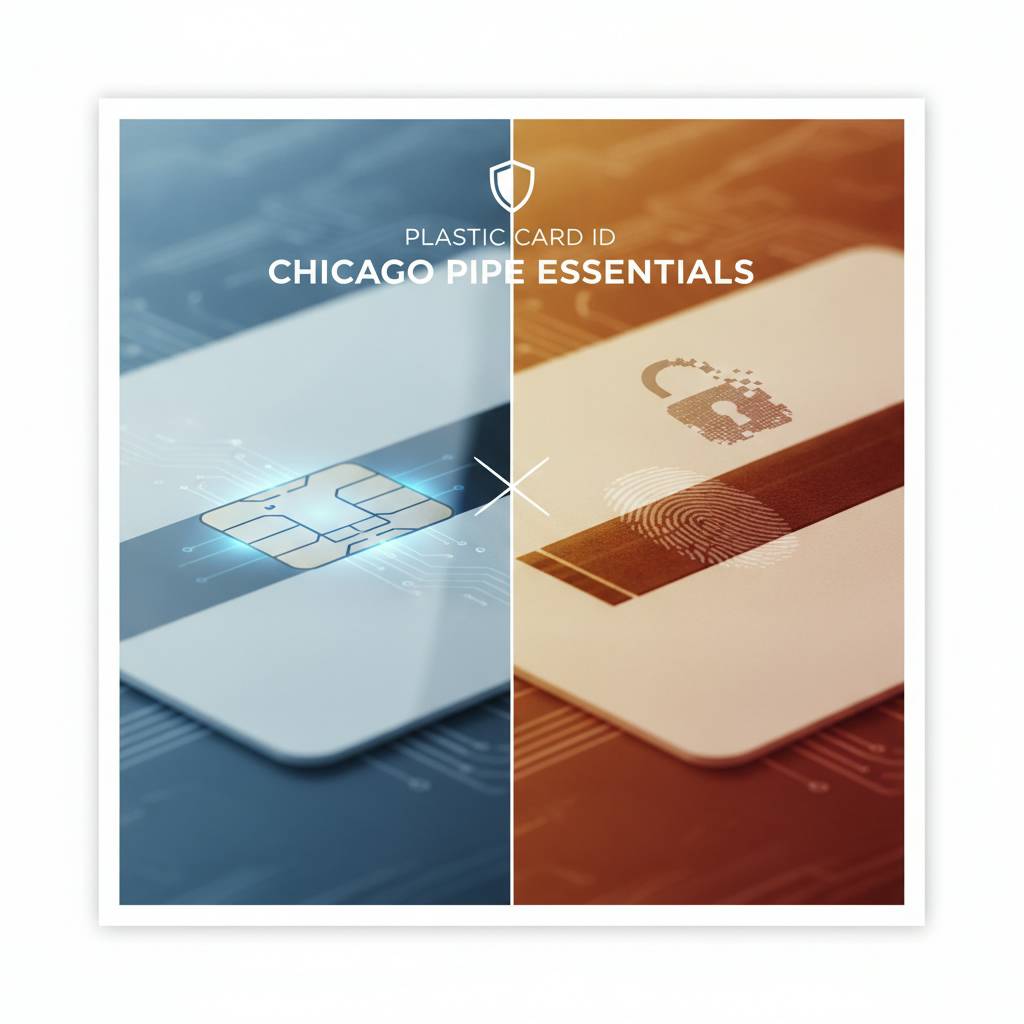 Choosing the right card technology is not simply a purchasing decision - it shapes how your organization handles identity, access, and data protection for years to come. The debate between smart chip and magnetic stripe cards is older than most people realize, yet it remains sharply relevant as businesses upgrade their card programs, harden their security posture, and demand more from every card in circulation.
Whether you manage employee badges, loyalty programs, membership credentials, hotel key systems, or campus access control, understanding the fundamental differences between these two technologies will save you money, reduce risk, and help you build a card program that actually performs. Plastic Card ID has guided tens of thousands of organizations through exactly this decision - and the right answer is almost never one-size-fits-all.
| Feature | Magnetic Stripe | Smart Chip (Contact) | Smart Chip (Contactless/RFID) |
|---|---|---|---|
| Data Capacity | Low (up to 1KB) | High (up to 64KB) | High (varies by chip) |
| Cloning Difficulty | Easy to clone | Extremely difficult | Very difficult (encrypted) |
| Read Speed | Requires swipe contact | Requires insertion | Tap or proximity |
| Cost Per Card | Lower | Moderate to Higher | Moderate to Higher |
| Ideal Use Case | Loyalty, gift, low-security access | ID, healthcare, government | Access control, hotel keys, events |
Understanding Magnetic Stripe Technology
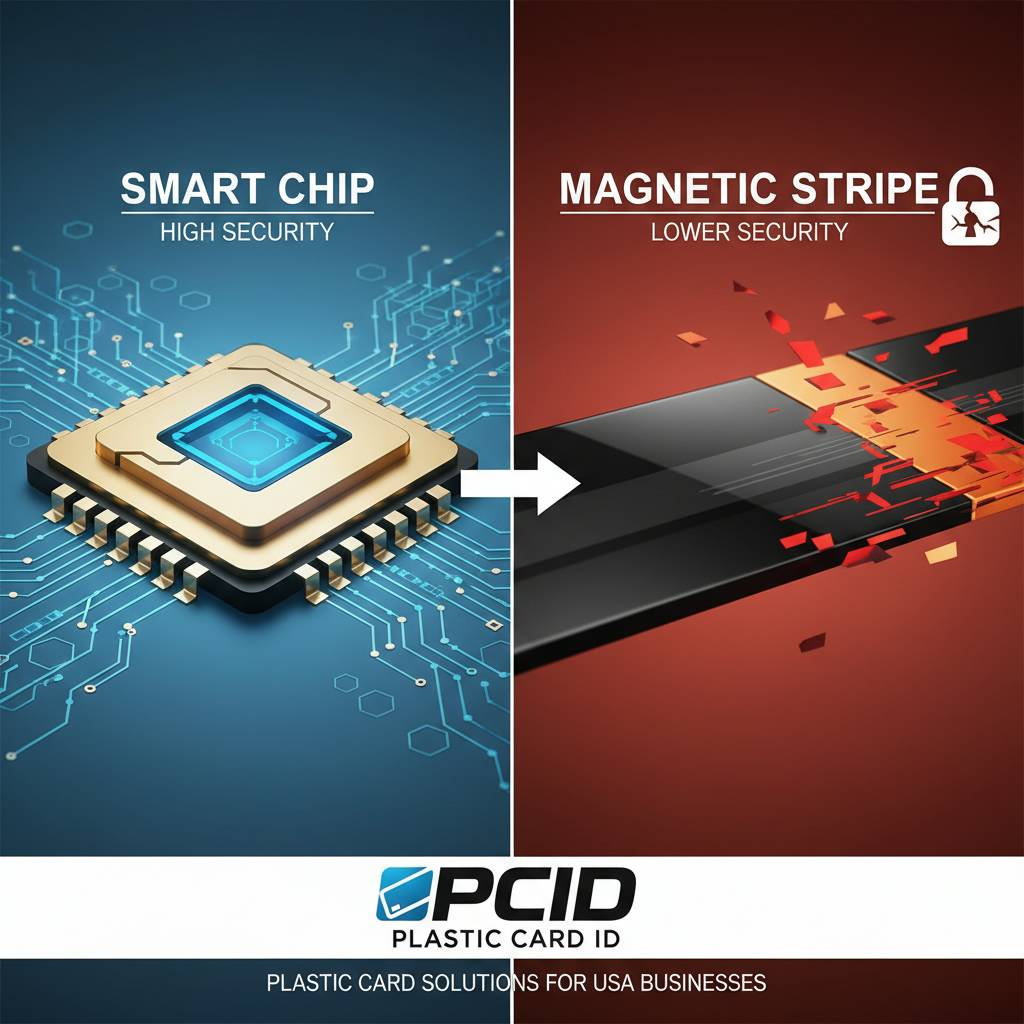 Magnetic stripe cards have been a backbone of card programs since the 1960s. The technology is deceptively simple: a band of iron-based magnetic particles runs along the back of the card, storing data in a sequence of magnetized regions. Swipe it through a reader, and the data transfers in milliseconds. Reliable, fast, and widely compatible - there is a reason magnetic stripe endured for over half a century.
But simplicity has a shadow side. Magnetic stripe data is fundamentally static and relatively unprotected. Once encoded, the information sits on the card in a form that specialized equipment can read - and replicate - without extraordinary effort. For low-stakes applications, this does not pose a significant problem. For anything involving restricted access or sensitive identity data, it demands careful consideration.
HiCo vs LoCo: The Two Flavors of Magnetic Stripe
Not all magnetic stripes are equal. High-coercivity (HiCo) stripes require a stronger magnetic field to encode and are far more resistant to accidental erasure from everyday magnets, wallet clasps, or proximity to electronic devices. HiCo cards are the preferred choice for long-term card programs - employee badges, loyalty cards, membership credentials - where durability matters across months or years of use.
Low-coercivity (LoCo) stripes encode at lower field strengths, making them faster and cheaper to produce. They work well for short-term applications: hotel key cards, event credentials, temporary access passes. The tradeoff is vulnerability. LoCo cards can be wiped or corrupted by stronger magnetic fields encountered in daily life. Matching the stripe type to your card's expected lifespan is a decision worth making deliberately.
Data Tracks and What They Actually Store
A standard magnetic stripe contains up to three data tracks. Track 1 holds alphanumeric data - typically a name and account number. Track 2 is numeric-only and is the track most commonly read by access control and point-of-sale systems. Track 3 is read/write capable and used in specialized applications including some transit and loyalty systems. Most business card programs use Track 1 and Track 2 encoding together.
The total data capacity across all three tracks amounts to roughly 220 bytes - enough for an account number, cardholder name, and a handful of additional fields, but nowhere near the capacity of even a basic smart chip. For simple lookup-based systems where the card merely carries an ID number that references a database, this limitation rarely matters. For applications that need the card itself to carry meaningful data securely, the gap becomes significant.
Where Magnetic Stripe Still Wins
Despite legitimate security concerns, magnetic stripe technology remains the right tool for a wide range of business applications. For loyalty programs, gift card systems, and promotional cards, magnetic stripe delivers excellent value at a cost point that keeps per-card investment low. Retailers who have transitioned from paper punch cards to plastic magnetic stripe loyalty cards consistently report stronger customer retention and higher average transaction values - the card itself becomes a brand touchpoint that paper cannot replicate.
CPE stocks both HiCo and LoCo magnetic stripe blank cards ready for immediate encoding and printing through any compatible card printer. Organizations running programs of 50 to 50,000 cards can scale without friction, keeping card costs predictable while leveraging infrastructure they likely already own. When the application fits, magnetic stripe remains a proven, cost-effective solution.
Smart Chip Cards: A Fundamentally Different Security Architecture
Smart chip cards represent a structural departure from magnetic stripe technology - not merely an incremental improvement. Rather than storing static data in a magnetic medium, a smart chip card embeds a microprocessor or memory chip directly into the card body. This chip can execute logic, store encrypted data, generate dynamic authentication codes, and engage in two-way communication with a reader. The card is no longer a passive data carrier - it becomes an active participant in the authentication process.
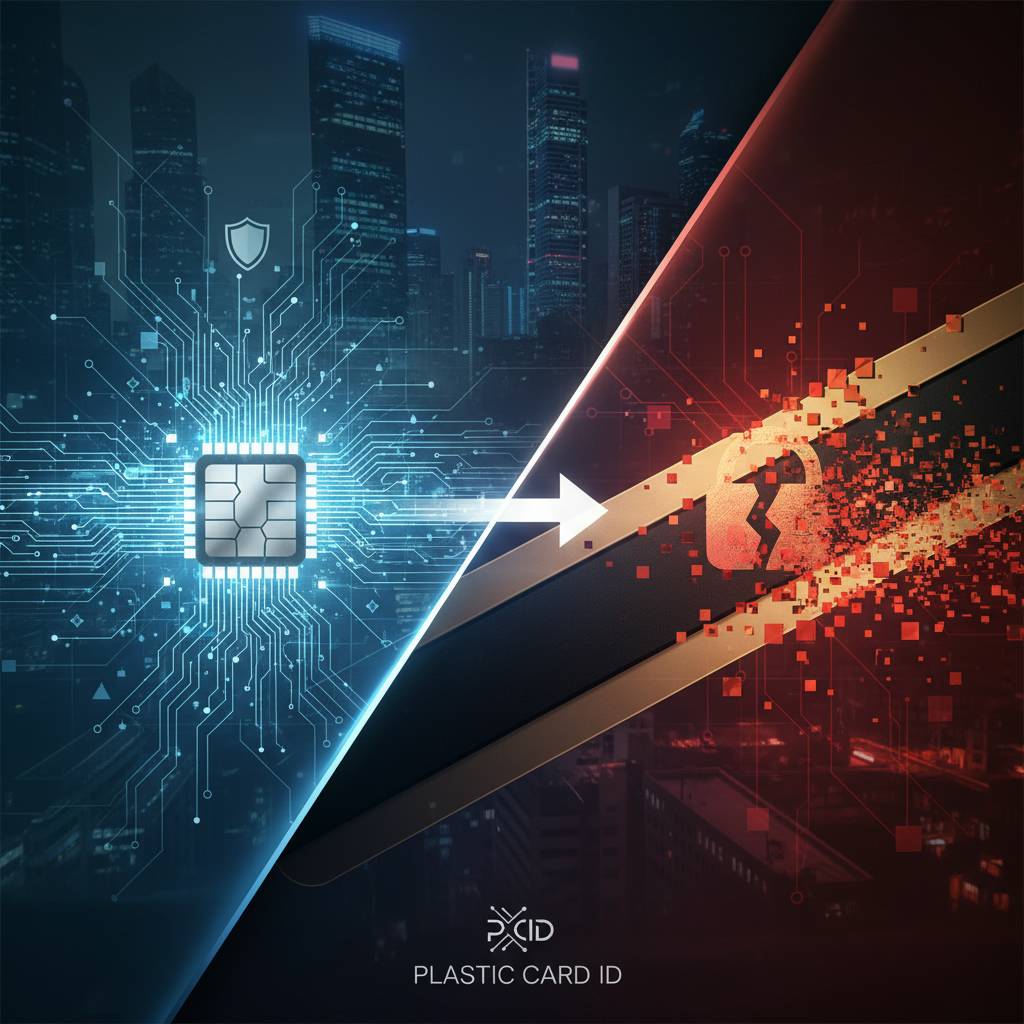
This distinction matters enormously from a security standpoint. Where a magnetic stripe broadcasts its data to any compatible reader, a smart chip can require cryptographic handshakes, verify the legitimacy of the reader, and generate transaction-specific codes that cannot be reused. Cloning a smart chip card is not merely more difficult - for properly implemented systems, it approaches the practically impossible.
Contact Smart Cards: ISO 7816 and How They Work
Contact smart cards communicate through a set of gold-plated contact pads visible on the card surface - the metallic rectangle you see on many ID and access cards. When inserted into a compatible reader, electrical contacts bridge the chip to the reader system. The chip and reader negotiate a secure session, authenticate credentials, and exchange data according to protocols defined by the ISO 7816 standard.
Contact smart cards are widely used in government-issued identification, healthcare credentials, and high-security facility access programs. They offer substantial data storage compared to magnetic stripe - commonly 32KB to 64KB or more - and support advanced encryption standards. For organizations where credential integrity is non-negotiable, contact smart chip technology sets the bar. The tradeoff is reader infrastructure cost and the physical insertion requirement, which introduces minor friction compared to a swipe or tap.
Contactless Smart Cards and RFID Technology
Contactless smart cards communicate via radio frequency, embedding an antenna within the card body that activates when brought within range of a reader. The user taps or simply holds the card near a reader - no insertion, no swipe. This combination of speed and security has driven rapid adoption in access control, transit systems, hotel key programs, and event management scenarios where throughput matters as much as protection.
RFID-based smart cards operate at different frequency bands depending on their application. Low-frequency (125 kHz) proximity cards are common in legacy access control installations and offer basic identification capability. High-frequency (13.56 MHz) cards - including those using MIFARE DESFire and similar standards - support robust encryption and mutual authentication. MIFARE DESFire, in particular, represents the gold standard in contactless card security, employing AES-128 encryption and anti-cloning measures that protect even the most demanding deployments.
Casino Player Cards and Specialty Smart Applications
Some industries push card technology to its limits. Casino player cards, for example, must track activity across multiple systems in real time, survive high-volume daily use, and resist tampering while maintaining seamless player experience. These cards frequently combine magnetic stripe encoding with smart chip capability - leveraging the broad reader compatibility of magnetic stripe for legacy systems while using the chip for secure program tracking and tier management.
Hotel key cards represent another high-volume smart card application. A hotel key card must be programmed quickly at check-in, function reliably across the stay, and be easily deactivated at checkout. RFID-based hotel key systems allow front desk staff to encode cards in seconds while the contactless read technology provides guests with effortless room access. CPE supplies both the cards and the printer hardware to support hotel programs at any scale, from boutique properties to large-venue operators.
Head-to-Head Security Comparison: The Details That Matter
 When organizations frame the smart chip versus magnetic stripe question purely as a cost comparison, they tend to undervalue the security dimension until an incident forces the issue. A single unauthorized access event or credential compromise can cost far more than the entire investment in upgraded card technology. Understanding the specific mechanisms by which each technology succeeds or fails under attack is the foundation of an informed card program decision.
The vulnerabilities of magnetic stripe are well-documented and widely exploited. Skimming devices - which can be concealed within legitimate-looking card reader housings - capture magnetic stripe data silently and completely. The captured data can then be written to a blank card, creating a functional clone. For access control applications, this represents a direct security breach. For loyalty and gift card programs, it can enable systematic fraud that erodes program value and customer trust over time.
Why Chip Cloning Is Practically Infeasible
Smart chip cards counter skimming through a combination of hardware and cryptographic protections. The chip itself stores sensitive data in secure memory regions that cannot be read directly - even by a legitimate reader. Instead, the chip performs internal computations and returns only the outputs that authentication protocols require. Without the cryptographic keys stored inside the chip's secure element, an attacker capturing the communication between a chip and reader gains nothing reusable.
Modern smart chip cards also implement anti-tampering measures at the hardware level. Attempts to physically extract the chip and read its memory directly trigger self-destruct mechanisms that erase sensitive data. This is not theoretical - it is part of the hardware certification requirements for cards meeting ISO/IEC 7816 and Common Criteria security standards. The practical result: smart chip cards make counterfeiting and credential cloning an economically unviable attack vector for all but the most sophisticated and well-resourced adversaries.
Dynamic Authentication vs Static Data
Perhaps the most important security distinction between magnetic stripe and smart chip technologies is the concept of dynamic versus static authentication. Magnetic stripe data is fixed at encoding. The card number, name, and other fields remain identical every time the card is read. This static nature is precisely what makes skimming so effective - the captured data is fully valid for replay.
Smart chip cards can implement dynamic authentication, generating a unique cryptographic code for each transaction or access event. Even if an attacker captures the communication during a legitimate read, the captured data is valid only for that single instance and cannot be replayed to impersonate the cardholder. This one architectural difference renders the entire class of replay attacks irrelevant against properly implemented smart chip systems. For access control, employee identification, and any program where credential reuse represents a meaningful threat, dynamic authentication is not a luxury - it is a necessity.
Physical Durability Under High-Use Conditions
Security is not only about cryptography. Physical durability contributes directly to the integrity of a card program. A card that degrades quickly - losing its magnetic encoding, cracking at the chip contacts, or becoming unreadable - creates operational disruptions and replacement costs that accumulate into genuine program expenses.
Standard CR80 PVC cards at 30 mil thickness provide excellent durability for both magnetic stripe and chip-embedded applications. The laminated construction protects both the magnetic stripe and the chip's contact pads from typical wear. CPE supplies cards built to ISO 7810 dimensional standards, ensuring compatibility across reader hardware from every major manufacturer. Durability and precision manufacturing are not afterthoughts - they are core to the value of every card in your program.
Choosing the Right Technology for Your Card Program
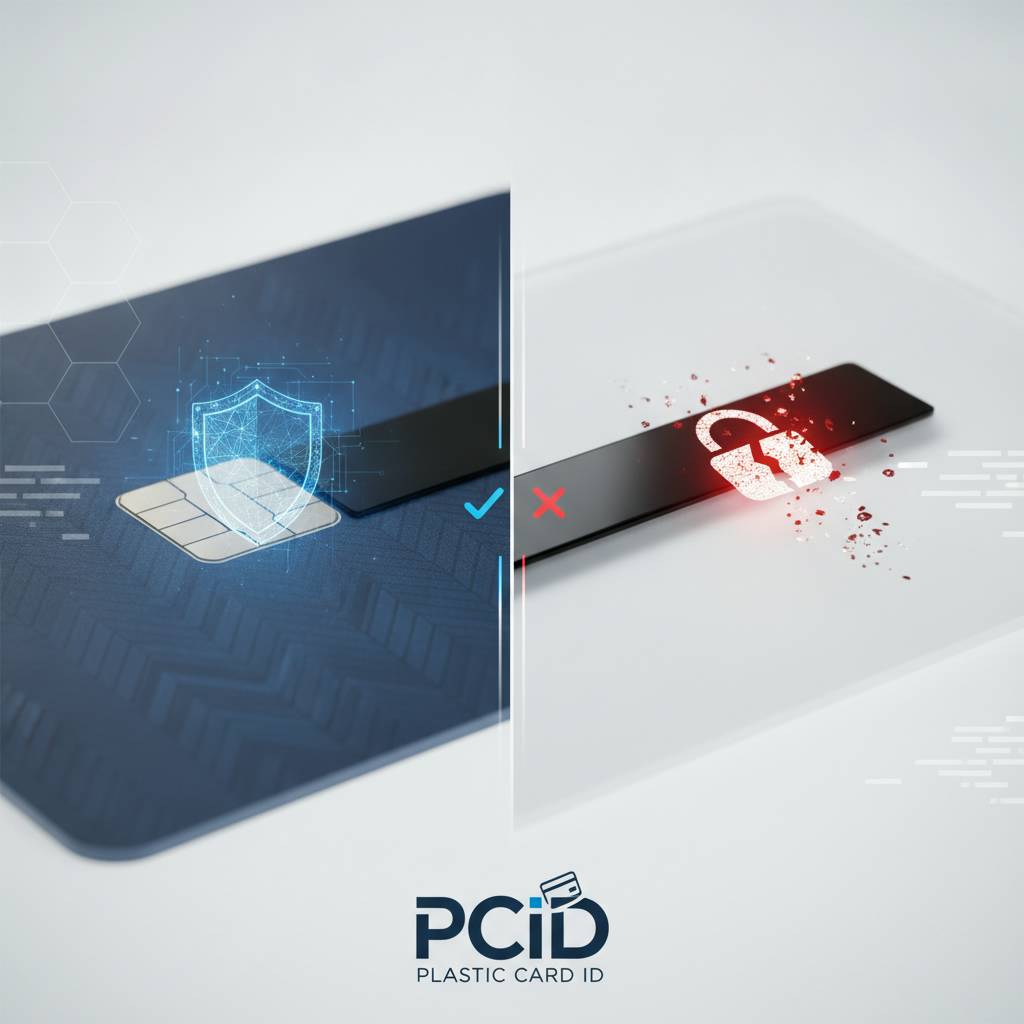 The choice between smart chip and magnetic stripe is not always a binary one - many effective card programs combine both technologies on a single card, serving multiple reader types and use cases simultaneously. A membership card might carry a HiCo magnetic stripe for point-of-sale loyalty tracking while embedding an RFID chip for building access. A casino player card might use all three: magnetic stripe, contact chip, and printed barcode.
Start with your use case, not your budget. Budget constraints are real, but they should shape how you implement the right technology - not replace it with the wrong one. Organizations that make card technology decisions based on upfront per-card cost alone frequently encounter higher long-term costs through fraud exposure, credential failures, and program rebuilds. Matching technology to application is the single most important factor in total program cost over time.
Low-Stakes Programs: When Magnetic Stripe Is the Right Call
Retail loyalty programs, promotional gift cards, event credentials, and internal badge programs with low security requirements are excellent candidates for magnetic stripe cards. The per-card cost is lower, the reader infrastructure is widely available and inexpensive, and the encoding process is straightforward using virtually any desktop card printer. Programs running on tight margins - including small retail operations, community organizations, and seasonal businesses - can launch effective card programs without the higher infrastructure investment that smart chip systems require.
Magnetic stripe cards from CPE are available in HiCo and LoCo variants, in standard CR80 sizing, and in a range of card stocks including standard white PVC, colored stock, and clear or frosted options for distinctive program aesthetics. Volume pricing makes scaling from a pilot program to full deployment financially straightforward, and blank stock gives your team full design control over the printed face while the stripe handles the functional data layer.
High-Stakes Programs: When Smart Chip Is Non-Negotiable
- Physical access control for facilities, data centers, or multi-tenant office environments where unauthorized entry carries real risk
- Employee identification in industries with regulatory compliance requirements around identity verification
- Healthcare credentialing where patient data protection standards demand robust authentication
- Campus and university ID programs that combine access control, meal plan tracking, and library services on a single card
- Hotel key card systems requiring fast encoding, reliable room access, and easy deactivation
- Casino player tracking with multi-system integration and fraud resistance requirements
- Government and municipal ID programs where credential integrity is a legal and public safety concern
For all of these applications, the security architecture of smart chip technology provides protection that magnetic stripe simply cannot match. The investment in smart chip cards and compatible reader infrastructure is an investment in program integrity - and in the trust of every cardholder your program serves. CPE carries proximity cards, MIFARE-compatible RFID cards, and contact chip card options to support programs at every scale and security tier.
Printer Compatibility: Making Your Technology Choice Work
Card technology selection and printer selection are deeply interconnected decisions. A standard card printer with a magnetic stripe encoding module handles HiCo and LoCo encoding seamlessly. Adding smart chip capability requires a printer equipped with a chip contact station (for contact smart cards) or an RFID encoding module (for contactless cards). Evolis, Zebra, and Fargo all offer printer models with these capabilities, and Plastic Card ID supplies the full lineup along with ribbons, cleaning kits, and technical support.
Organizations upgrading from magnetic stripe to smart chip programs do not necessarily need to replace their entire printer fleet. Many mid-range and professional-tier card printers can be configured with encoding modules that support both technologies, allowing a phased migration. Planning your printer investment alongside your card technology decision avoids costly mid-program hardware changes and keeps your card issuance operation running without disruption through any technology transition.
Frequently Asked Questions: Smart Chip vs Magnetic Stripe
Buyers consistently return to a handful of questions when evaluating these two technologies. The answers below reflect real-world program experience across the thousands of organizations Plastic Card ID has served - practical guidance grounded in how card programs actually function, not just how they are specified on paper.

Can I Put Both Technologies on the Same Card?
Yes - and for many programs, doing so is the optimal solution. Combination cards carry a magnetic stripe for compatibility with legacy readers while an embedded chip handles secure authentication for newer systems. This approach is common in campus ID programs, corporate access control deployments, and hospitality environments where multiple reader types coexist. The card is manufactured to CR80 standard dimensions regardless of how many technologies it carries, and it prints and personalizes using standard card printers equipped with the appropriate encoding modules.
Dual-technology cards do cost more than single-technology equivalents, but the premium is frequently justified by the elimination of parallel card programs. One card replacing two means simpler issuance, fewer cards for employees and members to manage, and a cleaner cardholder experience overall. If your environment includes mixed reader infrastructure, a combination card is almost always the most cost-effective long-term solution. Reach out to Plastic Card ID at 800.835.7919 for help specifying the right combination for your deployment.
How Long Do Smart Chip Cards Typically Last?
Contact smart cards used in high-frequency insertion environments typically carry manufacturer ratings of 100,000 insertion cycles or more. In practical terms, a card inserted and removed once daily would reach that threshold in over 270 years - card replacement due to chip wear is essentially never the limiting factor. Physical wear to the card body, contact pads, or printing is far more likely to prompt replacement than chip failure.
Contactless RFID cards have no moving parts and no contact wear at all, making them exceptionally durable in demanding environments. The antenna embedded in the card body is sealed within the PVC laminate and protected from moisture, abrasion, and typical physical stresses. Both smart chip card types significantly outlast the magnetic stripes on cards used in high-swipe environments, where stripe degradation over 12-24 months of daily use is a common replacement driver.
What Does Implementation Actually Cost?
Total program cost encompasses cards, printer hardware, encoding software or middleware, reader infrastructure, and ongoing consumables. Magnetic stripe programs carry lower entry costs - a capable HiCo encoder/printer combination starts well below the price of a chip-capable printer, and HiCo blank cards are competitively priced. Smart chip programs require a higher initial infrastructure investment but frequently offer lower ongoing costs related to fraud, credential failure, and program management complexity.
A rough planning framework: magnetic stripe programs in the 500-5,000 card range can be launched for a total hardware investment of $300-$1,500 depending on printer capability, with per-card blank costs running well under a dollar at volume. Smart chip programs at comparable scale should budget $800-$3,000 for hardware depending on chip type and reader requirements, with per-card costs varying based on chip specification. Neither technology is inherently expensive relative to the value a well-run card program generates - the question is always fit to purpose.
Partner With Plastic Card ID to Build Your Card Program Right
 Twenty-five years and more than 50 million cards have given Plastic Card ID a perspective on card programs that is difficult to replicate. We have watched organizations launch with magnetic stripe, scale into smart chip, combine technologies as their programs matured, and build card ecosystems that serve their members and customers with genuine reliability. The right technology decision made at the start of a program eliminates a cascade of avoidable problems downstream.
Whether you are launching a first-time loyalty program, upgrading an aging access control system, or building a full-scale identity credentialing program from the ground up, CPE has the cards, printers, supplies, and expertise to make it work. Our catalog spans every card technology in use today - from the simplest blank HiCo stripe card to MIFARE DESFire-encrypted RFID smart cards - alongside the full lineup of Evolis, Zebra, and Fargo printers and every consumable your card program requires.
Your Next Step Starts Here
Getting the smart chip versus magnetic stripe decision right matters. It affects your security posture, your program economics, and the experience of every person who carries your card. Talk to a card program specialist who has seen it all - from 50 cards a month to tens of thousands - and get guidance that actually fits your situation. Not a generic sales pitch, but a real conversation about what your program needs and how to build it cost-effectively.
Call 800.835.7919 today and speak directly with the CPE team. We supply across the entire United States and have helped over 100,000 businesses and organizations build card programs that deliver measurable results. Whatever your scale, whatever your technology requirements - Plastic Card ID is ready to be the strategic partner your card program deserves.
Contact Plastic Card ID now at 800.835.7919 - and build your card program on a foundation that lasts.
Previous Page