Blank Plastic Cards vs Paper Cards: Durability Comparison
Table of Contents []
- Blank Plastic Cards vs Paper Cards: Why the Material You Choose Changes Everything - Plastic Card ID
- The Durability Factor: What Plastic Does That Paper Simply Cannot
- The Loyalty Card Effect: Plastic Drives Real Revenue Results
- Blank vs Pre-Printed: The Case for Buying Blank PVC Cards
- Card Printers, Ribbons, and Accessories: The Complete Program Ecosystem
- Identity, Access, and Event Cards: High-Stakes Applications Where Plastic Is Non-Negotiable
- Why Plastic Card ID Is the Right Partner for Your Card Program
Blank Plastic Cards vs Paper Cards: Why the Material You Choose Changes Everything - Plastic Card ID
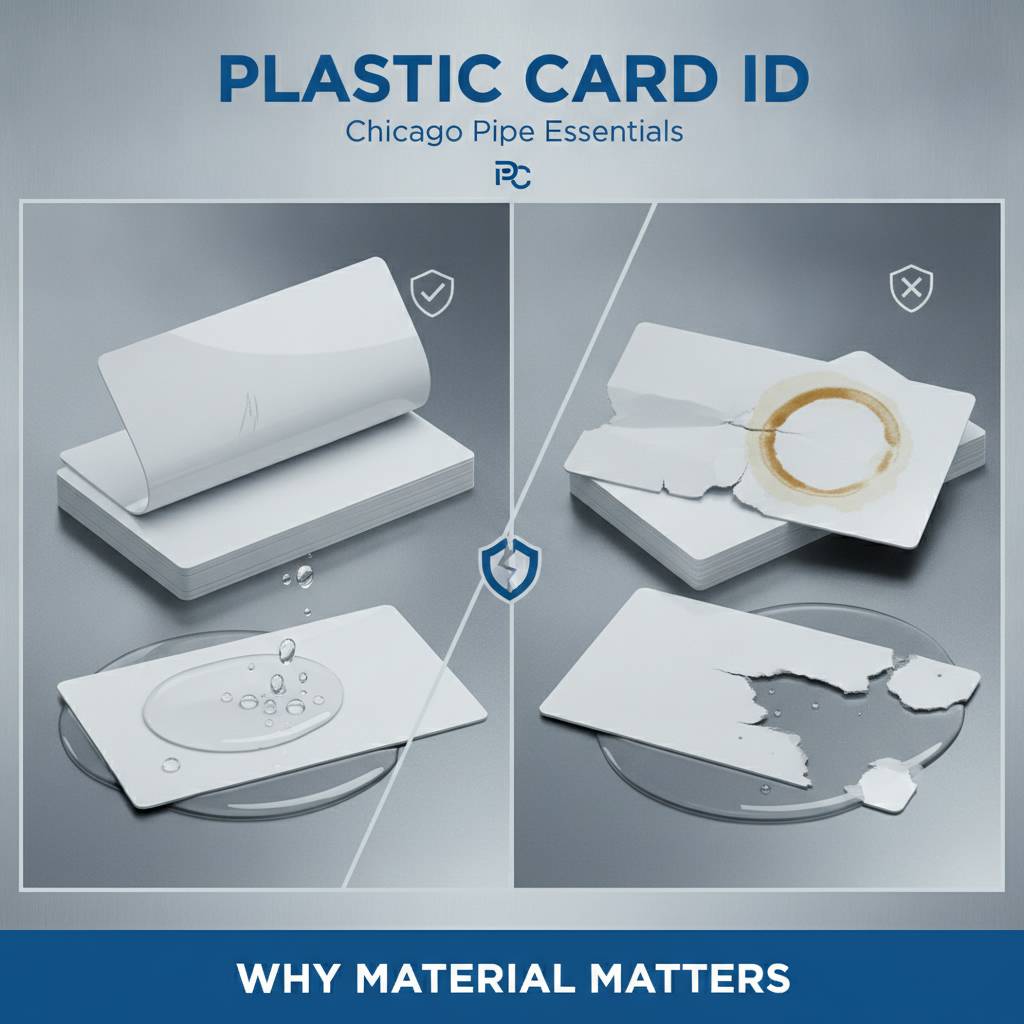 Picture this: a customer pulls out their loyalty card at your register, and it's a crumpled, coffee-stained paper punch card with two holes missing. Now picture them pulling out a sleek, rigid plastic card with your logo printed cleanly across the front. The difference isn't just visual - it's the entire message your brand sends. That gap between paper and plastic is wider than most business owners realize, and once you understand it, going back feels impossible.
At Plastic Card ID, we've spent over 25 years watching businesses make this transition - and the results speak consistently. Retailers, gyms, hotels, event organizers, schools, and healthcare providers have all discovered that the humble blank plastic card is one of the most quietly powerful tools in a business's arsenal. This page is about helping you see exactly why, backed by real-world data and decades of experience supplying more than 50 million cards to businesses across the United States.
| Feature | Blank Plastic Cards (CR80 PVC) | Paper Cards |
|---|---|---|
| Durability | 3-5 years typical lifespan | Weeks to months |
| Wallet Fit | Standard CR80 (ISO 7810 compliant) | Rarely wallet-sized or rigid |
| Water Resistance | Fully waterproof | Degrades immediately |
| Print Quality | Sharp, professional, vibrant | Fades, smears, bleeds |
| Magnetic Stripe Support | Yes (HiCo and LoCo available) | No |
| RFID / Smart Chip | Yes | No |
| Customer Retention Signal | High perceived value | Disposable feel |
| Cost Over Time | Lower cost per use | Frequent replacement needed |
The Durability Factor: What Plastic Does That Paper Simply Cannot
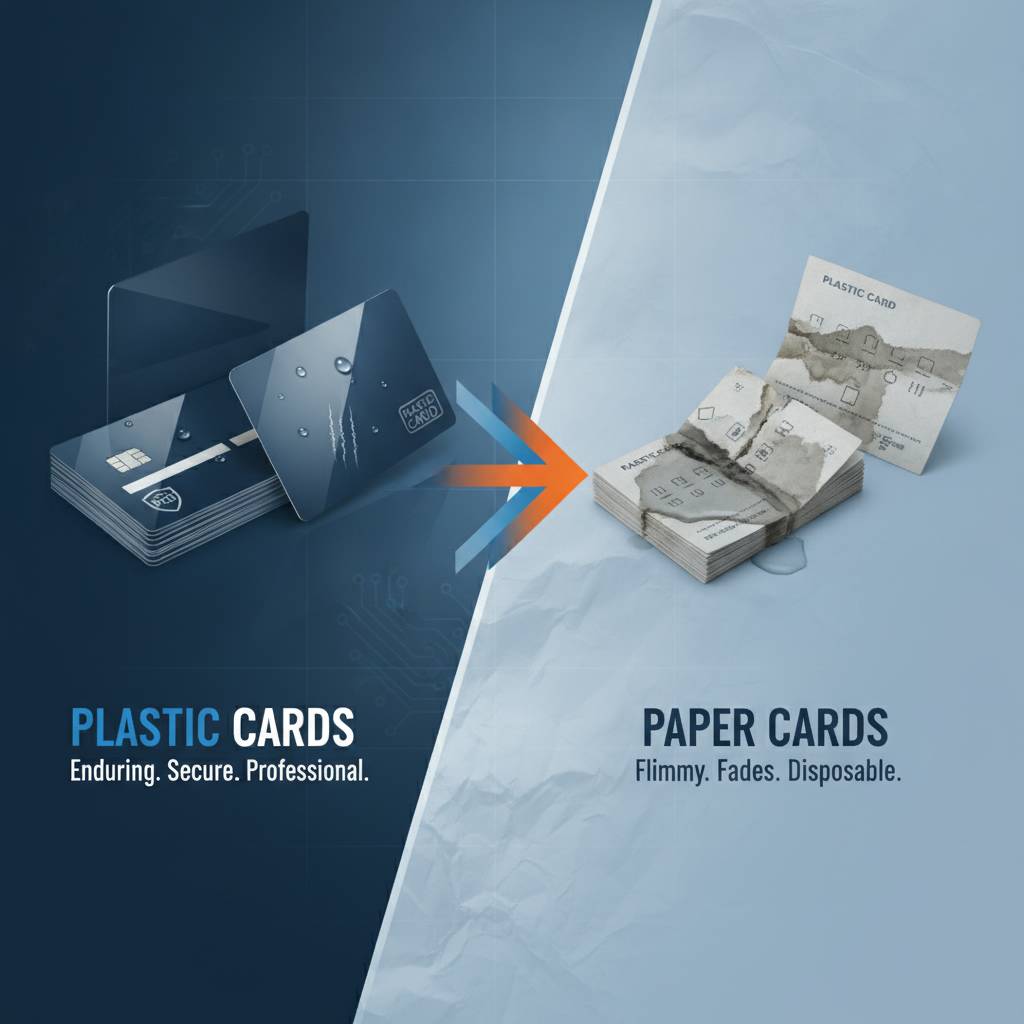 Durability isn't just a specification on a product sheet. It directly affects how long your card stays in circulation, how often customers interact with your brand, and whether your card program delivers return on investment. A paper card that dies in a wallet after three weeks is marketing spend wasted. A plastic card that lasts three to five years is a daily brand touchpoint that compounds in value over time.
Blank CR80 PVC cards are manufactured to 30 mil thickness - the same ISO 7810 standard used internationally for identification and access credentials. That's not coincidental. It means your loyalty card, membership card, or employee badge fits perfectly in every standard wallet slot, badge holder, and card reader on the market. Paper cards fit nowhere cleanly, and they certainly don't swipe through a magnetic reader or tap against an RFID sensor.
Physical Stress: Bending, Moisture, and Daily Wear
Consider what a card in someone's back pocket experiences in a single month. Flexing when they sit down, exposure to sweat and humidity, friction against other cards and coins, the occasional trip through the laundry. Paper cards fail this test spectacularly. PVC plastic cards are engineered to absorb that stress without delaminating, fading, or warping under normal conditions.
This isn't theoretical - it's the reason physical therapists, hair salons, and coffee shops that switched from paper punch cards to plastic loyalty cards report dramatically higher card retention rates among their customers. When a card survives, it stays in the wallet. When it stays in the wallet, it gets used. That cycle is the entire engine of a successful card program.
Print Permanence and Surface Integrity
Paper absorbs ink. That's its nature. Over time, printed text and graphics on paper cards fade, smear in humidity, and lose contrast. Plastic cards printed with a dedicated card printer using dye-sublimation technology bond the ink into the card surface rather than sitting on top of it. The result is a print that resists fading, scratching, and moisture with a durability that paper simply cannot replicate.
At CPE, we supply a full range of card printers from Evolis, Zebra, and Fargo specifically designed to produce this kind of high-quality, permanent output on PVC card stock. Whether you're printing 50 cards a month in-house or running a high-volume program, the combination of the right blank card and the right printer is what separates amateur-looking card programs from professional ones.
Longevity and Total Cost of Ownership
Paper cards might appear cheaper at the unit level. But the math changes completely when you factor in replacement frequency. If a paper card lasts two months and a plastic card lasts three years, you're replacing paper cards 18 times for every one plastic card replacement. Multiply that by your card program volume, and the cost differential becomes significant - and that's before accounting for the labor cost of constant reissuance.
Blank plastic CR80 cards from Plastic Card ID offer a lower cost per use over the life of a program - especially for businesses that print in-house with their own card printer. Buying blank stock in bulk and printing on demand gives organizations complete design control, zero minimums on design changes, and the flexibility to update card artwork without discarding pre-printed inventory.
The Loyalty Card Effect: Plastic Drives Real Revenue Results
There's a measurable behavioral difference between customers who carry plastic loyalty cards and those who carry paper equivalents. It's not just aesthetic preference - it's rooted in perceived value. A rigid plastic card feels like something worth keeping. A paper card feels like something worth losing. And lost cards mean lost program participation, which means lost repeat visits.
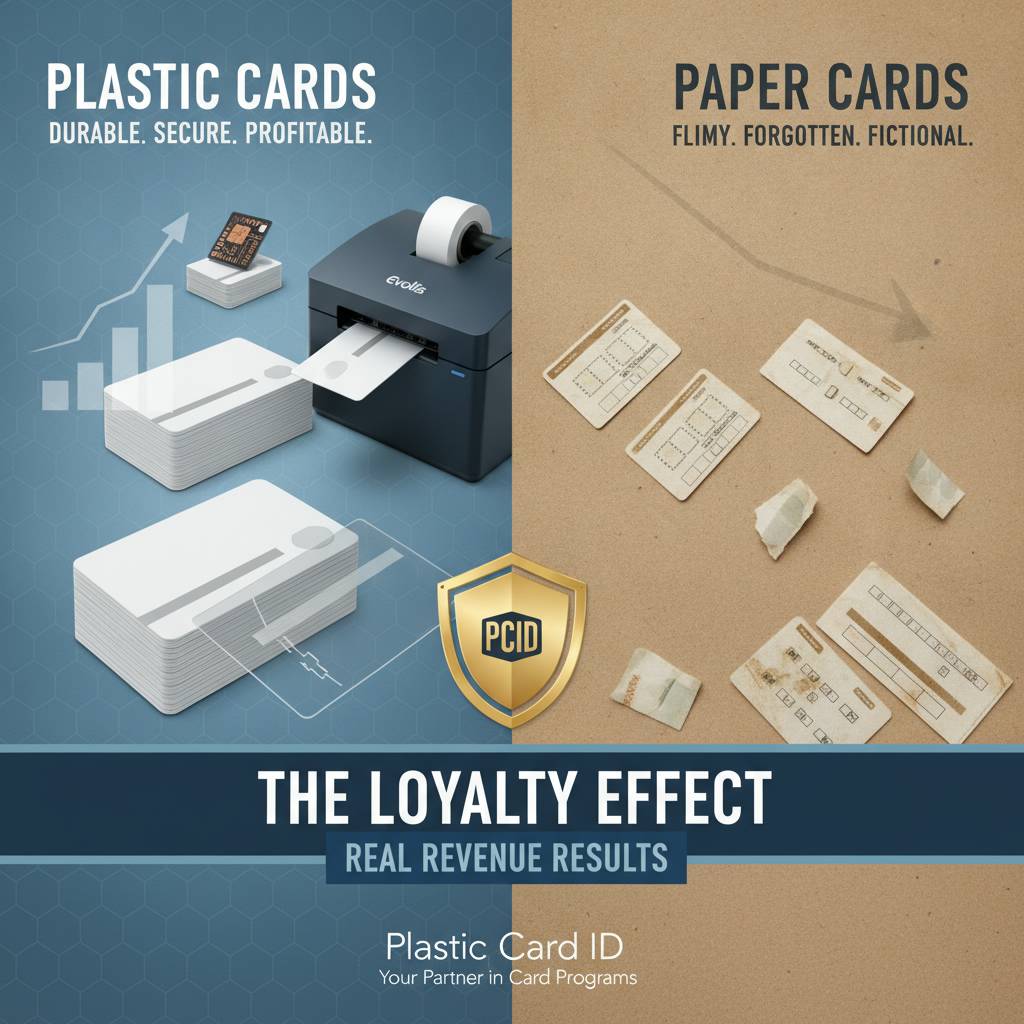
Retailers who transition from paper-based loyalty programs to plastic card programs have documented sales increases in the 35-50% range. That's not a marginal improvement - it's a significant lift driven entirely by a format change. The card itself becomes a behavioral nudge that paper simply cannot replicate at scale.
Wallet Presence and Brand Recall
When a plastic card lives in a customer's wallet, it appears every time they open it. That's passive brand recall, delivered dozens of times a week, at zero additional marketing cost. Paper cards get folded into pockets, stuck in junk drawers, or thrown away entirely. Plastic stays in the wallet - and that presence translates directly into return visits.
The format also signals something about the business issuing the card. A well-designed, professionally printed plastic loyalty card communicates that the program is permanent, the business is established, and the relationship is worth investing in. These are signals that paper cards, no matter how nicely printed, cannot fully convey.
Membership Cards That Command Respect
Membership cards are identity objects. They tell the holder - and anyone nearby - that they belong to something. Gyms, associations, clubs, co-ops, and professional organizations understand this instinctively when they make the switch from paper to plastic. A laminated paper membership card reads as temporary. A PVC plastic card reads as legitimate and enduring.
At Plastic Card ID, we've supplied membership card stock to organizations of every size, from small community associations issuing 50 cards a season to national organizations running programs in the tens of thousands. The format requirement is universal: plastic outperforms paper in member retention and perceived program value every time. Call us at 800.835.7919 to discuss the right blank card stock for your membership program.
Gift Cards: Where Format Directly Impacts Revenue
Gift cards are a unique category where the durability and presentation of plastic directly affect how much money changes hands. A plastic gift card looks like it has value. It looks like something worth giving. Recipients are more likely to use it, and businesses see higher average redemption rates and higher reload frequency with plastic versus paper alternatives.
Paper gift certificates get lost, forgotten, and damaged before redemption. Plastic gift cards get loaded into wallets alongside credit cards and debit cards, which means they're present at the point of purchase and far more likely to influence a buying decision. The format is doing sales work that the paper format physically cannot.
Blank vs Pre-Printed: The Case for Buying Blank PVC Cards
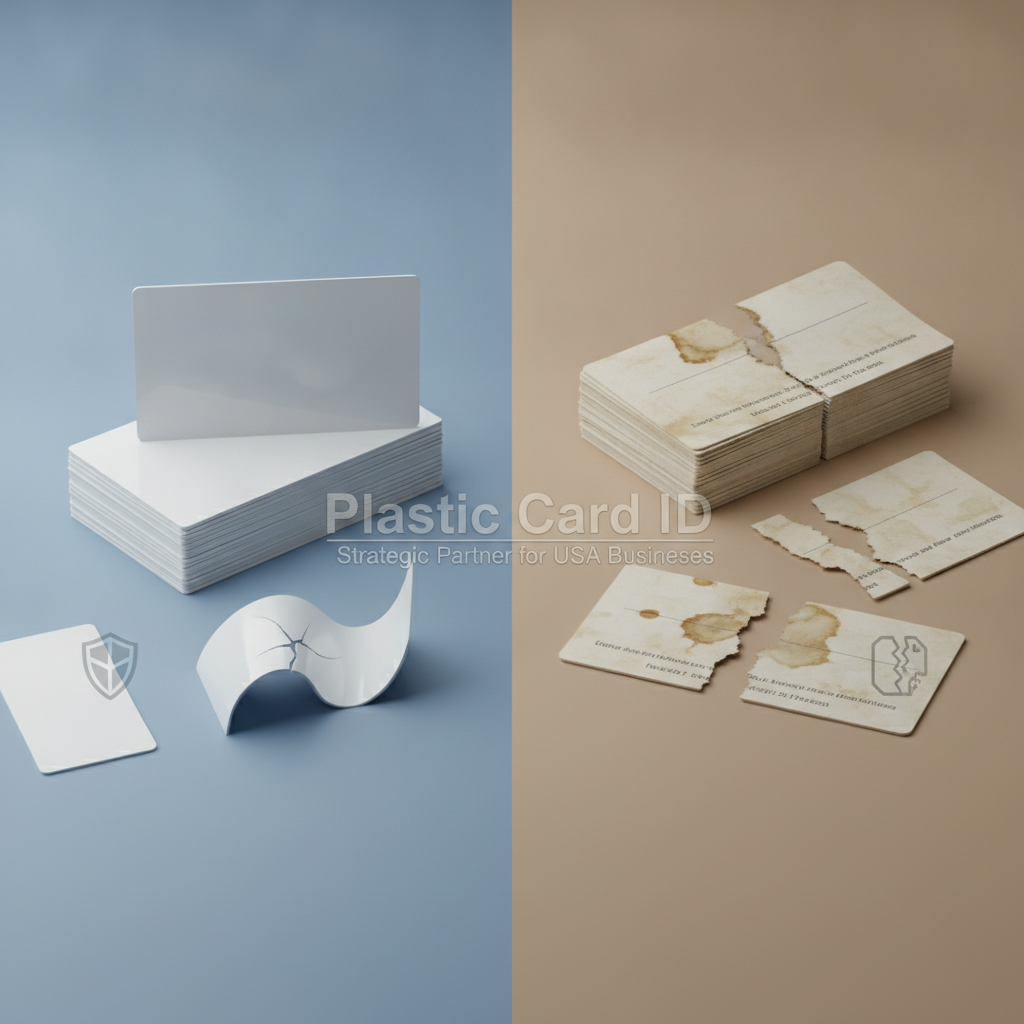 One of the most strategically sound decisions a growing business can make is to invest in in-house card printing capability using blank PVC card stock. The flexibility this creates is extraordinary. You print exactly what you need, exactly when you need it, without minimum order quantities or lead times from an outside printer. Employee leaves? Reprint their badge in two minutes. Membership design changes? Update the template and start the new run immediately.
Blank cards are the raw material of a flexible, responsive card program. They're also cost-effective at scale - buying in quantities of 500, 1,000, or 5,000 blank cards drops the per-card price significantly, and combined with in-house printing via a desktop card printer, the total program cost can be far lower than ordering pre-printed cards for every batch.
The CR80 Standard: Why It Matters
CR80 is the globally recognized standard card size: 3.375 inches by 2.125 inches at 30 mil thickness. Every card reader, badge holder, wallet slot, and laminator on the market is designed around this format. Choosing CR80 blank PVC cards means your cards will work everywhere without modification or special accommodation. It's the default for a reason.
At Plastic Card ID, our blank CR80 cards are produced to full ISO 7810 compliance, ensuring consistent thickness, dimensional accuracy, and surface quality for reliable printing results. Whether you're running an Evolis Primacy, a Zebra ZC300, or a Fargo HDP5000, our blank card stock is optimized to produce clean, vibrant output every time.
Specialty Blank Cards: Options Beyond Standard White PVC
Not every card program needs a standard white card as its canvas. CPE carries a broad range of specialty blank card options that give designers and brand managers more creative flexibility. Clear and frosted cards create a striking visual effect when printed. Colored stock in black, gold, silver, and other shades can anchor a brand identity right from the blank card's base layer.
For programs requiring access control or data encoding, blank magnetic stripe cards are available in both HiCo (High Coercivity) and LoCo (Low Coercivity) configurations. HiCo stripes are harder to accidentally erase and are preferred for long-term or frequently swiped cards. LoCo stripes are used for shorter-term applications like hotel key cards where data is rewritten regularly. Choosing the right stripe type before printing saves headaches downstream.
Advanced Card Technologies Available as Blank Stock
Modern card programs often require more than just a printed surface. RFID and proximity cards, smart chip cards, and contactless technology like MIFARE DESFire are all available as blank card stock through Plastic Card ID. These cards can be printed in-house or ordered as pre-encoded blanks, ready for your card management system to load with access credentials, loyalty data, or identification information.
Casino player cards, hotel key cards, and high-security access control programs all rely on this category of advanced blank stock. The ability to source these specialty formats from a single supplier - alongside the printers, ribbons, and accessories needed to complete the program - is exactly the kind of operational simplicity that Plastic Card ID was built to provide.
| Blank Card Type | Best Use Case | Key Feature |
|---|---|---|
| Standard White PVC CR80 | ID badges, loyalty cards, membership | Universal compatibility |
| HiCo Magnetic Stripe | Access cards, long-term loyalty programs | Durable data encoding |
| LoCo Magnetic Stripe | Hotel key cards, short-term credentials | Rewritable stripe |
| RFID / Proximity | Access control, smart building entry | Contactless functionality |
| Clear / Frosted | Premium loyalty, VIP membership | Distinctive visual presentation |
| Smart Chip (MIFARE DESFire) | Casino player cards, secure access | High-security data storage |
Card Printers, Ribbons, and Accessories: The Complete Program Ecosystem
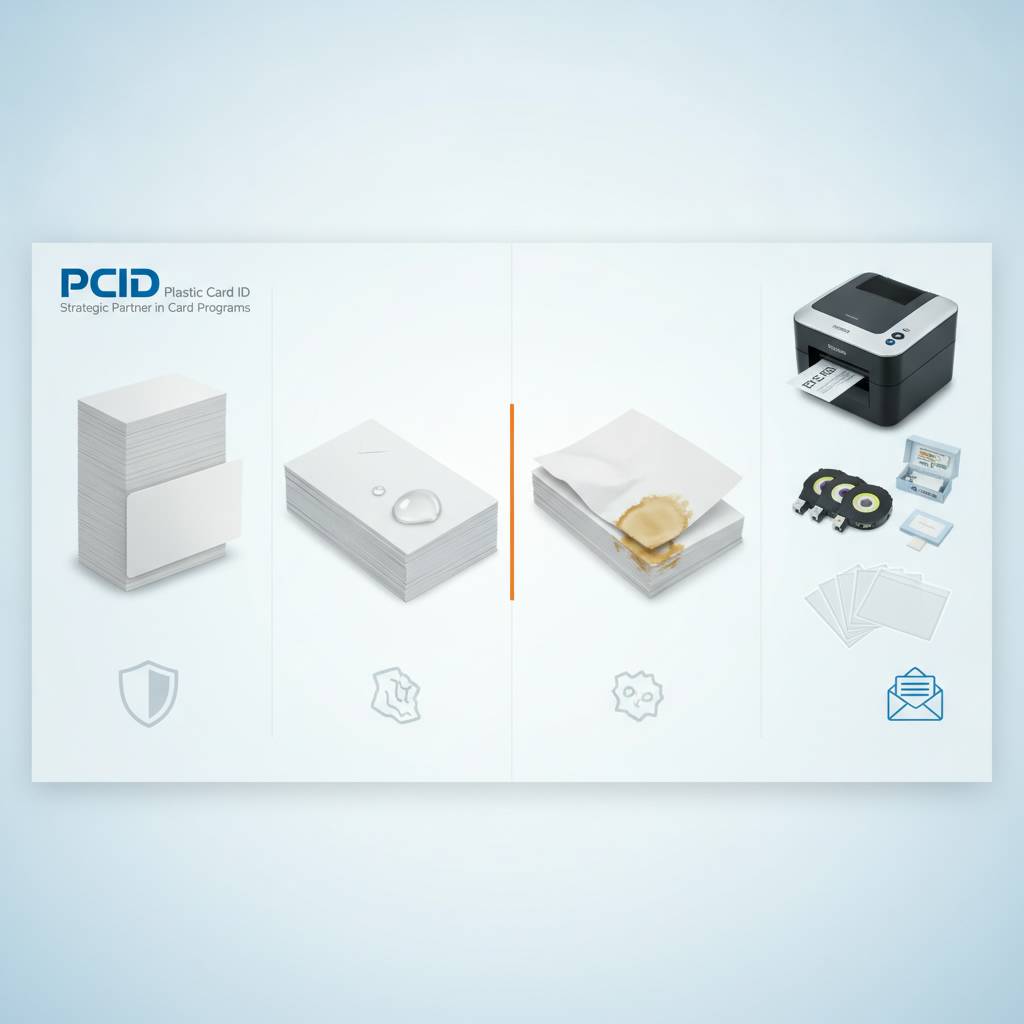 A blank card is only as good as the system surrounding it. That's why Plastic Card ID stocks not just the cards but the entire infrastructure needed to run a successful in-house card program. Card printers from the industry's most trusted brands - Evolis, Zebra, and Fargo - are available alongside the ribbons, cleaning kits, and accessories needed to keep them running reliably.
This matters more than most buyers initially appreciate. A card printer running dirty produces streaked, uneven output. A printer loaded with the wrong ribbon type produces cards that peel or fade. The difference between a professional-grade card program and a disappointing one often comes down to whether the right consumables are being used consistently.
Choosing the Right Card Printer for Your Volume
Entry-level desktop card printers from Evolis, like the Badgy or Primacy series, are excellent for small to mid-sized programs printing a few hundred cards per month. Zebra's ZC series and Fargo's DTC series step up for mid-volume programs requiring faster throughput, dual-sided printing, or lamination capability. High-volume programs running thousands of cards weekly may require the Fargo HDP5000 or similar retransfer printers for maximum print quality and durability.
At CPE, our team can help match your card volume, card type, and budget to the right printer model. This isn't about selling the most expensive option - it's about making sure your program runs efficiently from day one. The right printer for your program is the one that handles your volume without strain and produces output that reflects your brand accurately.
Ribbons, Cleaning Kits, and Card Accessories
Printer ribbons are consumables that affect both print quality and cost per card. Full-color YMCKO ribbons are standard for most ID and loyalty card programs. Monochrome ribbons - black, white, gold, silver - are used for single-color overlay printing and cost significantly less per panel. Understanding which ribbon type your program needs is a simple but impactful cost management decision.
Cleaning kits keep print heads clear of debris and extend the life of expensive printer components. Card sleeves and carriers protect finished cards during mailing and distribution. Plastic Card ID also offers card affixing and mailing services for programs that distribute cards to cardholders by mail, handling the fulfillment side so your team doesn't have to. Call 800.835.7919 to learn more about these value-added services.
Buyer Tips: Getting the Most from Your Blank Card Program
- Buy blank cards in bulk to reduce per-card cost and ensure consistent stock is always on hand.
- Match your magnetic stripe type (HiCo vs LoCo) to your card reader hardware before ordering to avoid compatibility issues.
- Run a cleaning card through your printer every 250-500 prints to maintain consistent output quality.
- Store blank PVC card stock in a cool, dry location away from direct sunlight to prevent warping or static buildup.
- Use overlay laminate ribbons (the "O" in YMCKO) for ID cards and frequently-handled cards to extend print life significantly.
- Consider clear or frosted blank cards for premium program tiers where visual distinction matters to cardholders.
- Test print quality on a small batch first when introducing a new card design or ribbon type to catch issues before full production.
Identity, Access, and Event Cards: High-Stakes Applications Where Plastic Is Non-Negotiable
Some card applications are simply not suitable for paper under any circumstances. Employee ID badges, access control credentials, event passes with encoded data, and security credentials all require the rigidity, durability, and encoding capability that only PVC plastic cards can provide. In these contexts, the comparison between plastic and paper isn't about preference - it's about functional necessity.
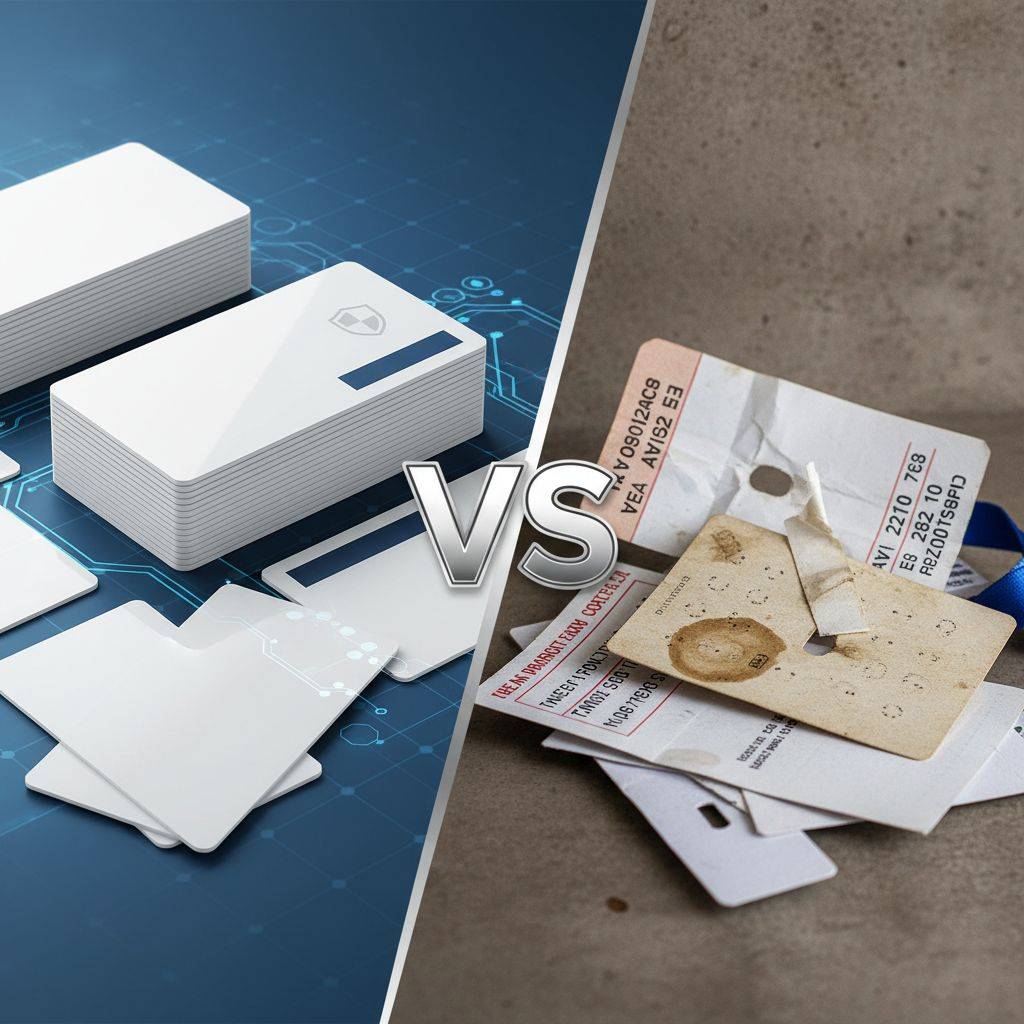
An employee badge needs to survive years of daily handling, badge reader swipes, and lanyard wear. An event credential needs to hold up through an entire multi-day conference without tearing, fading, or losing its printed information. An access card needs to communicate reliably with proximity readers across thousands of uses. None of these requirements can be met by paper.
Employee ID Badges and On-Demand Printing
Blank PVC cards are the standard substrate for employee ID badge programs across virtually every industry. HR teams and office administrators print badges on demand using desktop card printers, encoding magnetic stripes or RFID chips as needed for their access control systems. The ability to produce a professional, durable badge in under two minutes - without outsourcing - is a genuine operational advantage.
For organizations with high employee turnover or frequent visitor programs, keeping a stock of blank CR80 cards on hand and printing on demand eliminates the lag time and minimum order requirements associated with ordering pre-printed badges. It also allows for immediate revocation and reissuance when access needs change, without discarding expensive pre-printed inventory.
Event Credentials and Access Control Cards
Events that use magnetic stripe or RFID-encoded credentials for session tracking, access control, or payment rely entirely on plastic card substrates. Paper cannot hold a magnetic stripe. Paper cannot embed an RFID chip. The entire infrastructure of modern event management systems is built around plastic card technology.
From trade shows to music festivals, from corporate conferences to casino floor access, the event industry runs on plastic cards. Plastic Card ID supplies both the blank card stock and the encoding-ready card formats needed for these programs, with options for on-site printing setups and high-volume pre-encoded card orders for large events.
Proximity and RFID Access Cards for Secure Facilities
Physical access control systems in office buildings, data centers, healthcare facilities, and educational institutions rely on proximity and RFID cards because they offer a combination of durability, read range, and security that no paper-based alternative can approach. Cards encoded with MIFARE DESFire or other secure protocols resist cloning and unauthorized duplication at a level paper simply cannot address.
These cards also benefit from the same durability advantages as standard blank PVC cards - surviving the daily wear of badge clip attachment, wallet storage, and frequent reader proximity without degrading their functional performance. For security applications, there is no meaningful comparison between plastic and paper - plastic is the only viable choice.
Why Plastic Card ID Is the Right Partner for Your Card Program
 Over 100,000 customers across the United States have trusted Plastic Card ID to supply the blank cards, printers, and accessories that power their card programs. That track record isn't built on product alone - it's built on the kind of partnership that helps businesses make smart decisions about card format, volume, technology, and total program cost from the very beginning.
Whether your program is issuing 50 employee badges per month or producing tens of thousands of loyalty cards for a national retail chain, Plastic Card ID operates at your scale. The catalog is broad, the expertise is deep, and the commitment to helping card programs succeed is embedded in how we operate. This is what it means to work with a strategic partner rather than just a product vendor.
Serving Every Card Program Scale and Type
Small businesses, mid-market companies, enterprise organizations, nonprofits, educational institutions, healthcare providers, hospitality operators, and government agencies have all relied on Plastic Card ID to supply their card programs. The need for durable, professional plastic cards isn't limited to any single industry or organization size. It shows up wherever a business decides to take its identity, loyalty, access, or membership program seriously.
CPE carries the full range of blank card types, from standard white CR80 PVC to specialty formats like clear cards, custom die-cut shapes, luxury metal cards in stainless steel, brass, and gold, and advanced technology cards with RFID, magnetic stripe, and smart chip capabilities. Whatever your program requires, the inventory is here and ready to ship.
A True One-Stop Shop for Card Programs
The operational simplicity of sourcing everything from one supplier is underrated. When your blank cards, printer, ribbons, cleaning kits, card sleeves, and mailing services all come from a single source, reordering is straightforward, compatibility is guaranteed, and support is consistent. There's real value in eliminating the complexity of managing multiple vendors for a single program.
From the blank card to the finished, mailed credential - Plastic Card ID handles the entire chain. That's the definition of a one-stop shop, and it's the reason businesses return year after year to scale their programs without operational disruption.
Getting Started: Simple Steps to a Better Card Program
Starting a blank plastic card program doesn't require a massive upfront investment or specialized expertise. The barrier to entry is lower than most businesses expect. A desktop card printer, a supply of blank CR80 cards, and a basic card design template are all it takes to begin issuing professional plastic cards in-house. The learning curve is measured in hours, not weeks.
For businesses already running paper-based loyalty, membership, or ID programs, the transition to plastic is almost always worth making. The durability advantage alone justifies the switch. Add the revenue lift from better customer retention, the brand signal of a professional card, and the long-term cost savings of in-house printing, and the case for plastic over paper becomes straightforward. The only real question is how quickly you want to start seeing the results.
Ready to upgrade your card program? Contact Plastic Card ID today at 800.835.7919 - our team is standing by to help you choose the right blank cards, printers, and accessories for your exact program needs.
Plastic Card ID - over 25 years, more than 50 million cards, and one clear commitment: helping your card program succeed. Call 800.835.7919 now and let's build something that lasts.
Previous Page