Microtext Security Printing on Plastic ID Cards: How It Works
Table of Contents []
- Microtext Security Printing on Plastic ID Cards - Plastic Card ID
- What Microtext Actually Does for Card Security
- Card Types That Benefit Most from Microtext Security Printing
- Designing Microtext into Your Plastic Card Program
- Printer Capabilities and Microtext Quality
- Building a Complete Security Card Program with Plastic Card ID
- Frequently Asked Questions About Microtext Security Printing
- Take the Next Step with Plastic Card ID
Microtext Security Printing on Plastic ID Cards - Plastic Card ID
 Most people never notice it. That tiny line of text, barely visible to the naked eye, running along the edge of a credential or woven into a design element - it looks like a decorative border until someone holds it under a loupe. Then it resolves into words, serial numbers, or encoded data. That's microtext, and it's one of the most effective security features available for plastic ID cards today.
Plastic Card ID has spent over 25 years supplying plastic cards to businesses and organizations across the United States, and in that time, the conversation around card security has grown dramatically more sophisticated. Microtext security printing sits at the intersection of accessibility and authenticity - it doesn't require expensive readers or infrastructure, yet it creates a verification layer that counterfeiters consistently struggle to replicate at scale.
| Feature | Description | Best Use Case |
|---|---|---|
| Fine Line Microtext | Text printed at 0.2mm or smaller, readable only under magnification | Employee ID cards, membership credentials |
| Integrated Microtext Border | Security text disguised as a decorative card border | Event credentials, VIP passes |
| Background Pattern Microtext | Repeated text embedded within guilloche or security patterns | High-security access control cards |
| Variable Microtext | Unique encoded data per card, such as employee number or issue date | Government-adjacent ID programs |
| UV-Reactive Microtext | Invisible under standard light, visible only under ultraviolet | Casino cards, high-value event passes |
What Microtext Actually Does for Card Security
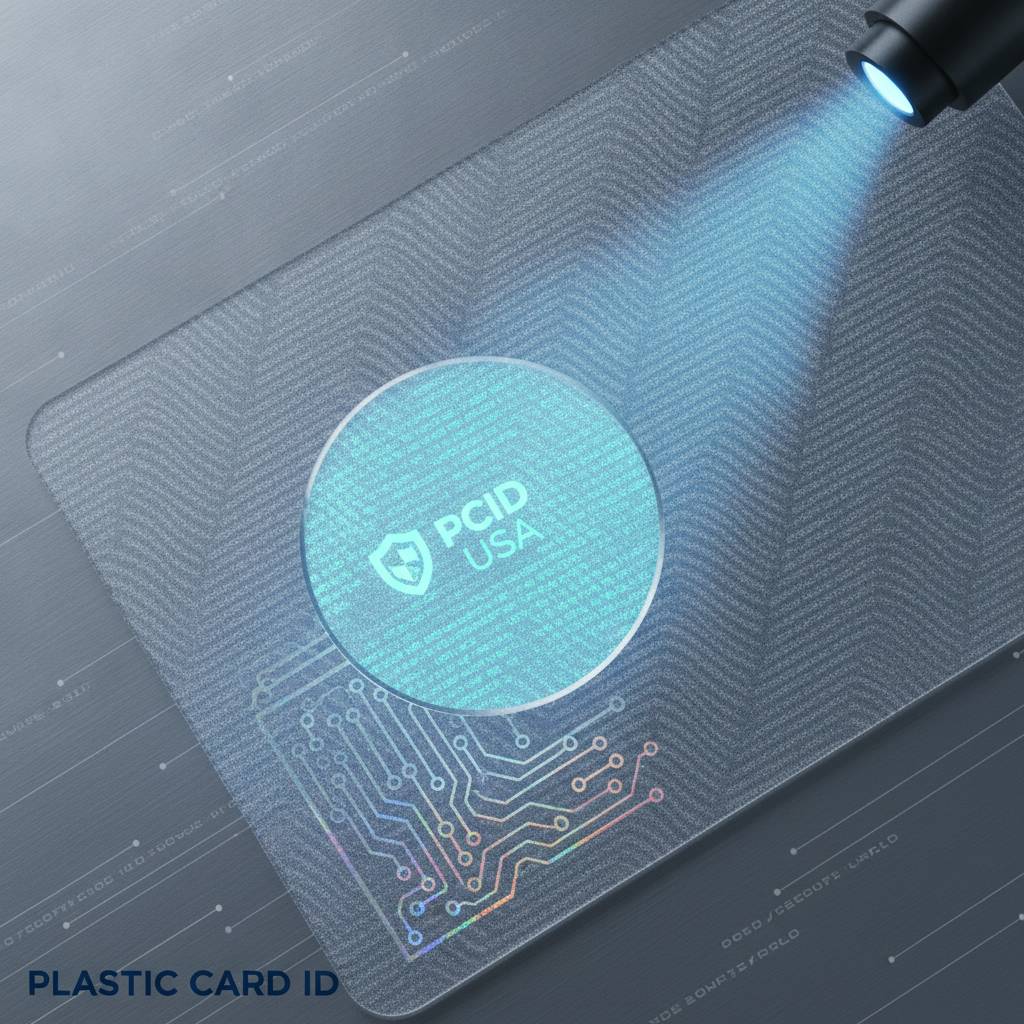 There's a reason government-issued documents - passports, national IDs, currency - have incorporated microtext for decades. The principle is elegant in its simplicity: print information at a resolution so fine that standard photocopiers, inkjet printers, and budget card printers cannot reproduce it faithfully. The copy degrades. The original doesn't. That delta is your security margin.
For organizations running plastic ID card programs, this matters more than many assume. A counterfeited employee badge doesn't just represent a branding problem - it's a physical security failure. An event credential that can be easily duplicated compromises both revenue and safety. Microtext adds a layer of authentication that's passive, always present, and doesn't rely on any reader infrastructure to function during a spot check.
The Counterfeiting Problem Microtext Solves
Consumer-grade card printers have become surprisingly capable and inexpensive. A determined bad actor with a $300 printer, a blank white PVC card, and a decent design scan can produce a superficially convincing fake badge. What they cannot easily replicate is microtext printed at professional resolution - the fine detail simply smears or vanishes in reproduction.
This is the core value proposition. Microtext raises the technical bar for counterfeiting without raising the cost of legitimate card production in any significant way. For organizations issuing hundreds or thousands of cards, the per-card security premium for microtext integration is minimal while the deterrent effect is substantial.
How Microtext Differs from Other Security Features
Holograms require special materials and application equipment. UV printing adds a process step. RFID and smart chips add meaningful per-card cost. Microtext, by contrast, is a print-time design decision - it exists in your card template, reproduced every time that template is printed, at no additional materials cost beyond the design work that created it.
That said, microtext works best as part of a layered security approach rather than a standalone solution. Pairing microtext with magnetic stripe encoding, smart chip data, or UV features creates a credential that demands progressively more sophisticated equipment and expertise to fake convincingly. CPE customers building serious card programs often combine two or three of these layers for exactly this reason.
Reading and Verifying Microtext in the Field
Verification is refreshingly low-tech. A jeweler's loupe, a magnifying glass, or even a smartphone camera in macro mode can reveal microtext that the naked eye perceives only as a fine line or textured border. This means your security staff doesn't need any specialized hardware - just awareness of where the microtext is and what it should say.
Training front-line staff to check microtext takes minutes, not days. Incorporating a brief verification step into your existing badge check process is straightforward. For higher-stakes environments, you can supply pocket loupes to security personnel at negligible cost. The authentication chain remains intact even if electronic readers are unavailable.
| Security Feature | Requires Special Reader? | Adds Per-Card Cost? | Counterfeit Difficulty |
|---|---|---|---|
| Microtext | No (loupe only) | Minimal | High |
| Magnetic Stripe | Yes | Low-Moderate | Moderate |
| Smart Chip (RFID) | Yes | Moderate-High | Very High |
| Hologram | No | Moderate | Moderate-High |
| UV Printing | UV light only | Low | High |
Card Types That Benefit Most from Microtext Security Printing
Not every card program carries the same security stakes, and that's a fair starting point. A coffee shop loyalty card doesn't need microtext. But a corporate employee badge that grants access to server rooms? An event credential for a sold-out festival with resale value? A casino player card linked to real monetary value? These are different conversations entirely, and microtext belongs in those conversations.
The question isn't really whether microtext adds value - it demonstrably does in any scenario where credential authenticity matters. The question is which card programs have enough at stake that the design investment is clearly justified. Plastic Card ID helps clients make that determination based on their specific program requirements, volume, and risk exposure.
Employee ID and Access Control Cards
Corporate and institutional ID cards are perhaps the most obvious candidates for microtext security printing. These credentials often govern physical access to facilities, data centers, executive floors, or restricted operational areas. A convincing fake could represent a serious security breach, and the consequences of that breach can be significant in both financial and legal terms.
Embedding microtext into the card design - as a border, within the background pattern, or integrated with the organizational logo - creates an authentication layer that even your own employees may not know exists unless briefed. That obscurity is a feature, not a limitation. If counterfeiters don't know exactly what to replicate, the replication challenge compounds.
Event Credentials and VIP Passes
The event industry has a persistent credential fraud problem. High-demand concerts, industry conferences, exclusive VIP areas - wherever access has real value, counterfeit credentials appear. Paper wristbands have limited security; plastic credentials with microtext raise the barrier considerably, especially when combined with variable data printing that makes each card unique to the registered attendee.
Event organizers who've switched from generic printed passes to custom plastic credentials with embedded security features consistently report fewer fraud incidents and faster entry processing - security staff spend less time scrutinizing credentials and more time managing flow efficiently. That operational improvement alone often justifies the upgrade cost.
Casino Player Cards and Gaming Credentials
Casino player cards occupy a uniquely demanding security niche. They're linked to loyalty point balances, comps, and sometimes significant monetary value. They're physically handled thousands of times and need to survive that abuse while maintaining readable security features. Microtext on casino cards typically appears in multiple locations - edge borders, the area around the player number, and sometimes as a UV-reactive layer visible only under blacklight.
CPE serves casino clients with a full range of card options designed for this environment, including cards rated for high-volume handling, options with HiCo magnetic stripes for reliable data retention, and custom security print configurations that meet gaming commission credential requirements in various states.
Membership and Professional Association Cards
Professional credentials - medical licensing cards, bar association membership, certified contractor credentials - carry institutional weight. When someone presents one of these cards, the receiving party is making a judgment about the holder's qualifications and legitimacy. Microtext reinforces that legitimacy in a way that a laminated paper card simply cannot.
Membership organizations that have upgraded from paper to secure plastic credentials with microtext and other security features report a meaningful shift in member perception. The card itself communicates seriousness, investment, and permanence. That perception has real value in member retention and acquisition conversations.
Designing Microtext into Your Plastic Card Program
 Here's where many organizations hit their first friction point: design. Microtext isn't something you drop into a card template in five minutes. It requires thoughtful placement, contrast management, and font selection to function correctly - text that's too thin at microtext scales simply disappears into the substrate. Getting it right requires either design expertise or a supplier who can guide the process.
This is where working with an experienced partner rather than a commodity card vendor makes a measurable difference. Plastic Card ID brings decades of card production knowledge to these conversations, helping clients understand not just what's possible but what's practical given their printer capabilities, card stock selection, and specific authentication requirements.
Font Selection and Sizing for Microtext
Microtext typically prints at 0.2mm to 0.4mm character height - roughly 0.6pt to 1.2pt in typographic terms, which is genuinely tiny. Not all fonts survive that reduction gracefully. Thin serif fonts, for example, can become nearly invisible at microtext scale. Bold, clean sans-serif typefaces generally perform most reliably at extreme small sizes, maintaining legibility under magnification while appearing as a simple fine line to the unaided eye.
Choosing the right font also involves thinking about what the microtext says. Common choices include the organization name, a security phrase, the card's issue date range, or a unique identifier series. Some programs use a rotating phrase that changes with each card batch, meaning a card from six months ago carries different microtext than a current-issue card - an elegant way to identify card age during audits.
Placement Strategy: Where to Put Microtext on a Card
Strategic placement amplifies the security value of microtext. Borders are the most common location - a thin rule around the card edge that resolves under magnification into repeating text. This is effective precisely because borders read as purely decorative at normal viewing distance. Security features hidden in plain sight are often the most robust because they require knowing what to look for, not just having the equipment to find it.
Secondary placement zones include the area beneath a signature panel, integrated into guilloche background patterns, and around photograph frames or logo areas. Using multiple placement zones creates redundancy - if one area is damaged or obscured, authentication can proceed from another location. For high-stakes credentials, this redundancy matters.
Combining Microtext with Other Print Security Features
- UV-reactive ink layers: Microtext printed in UV-reactive ink is invisible under normal light and readable only under ultraviolet - doubling the obscurity of the feature.
- Guilloche patterns: Complex mathematical background patterns that are both visually distinctive and practically impossible to reproduce on consumer printers.
- Variable data integration: Each card carries unique printed data (name, employee number, issue date) that makes mass counterfeiting significantly harder to execute convincingly.
- Laminate overlaminates: Security laminates with embedded holographic or UV features protect the printed card surface while adding another authentication layer.
- Magnetic stripe or smart chip encoding: Electronic data that can be verified by readers provides machine-readable authentication to complement visual microtext inspection.
The most secure card programs use three or more of these features in combination. The goal isn't to make counterfeiting theoretically impossible - it's to make it practically uneconomical. When faking a credential requires equipment, expertise, and materials that cost more than whatever fraudulent access provides, the security program has succeeded.
Printer Capabilities and Microtext Quality
 One critical variable that organizations often overlook when planning microtext programs is printer capability. Not all card printers reproduce microtext at the same quality level. Print resolution, ribbon quality, and printing technology all affect how faithfully the fine detail of microtext characters transfers to the card substrate. Getting this wrong means microtext that's blurry and easy to miss - defeating the purpose entirely.
Plastic Card ID carries the full lineup from three of the industry's most respected card printer manufacturers: Evolis, Zebra, and Fargo. Each brand offers models at different capability tiers, and selecting the right printer for a security card program is a decision that deserves careful thought rather than defaulting to the least expensive option.
Choosing the Right Card Printer for Security Printing
For microtext security printing, print resolution is the primary technical specification to evaluate. Higher DPI (dots per inch) printers reproduce microtext with significantly more faithful detail than budget-tier models. Direct-to-card printers at 300 DPI can produce acceptable microtext in many applications; retransfer printers operating at 600 DPI or higher produce substantially sharper results, particularly for very fine security text.
Retransfer printing technology, available on higher-end models from all three brands Plastic Card ID carries, also offers an edge-to-edge printing capability that matters for border microtext. Direct-to-card printers leave a slight white border around the print area; retransfer printers print to a transfer film first, then apply it to the card, allowing truly full-bleed printing that extends security features to the physical card edge.
Ribbon Selection for Fine Detail Security Printing
The ribbon is the media through which ink transfers to the card, and ribbon quality has a direct and often underappreciated impact on microtext legibility. OEM ribbons from Evolis, Zebra, and Fargo are engineered specifically for their respective printers, maintaining tight tolerances on ink density and transfer consistency. Using off-brand ribbons with security card applications is a risk not worth taking - the per-ribbon savings don't justify the quality variance when microtext clarity is a security requirement.
Plastic Card ID stocks ribbons for all printer models in its catalog, including monochrome black ribbons that produce the sharpest possible single-color microtext and full-color YMCKO ribbons for cards that combine security printing with full-color photography or color design elements. Ordering ribbons from the same supplier as your cards and printer simplifies reordering and ensures compatibility.
Call CPE at 800.835.7919 to discuss printer recommendations for your specific microtext security card application.
Maintenance Practices That Protect Print Quality
Even a high-resolution printer produces degraded microtext output if it isn't maintained properly. Dust, debris, and adhesive residue from card transport rollers accumulate over time and introduce artifacts into fine-detail printing. Regular cleaning cycles using manufacturer-approved cleaning cards and cleaning kits keep the print path clear and maintain the consistency that security printing demands.
Plastic Card ID supplies cleaning kits for all major printer brands in its catalog. Building a regular cleaning schedule into your card production workflow - typically every 500-1000 card prints, or whenever print quality shows any visible degradation - is a simple practice that pays dividends in consistent security feature reproduction over the long life of your printer investment.
Building a Complete Security Card Program with Plastic Card ID
Microtext doesn't exist in isolation. It's one component - an important one - of a card program that may also involve specific card stock selection, encoding requirements, printer capabilities, issuance workflow, and ongoing supply chain management. Organizations that try to source each of these components from different vendors typically encounter compatibility problems, longer lead times, and no single point of accountability when issues arise.
That's the practical argument for Plastic Card ID as a program partner rather than a card commodity vendor. Over 100,000 customers and 50 million cards sold over 25 years generates a lot of institutional knowledge about what works, what breaks, and what organizations at different scales and security levels actually need. That knowledge is genuinely available when you call, not locked behind a consulting engagement.
Card Stock Selection for Security Applications
Standard CR80, 30-mil PVC cards are the foundation of most ID programs - ISO 7810 compliant, universally compatible with all card printers, and available in bulk quantities that keep per-card cost manageable. For security card applications, the same card stock that works for loyalty cards often works fine for microtext printing. What matters more is the surface finish and the printer's interaction with it.
Matte-finish cards produce slightly sharper microtext resolution than glossy cards in some printer configurations, because the matte surface provides more ink adhesion points. Glossy cards, however, are more resistant to surface handling wear. Discussing your specific use case - how the card will be handled, how long it needs to last, and what verification process will be used - helps determine the right stock specification for your program.
Volume Pricing and Program Scalability
CPE works with card programs of every scale, from 50 cards per month for a small membership organization to tens of thousands per month for large enterprise or event programs. Volume pricing at higher quantities makes a meaningful difference to per-card cost, and understanding your projected volume before placing your first order helps structure a purchasing arrangement that makes sense financially from the start.
Programs that start small frequently grow. A regional membership organization becomes national. A single-location corporate ID program expands to 12 locations. Establishing a supplier relationship with a company that can scale alongside your program - without requiring you to find a new vendor when your volume outgrows a smaller supplier's capabilities - is worth thinking about at the outset, not when you're in the middle of a rapid expansion.
Value-Added Services That Complete the Card Program
Card production doesn't end when the cards come off the printer. Depending on your program, cards may need to be mailed to members or employees, inserted into branded card carriers, sleeved for protection, or affixed to documents. Plastic Card ID offers a full complement of these fulfillment services, meaning your card program can operate end-to-end through a single vendor relationship rather than a fragmented multi-supplier arrangement.
- Card carriers and mailers designed for CR80 standard cards
- Protective card sleeves in multiple material options
- Card affixing services for document attachment applications
- Bulk mailing fulfillment for high-volume issuance programs
- Printer ribbons and cleaning kits for in-house card production
- Ongoing card stock supply with consistent quality standards
This breadth of capability under one roof is what separates a strategic card program partner from a basic card supplier. When your entire card program runs through one trusted vendor, troubleshooting is faster, reordering is simpler, and program changes are easier to implement consistently.
Frequently Asked Questions About Microtext Security Printing
 Organizations evaluating microtext for the first time consistently arrive with similar questions. The following addresses the most common ones directly, based on the actual conversations Plastic Card ID has with clients exploring security card upgrades.
Can I Add Microtext to Cards I Print In-House?
Yes, in most cases. If your organization already operates a card printer - particularly a higher-resolution model from Evolis, Zebra, or Fargo - adding microtext to your card template is primarily a design exercise. The template is modified to include microtext elements, and the printer reproduces them as it would any other printed element. The critical variable is whether your printer's resolution is sufficient to reproduce microtext faithfully enough to function as a security feature.
Lower-resolution printers may produce microtext that's technically present but too blurry to be reliably legible under magnification - which undermines the security value. CPE can assess your current printer model and let you know whether it's suitable for microtext security printing or whether an upgrade would be warranted for your specific application.
How Much Does Microtext Security Printing Add to Card Program Cost?
The honest answer is: very little, relative to the security value delivered. Microtext lives in your design template - it's not a separate material applied to the card, and it doesn't require a separate process step during printing. The primary investment is in the design work to create a card template that incorporates microtext correctly. For organizations designing new cards, this is simply part of the design process. For organizations updating existing cards, it's a template modification project.
If your program involves outsourced card printing rather than in-house production, there may be a modest setup fee for configuring the security print template. Across the life of a card program issuing hundreds or thousands of cards, this cost amortizes to a negligible per-card increment. Compared to the cost consequences of a security breach enabled by a counterfeited credential, it represents exceptional value.
Is Microtext Visible to Cardholders?
This depends on placement and design choices. Microtext integrated into border lines or background patterns is typically invisible to cardholders going about their normal use of the card - they see a design detail, not text. Microtext placed in a more prominent location may be visible as a fine-line detail without being legible without magnification. Whether cardholders should be aware of the microtext is a program design decision that depends on your security philosophy.
Some organizations choose to inform cardholders about microtext as a reassurance feature - "your credential includes security features that protect against fraud." Others prefer to keep the feature undisclosed, limiting knowledge of its existence to security personnel and program administrators. Both approaches are valid; the right choice depends on your specific program context and communication goals.
Ready to explore microtext security printing for your card program? Plastic Card ID is ready to help you design a credential that works harder for your organization. Call 800.835.7919 today.
Take the Next Step with Plastic Card ID
 Security isn't an afterthought - it's a design decision made before the first card is ever printed. Organizations that build authentication features like microtext into their card programs from the start operate with a meaningful advantage over those scrambling to address credential fraud after it becomes a visible problem. Plastic Card ID has spent 25 years helping businesses and institutions across the United States build card programs that hold up under real-world conditions - programs that scale, perform, and protect.
Whether you're launching a new ID card program, upgrading an existing one, or adding security features to credentials that have outgrown their current design, the conversation starts with a phone call. Call Plastic Card ID at 800.835.7919 and speak with a team that has seen virtually every card program challenge imaginable - and knows how to help you solve yours.
Previous Page