Blank Plastic Cards Made in the USA: Your Sourcing Guide
Table of Contents []
- Why Plastic Card ID Is the Trusted Source for Blank Plastic Cards Made in the USA
- The Full Catalog: Every Blank Card Type Your Business Might Need
- Real-World Applications: What Businesses Actually Do With Blank Plastic Cards
- Card Printers and the Supplies That Keep Programs Running
- Frequently Asked Questions About Blank Plastic Cards Made in the USA
- What Sets Plastic Card ID Apart After 25 Years in the Industry
- Get Started With Plastic Card ID: Your Partner in Blank Plastic Cards Made in the USA
Why Plastic Card ID Is the Trusted Source for Blank Plastic Cards Made in the USA
 There is something remarkably powerful about a blank plastic card. It sits in your hand, featureless, patient - a canvas waiting to become something. A membership credential. An employee badge. A hotel key. A loyalty card that keeps a customer coming back. What separates a thriving card program from a forgettable one often comes down to the quality of that blank card before anything is printed, encoded, or distributed. That is precisely where Plastic Card ID has built its reputation over 25 years and across more than 50 million cards sold.
USA businesses demand a supplier who understands scale, urgency, and variety. Whether you are ordering 50 cards a month for a small fitness studio or tens of thousands for a regional retail chain, the expectation is the same: consistent quality, reliable fulfillment, and a partner who actually knows this industry. Plastic Card ID delivers exactly that, serving over 100,000 customers with a catalog that covers every card type a domestic business could need.
This page is built for decision-makers who want clarity. You will find product breakdowns, practical guidance, use-case comparisons, and the kind of candid information that helps you make a confident purchasing decision. Let us get into it.
What Makes a Blank Plastic Card "Made in the USA" Significant?
Sourcing blank plastic cards domestically is not merely a patriotic preference. It translates into faster shipping times, tighter quality control, and supply chain reliability that imported alternatives simply cannot guarantee. When a vendor ships from overseas, lead times stretch, communication suffers, and the risk of quality variation grows with every batch.
USA-sourced blank PVC cards conform to ISO 7810 standards, the international specification that governs CR80 card dimensions - the same size as a standard credit card at 3.375 x 2.125 inches and 30 mil thickness. This standardization matters enormously because your card printer is calibrated for exactly these tolerances. Off-spec cards cause jams, misaligned prints, and wasted ribbons. Domestic manufacturing keeps these tolerances tight.
Plastic Card ID has spent decades cultivating relationships with USA-based production partners whose quality standards match what large enterprise clients expect. That consistency flows down to the smallest order. A 50-card minimum runs through the same quality standards as a 50,000-card production run.
The CR80 Standard: Why Most Blank Cards Share This Format
The CR80 designation is ubiquitous for a reason. It fits wallets. It works in card printers. It slides into badge holders, card readers, access panels, and POS scanners without modification. When businesses design in-house card programs - whether for employees, members, guests, or customers - the CR80 blank card is the logical starting point because the infrastructure around it is already everywhere.
At 30 mil thickness, the CR80 card is sturdy enough to survive daily handling, resist bending in a wallet, and maintain print quality over time. Thinner cards feel flimsy and undermine perceived value. Thicker specialty cards exist for specific applications. But for the overwhelming majority of card programs, 30 mil CR80 is the professional standard - and CPE stocks them in depth.
Call Us Before You Order: Getting Your Specs Right the First Time
Card programs fail most often not because of poor design but because of specification mismatches. A business orders bulk blank cards without confirming compatibility with their existing printer model, or selects the wrong magnetic stripe coercivity for their reader system. These are expensive mistakes. A quick conversation prevents them entirely.
Reach out to our team at 800.835.7919 before placing a large order. We walk clients through printer compatibility, encoding requirements, card finish options, and quantity tiers so that the first order is the right order. That kind of proactive guidance is what separates Plastic Card ID from a commodity web store that just takes your payment and ships boxes.
| Card Type | Common Uses | Key Feature |
|---|---|---|
| Blank PVC CR80 | ID badges, loyalty, membership | ISO-standard size, universal compatibility |
| HiCo Magnetic Stripe | Hotel keys, access control, gift cards | 2750 Oe, high durability encoding |
| LoCo Magnetic Stripe | Short-term credentials, event passes | 300 Oe, cost-effective for temp programs |
| RFID / Proximity | Building access, contactless ID | 125 kHz and 13.56 MHz options |
| Smart Chip (MIFARE DESFire) | Secure access, casino, transit | Encrypted contactless data storage |
| Clear / Frosted PVC | Premium membership, VIP credentials | Distinctive visual presentation |
The Full Catalog: Every Blank Card Type Your Business Might Need
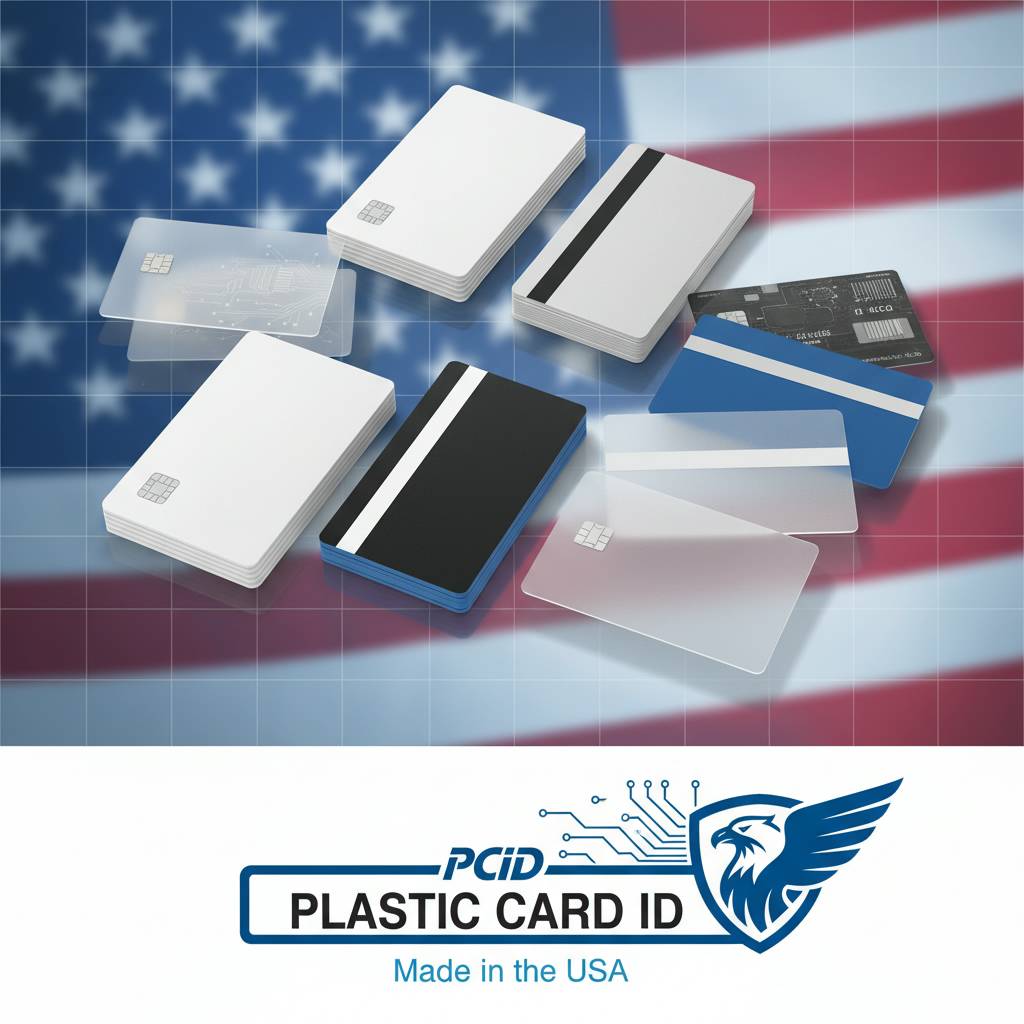 Breadth matters. When a vendor carries only two or three card types, you eventually outgrow them and face the disruption of switching suppliers. Plastic Card ID built its catalog deliberately around the full range of blank plastic cards that USA businesses actually use - from the most common white PVC blank to specialty casino player cards and luxury metal cards in stainless steel, brass, and gold.
Understanding the differences between card types helps you make smarter program decisions. Below is a practical breakdown of what each card type delivers and where it performs best in real-world applications.
Blank White PVC Cards: The Foundation of Every In-House Card Program
If there is a single product that anchors the world of card printing, it is the plain white CR80 PVC card. This is the card that goes into every desktop card printer - the Evolis Primacy, the Zebra ZC300, the Fargo HDP5000 - and emerges on the other side as a finished credential. The blank white PVC card is where every custom card program begins.
Organizations choose blank white cards because they want complete design flexibility. Your graphic designer creates the card layout. Your card printer transfers it. Your staff or your automated system handles distribution. The per-card cost is low, the print quality can be exceptional, and there is no waiting for external production runs. You print what you need, when you need it.
Businesses running ID badge programs, gym memberships, club credentials, school IDs, and loyalty programs have made the blank white CR80 their workhorse for decades. CPE ships these in quantities from small starter packs to bulk case lots, so whether your program is growing or fully mature, your supply chain stays intact.
Magnetic Stripe Cards: HiCo vs. LoCo and When Each Makes Sense
Magnetic stripe cards carry data on a stripe of iron-based magnetic particles bonded to the card's surface. The coercivity - measured in oersteds (Oe) - determines how strongly the data is encoded and how resistant it is to accidental erasure. Choosing the wrong coercivity is one of the most common and costly mistakes in card procurement.
High coercivity (HiCo) cards at 2750 Oe are the right choice for programs where cards are used repeatedly and stored near other magnets, cards, or electronic devices. Hotel room keys, loyalty cards, access badges, and gift cards all benefit from HiCo encoding because the data holds reliably through thousands of swipes and years of wallet storage.
Low coercivity (LoCo) cards at 300 Oe work well for short-duration programs - event credentials, temporary passes, or guest access cards that are collected and discarded after a single use or short period. Their lower encoding resistance is a non-issue when the card life is brief, and their cost advantage can be meaningful at scale. Plastic Card ID stocks both, so you choose based on application, not availability.
RFID, Proximity, and Smart Chip Cards: Contactless and Encoded Access
The world of contactless card technology spans several frequencies and standards, each optimized for different use cases. Proximity cards operating at 125 kHz are the classic building access credential - reliable, widely compatible, and simple to deploy with standard readers. RFID cards at 13.56 MHz open the door to more sophisticated applications including transit, hospitality, and secure facility management.
Smart chip cards with MIFARE DESFire technology represent the leading edge of contactless card security. They support encrypted data storage and mutual authentication between card and reader, making them the preferred credential for casinos, secure government facilities, and high-security enterprise environments. These are not commodity cards - they require matching infrastructure - but for organizations operating at that level, CPE has the inventory.
Specialty Cards: Clear, Frosted, Colored Stock, Die-Cut, and Metal
Some card programs need to do more than function - they need to impress. Clear and frosted PVC cards create an immediate visual distinction that white cards cannot replicate. When a VIP member pulls a clear card out of their wallet, it signals something different. It says the issuing organization takes its brand seriously.
Custom die-cut shapes allow organizations to break the rectangular CR80 mold entirely for promotional or novelty applications. Colored card stock saves print time and cost by starting from a base color rather than printing solid backgrounds. And for organizations that want the ultimate in perceived value, Plastic Card ID offers luxury metal cards in stainless steel, brass, and gold finishes - a physical object that commands attention and communicates premium status without saying a word.
Real-World Applications: What Businesses Actually Do With Blank Plastic Cards
Reading a product catalog is one thing. Understanding how the cards translate into actual business results is what drives confident purchasing decisions. Plastic Card ID has supplied cards to enough industries over 25-plus years to have seen - and helped shape - programs that genuinely move the needle.
Below are the core application categories where blank plastic cards deliver measurable value, along with the specific card types and configurations that perform best in each.
Retail Gift Card Programs: Where Plastic Consistently Outperforms Paper
Retailers who make the transition from paper gift certificates to plastic gift cards see something remarkable happen. Sales data across the industry consistently shows increases in the range of 35-50% when plastic replaces paper. That is not a marginal improvement - that is a program transformation. Plastic gift cards are perceived as more valuable, more professional, and more permanent by consumers, and that perception drives purchasing behavior.
Blank magnetic stripe cards are the backbone of retail gift card programs. The retailer loads them through their POS system, prints custom designs in-house or through a print partner, and deploys them at the counter, in packaging, or through digital gifting integrations. The card itself costs pennies. The revenue it generates and retains can be extraordinary.
Loyalty Programs: Keeping Customers Coming Back
A loyalty card that lives in a customer's wallet is a recurring reminder of your business. Every time they open their wallet - for anything - they see your brand. Wallet presence is marketing you do not pay for after the card is issued. Paper punch cards get lost, laundered, and ignored. Plastic loyalty cards get kept.
The mechanics are straightforward: blank CR80 cards printed with your loyalty program design, encoded with a magnetic stripe or barcode if your POS system requires it, and distributed at the point of sale. Simple programs can use barcode-based systems that require no encoding. More sophisticated programs use magnetic stripe or RFID-linked accounts. Plastic Card ID can supply blank cards appropriate for any of those configurations.
Employee ID and Access Control: When the Badge Is the Credential
For organizations managing building access, time and attendance tracking, or multi-site identification, the plastic ID card is both a visual credential and a functional access token. Proximity and RFID blank cards are printed, encoded, and issued to employees - then activated in the access control system to define which doors they can open and during which hours.
The in-house card printing model gives HR and security teams total control over the issuance process. New hire starts on Monday; their badge is ready before they walk in the door. Card lost on Thursday; a replacement is printed the same day. This responsiveness is only possible when your organization owns the printing process - and that process starts with a reliable supply of blank cards from a vendor you can count on. Call 800.835.7919 to discuss volume pricing for employee ID programs.
Card Printers and the Supplies That Keep Programs Running
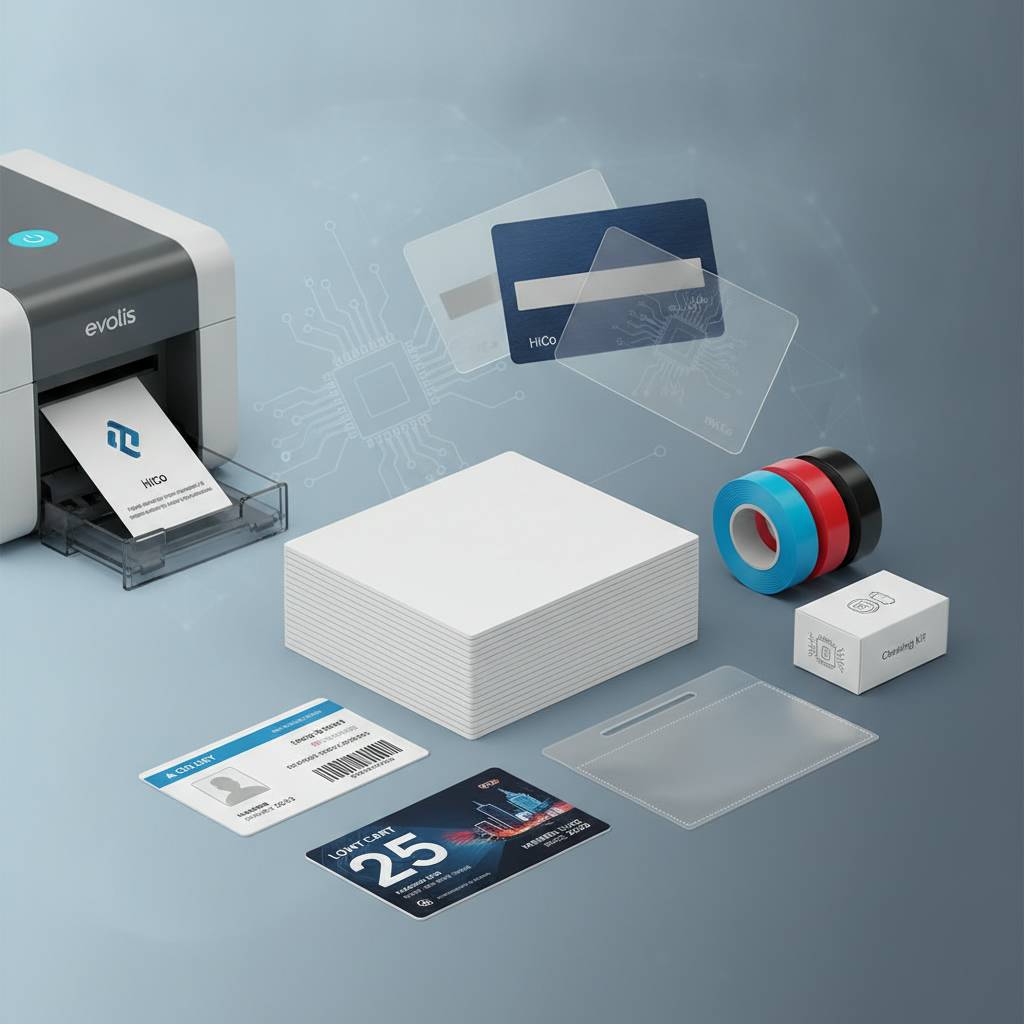 Blank cards and card printers are inseparable. A card without a printer is inventory with no purpose. A printer without cards is hardware gathering dust. Plastic Card ID stocks the full ecosystem - printers, ribbons, cleaning kits, card carriers, sleeves, and affixing and mailing services - so that organizations can build and sustain their card programs from a single supplier relationship.
Evolis, Zebra, and Fargo: Professional Card Printer Brands
The three dominant brands in professional card printing each bring distinct strengths. Evolis printers are known for reliability, compact footprint, and excellent output quality across a broad range of card types - they are a popular choice for small-to-medium organizations running in-house programs. Zebra card printers bring enterprise-grade throughput and durability to high-volume environments like large corporate campuses and healthcare systems.
Fargo printers - now operating under the HID brand umbrella - are particularly well-regarded in secure ID and access control applications, with strong support for smart card encoding and high-definition printing technologies. Choosing the right printer for your card volume and encoding needs is a decision that pays forward for years. CPE carries all three brands and can help you match printer to program without overselling.
Ribbons, Cleaning Kits, and Consumables: The Ongoing Supply Chain
Printer ribbons are the most frequently replaced consumable in any card printing operation. Using off-brand or incompatible ribbons is a false economy - they cause print defects, accelerate printhead wear, and void manufacturer warranties. Plastic Card ID stocks OEM-compatible ribbons for Evolis, Zebra, and Fargo printers so that organizations stay in spec while managing supply costs sensibly.
Cleaning kits are often overlooked until a print quality problem emerges. Regular cleaning of rollers and printheads extends equipment life meaningfully and prevents the kinds of card jams and streaking issues that disrupt production. Card carriers and sleeves protect finished cards during mailing and distribution, ensuring the card arrives at the recipient in pristine condition. These details are what distinguish a well-run program from a chaotic one.
Card Affixing and Mailing Services: From Production to Recipient
Some organizations print and distribute cards internally. Others need to reach members or customers by mail - loyalty cards going to new registrants, membership renewals, hotel key card envelopes, casino player card welcome packages. Plastic Card ID offers card affixing and mailing services that bridge the gap between production and the end recipient.
This service removes the fulfillment burden from internal teams who are already stretched. Cards get affixed to mailers, inserted into appropriate packaging, addressed, and sent. For organizations running scaled card programs - particularly in hospitality, retail, or association management - outsourcing this step improves delivery consistency and frees staff for higher-value work.
Frequently Asked Questions About Blank Plastic Cards Made in the USA
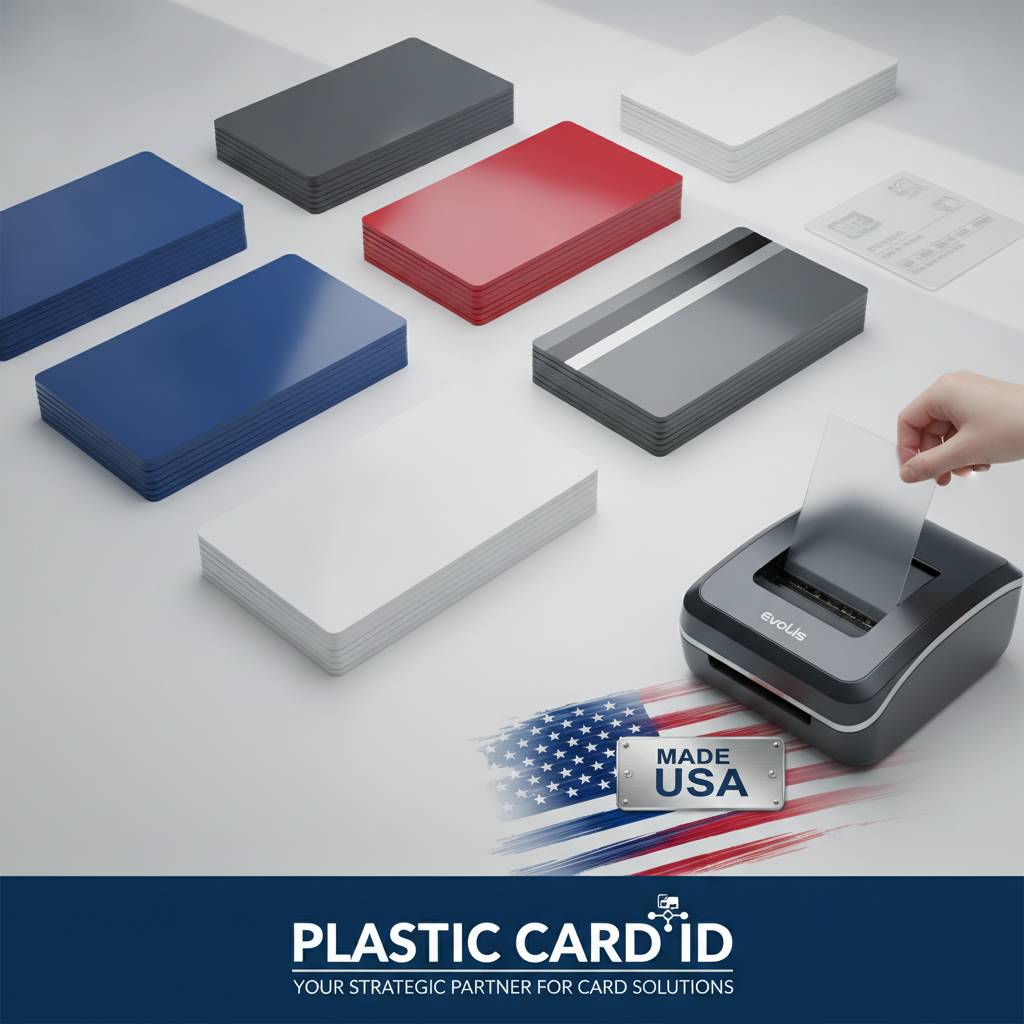 Years of customer conversations have produced a fairly consistent set of questions from organizations evaluating blank card suppliers. The following FAQ addresses the most common points of confusion and hesitation, offering straightforward answers that help buyers move forward with confidence.
What Quantity Should I Order, and How Do I Know When to Buy in Bulk?
Minimum order quantities at Plastic Card ID start as low as 50 cards, which makes the entry point accessible for small organizations testing a card program. But the per-card cost drops significantly as quantity increases, and for organizations with predictable card usage, buying in larger lots generates meaningful savings over time. The break-even point for bulk purchasing typically arrives faster than most buyers expect.
- Orders of 500-999 cards offer the first meaningful per-card discount over minimum quantities.
- Orders of 1,000-4,999 cards drop into a significantly lower price tier appropriate for most small-to-medium programs.
- Orders of 5,000 cards and above unlock case pricing that is competitive with any domestic supplier in the market.
- Programs exceeding 10,000 cards per run should request a custom quote - volume at that scale almost always warrants a direct conversation about pricing and fulfillment logistics.
- Storage is rarely an issue for blank cards - they are compact, stackable, and stable at room temperature for years when kept away from heat and direct sunlight.
Are All Your Blank Cards Compatible With My Existing Printer?
CR80 cards at 30 mil thickness are compatible with virtually every professional card printer on the market. If your printer accepts standard credit-card-sized cards - which every Evolis, Zebra, Fargo, and most other brand printers do - then standard blank PVC cards from Plastic Card ID will run through it correctly. The key variables are card thickness and any optional features like magnetic stripes or chips.
Where compatibility questions arise most often is with specialty cards - clear PVC, frosted, or cards with pre-applied magnetic stripes. Some printers require specific media settings for these card types, and certain older or budget-tier printers may not support magnetic stripe writing at all. If you have questions about your specific printer model, our team can answer them before you place an order. Do not guess on a bulk purchase - confirm compatibility first.
What Are the Differences Between Standard PVC and Premium Card Options?
Standard white PVC cards are the most cost-effective option and the right choice for the vast majority of programs. They print beautifully, hold encoding reliably, and perform consistently through years of regular use. For most ID badge, loyalty, membership, and gift card programs, standard PVC is the answer.
Premium options - clear PVC, frosted PVC, colored stock, custom die-cut shapes, and metal cards - exist for programs where visual distinction is a strategic priority. A law firm issuing premium client cards, a private club creating a members-only credential, or a hospitality brand designing a VIP experience all have legitimate reasons to spend more on the card itself. The card is often the first physical touchpoint a recipient has with your brand - premium materials communicate premium positioning before a single word is read. Contact 800.835.7919 for specialty card pricing and samples.
What Sets Plastic Card ID Apart After 25 Years in the Industry
Longevity in a competitive industry is not accidental. Plastic Card ID has served over 100,000 customers and sold more than 50 million blank and custom plastic cards because the fundamentals of the business have stayed consistent: quality products, honest guidance, reliable fulfillment, and genuine investment in long-term client relationships.
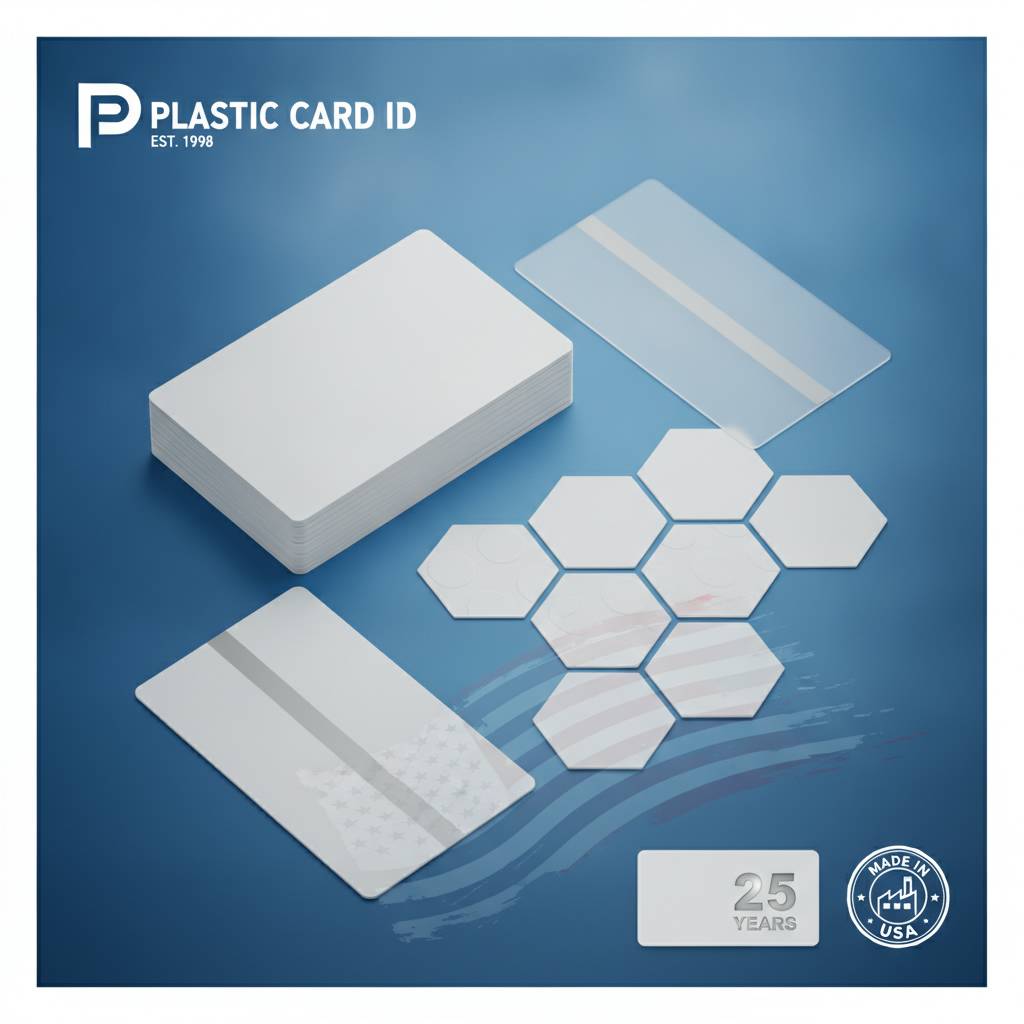
The vendors who treat card sales as a transaction - take the order, ship the boxes, move on - are easy to find. The vendors who function as strategic partners in your card program are considerably rarer. Plastic Card ID operates as a partner, which means when your program grows, changes technology, or faces a supply challenge, you have an experienced team already familiar with your operation standing ready to help solve it.
Serving Every Scale, From 50 Cards to 50,000
The needs of a small local gym running a 50-card-a-month membership program are genuinely different from the needs of a national hotel chain ordering tens of thousands of key cards per fulfillment cycle. Plastic Card ID designed its operations to serve both effectively - not by homogenizing the experience, but by having the product depth, inventory capacity, and team expertise to meet each client where they are.
Small programs get responsive service without being deprioritized. Large programs get the volume pricing, dedicated support, and fulfillment reliability they depend on. This range of capability is what makes Plastic Card ID the kind of supplier that clients stay with as their programs evolve rather than outgrow and replace.
A One-Stop Shop That Eliminates Vendor Sprawl
Managing multiple suppliers for cards, printers, ribbons, cleaning supplies, and mailing services is an administrative burden that accumulates over time. Every additional vendor relationship is another account to manage, another invoice to reconcile, another customer service line to navigate when something goes wrong. Consolidating your card program supply chain with a single vendor simplifies everything.
CPE offers blank cards, custom cards, card printers, printer ribbons, cleaning kits, card carriers, sleeves, and card affixing and mailing services under one roof. That is not a coincidence - it is a deliberate business design built around the reality that clients who get everything they need in one place stay longer, order more confidently, and spend less time managing logistics.
Industries Served Across the United States
Plastic Card ID supplies USA-based businesses and organizations exclusively. The industries served span an exceptionally broad range, reflecting the versatility of blank plastic cards as a foundational business tool across virtually every sector of the domestic economy.
- Retail: gift cards, loyalty programs, promotional cards
- Hospitality: hotel key cards, casino player cards, resort membership credentials
- Healthcare: patient ID cards, staff badges, access credentials
- Education: student ID cards, staff badges, library cards, event credentials
- Corporate: employee ID cards, visitor passes, access control credentials
- Association and membership organizations: member cards, renewal credentials, event badges
- Government and municipal agencies: staff ID, access control, program cards
- Fitness and wellness: gym memberships, class pass credentials, locker key cards
Ready to explore what blank plastic cards can do for your organization? Call 800.835.7919 and speak with a card specialist today.
Get Started With Plastic Card ID: Your Partner in Blank Plastic Cards Made in the USA
 Twenty-five years. Over 100,000 customers. More than 50 million cards. Those numbers represent something beyond sales volume - they represent programs that worked, clients who returned, and a track record that speaks before we say a word. When you choose Plastic Card ID as your blank plastic card supplier, you are choosing a vendor with the depth of experience to keep your program running at any scale, through any change, for as long as you need.
Whether you are launching a card program for the first time and need guidance on where to start, or you are running a mature program and looking for a more dependable supplier, the conversation starts with a phone call or a browse through our full catalog. The right blank card for your program exists in our inventory - from plain white CR80 PVC to HiCo magnetic stripe, RFID proximity, smart chip, clear, frosted, colored, die-cut, and metal. We have it. We stock it. We can ship it.
Contact Plastic Card ID at 800.835.7919 today. Your card program deserves a partner who has been doing this longer than most competitors have existed - and who will still be here when your program grows into something even bigger.
Previous Page