ISO 7810 Card Standard: What It Means for Buyers
Table of Contents []
- What Every Buyer Should Know About the ISO 7810 Card Standard - And Why Plastic Card ID Makes It Work For You
- Breaking Down the ISO 7810 Standard: The ID-1 Format in Plain Language
- Magnetic Stripe Cards and ISO 7810: Understanding HiCo vs. LoCo
- RFID and Smart Chip Cards: Advanced Technology in the CR80 Format
- Buyer Tips: Frequently Asked Questions About the ISO 7810 Standard
- The Full Plastic Card ID Catalog: One Source for Every Card Program Need
- Ready to Build a Smarter Card Program? Start With Plastic Card ID
What Every Buyer Should Know About the ISO 7810 Card Standard - And Why Plastic Card ID Makes It Work For You
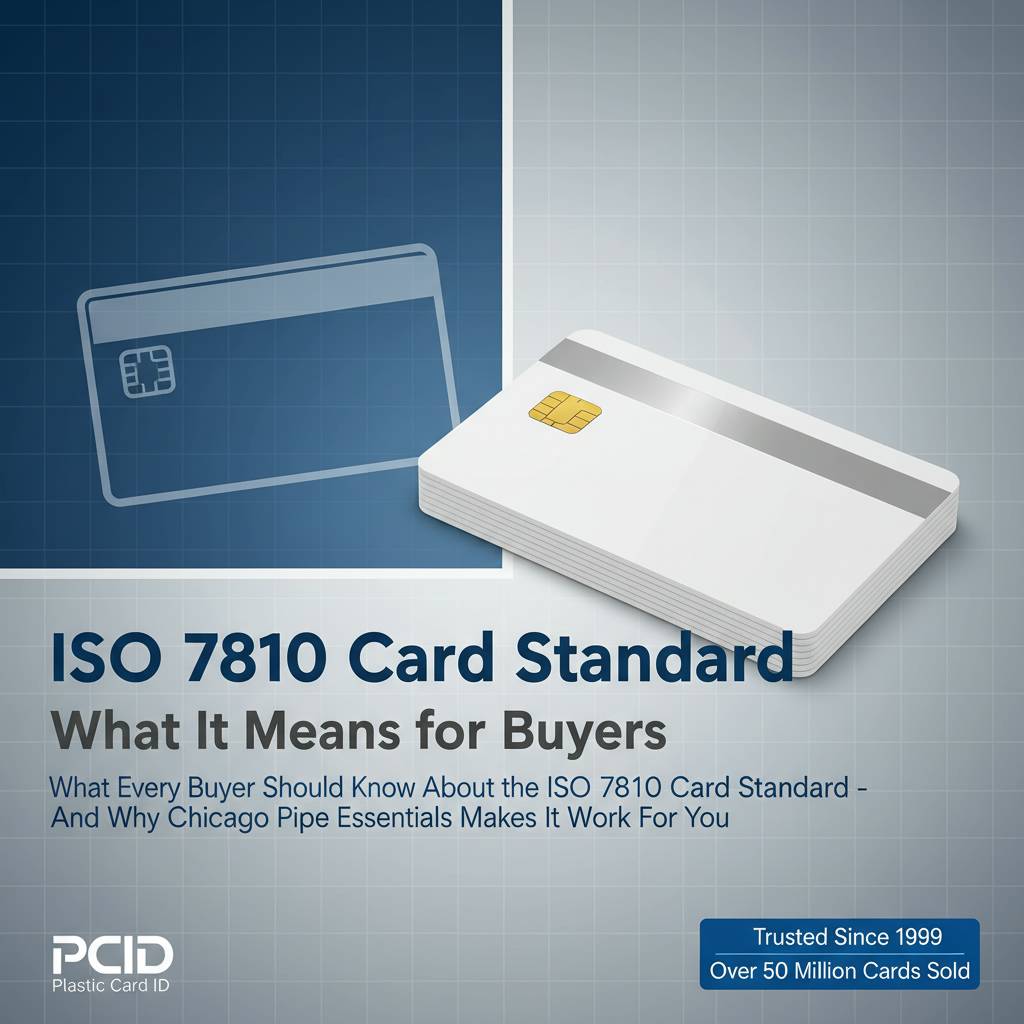 Most people have held an ISO 7810 card without ever knowing the name. Credit cards, loyalty cards, employee badges, hotel keys - they all share the same precise physical dimensions. That consistency is no accident. It is the result of a globally adopted specification that defines exactly how a standard card must look, feel, and behave. Understanding what that standard actually means - and why it matters when you are buying cards for your business - puts you in a far stronger position than most buyers ever reach.
Whether you are sourcing 200 blank cards a month for an in-house printing operation or placing a bulk order for tens of thousands of custom membership cards, the ISO 7810 standard underpins every smart purchasing decision. Plastic Card ID has spent over 25 years helping USA-based businesses navigate these decisions with clarity and confidence - and this page is designed to give you the same informed foundation before you ever place an order.
| Card Format | Dimensions (mm) | Common Use Cases | Thickness |
|---|---|---|---|
| ID-1 (CR80) | 85.60 x 53.98 | Employee badges, loyalty cards, membership, hotel keys | 30 mil (0.76mm) |
| ID-2 | 105 x 74 | Some European ID documents, specialized formats | Varies |
| ID-3 | 125 x 88 | Passports, travel documents | Varies |
| CR79 (Die-Cut) | Slightly smaller than CR80 | Cards designed to fit inside standard credit card slots | 30 mil |
Breaking Down the ISO 7810 Standard: The ID-1 Format in Plain Language
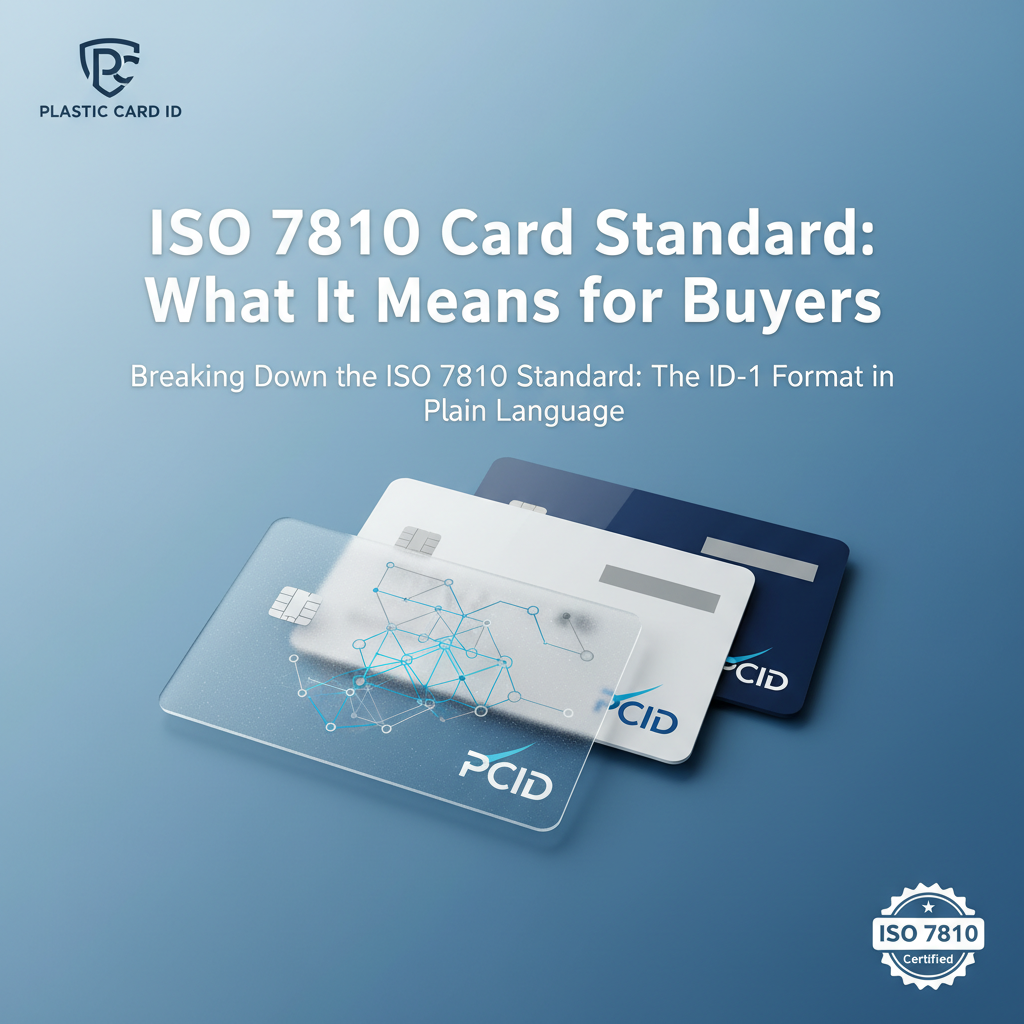 ISO 7810 is an international standard published by the International Organization for Standardization. It defines the physical characteristics of identification cards - primarily their dimensions, flexibility, surface distortion tolerances, and material properties. The most relevant format for businesses in the United States is the ID-1 format, better known in the card industry as the CR80.
At 85.60mm x 53.98mm (approximately 3.375 inches by 2.125 inches) and a standard thickness of 0.76mm (30 mil), the CR80 is the same size as every credit card you have ever carried. That dimensional standard is what makes your cards compatible with wallets, badge holders, card readers, printers, and dispensers - without any guesswork or custom engineering.
Why Dimensional Precision Actually Matters in Purchasing
A card that deviates even slightly from the ISO 7810 specification can cause frustrating downstream problems. Cards that are too thick may jam in printers or card dispensers. Cards that are marginally undersized may slip through card slots or fail to make clean contact with magnetic stripe readers. These are not hypothetical problems - they are real operational headaches that businesses face when sourcing cards from non-compliant suppliers.
Dimensional compliance is not just a technical formality - it is a purchasing safeguard. When you source CR80 cards from Plastic Card ID, every card in every order meets ISO 7810 specifications consistently. That predictability is what allows organizations to print, encode, and deploy cards at scale without variance-related disruptions.
The Role of Material Composition in ISO 7810 Compliance
ISO 7810 does not just specify size. The standard also addresses physical properties including flexibility, surface distortion, and resistance to deformation. PVC (polyvinyl chloride) is the dominant material used to manufacture ID-1 format cards precisely because it satisfies these requirements reliably. PVC cards are stiff enough to retain their shape in wallets and readers but flexible enough not to crack under normal handling stress.
The 30 mil thickness is a critical measurement for printer compatibility. Card printers from manufacturers like Evolis, Zebra, and Fargo are engineered specifically around the 30 mil CR80 format. Using cards of incorrect thickness - even by a few mils - risks printer damage, misfeeds, and inconsistent print quality. Material consistency and dimensional precision go hand in hand when running a reliable card program.
Blank CR80 Cards: The Strategic Starting Point for In-House Programs
Blank CR80 PVC cards are the backbone of in-house card programs for a compelling reason: they offer total flexibility. A single stock of blank white CR80 cards can become an employee ID badge on Monday, a membership card on Tuesday, and a gift card on Wednesday - depending entirely on what is printed or encoded onto the surface. This versatility drives down long-term per-card costs significantly compared to ordering pre-printed cards for each application.
Organizations that invest in a card printer and a stock of ISO 7810-compliant blank cards gain the ability to produce cards on demand, eliminate minimum-order constraints, and update card designs without waste. CPE supplies blank CR80 cards in standard white PVC, as well as colored stock, clear, and frosted options - all maintaining strict ISO 7810 compliance.
Magnetic Stripe Cards and ISO 7810: Understanding HiCo vs. LoCo
When a CR80 card includes a magnetic stripe, additional standards come into play - most notably ISO 7811, which governs the recording and encoding of data on magnetic stripes. But understanding how magnetic stripe cards fit within the broader ISO 7810 framework matters for any buyer sourcing cards for loyalty programs, access control, gift card programs, or membership systems.
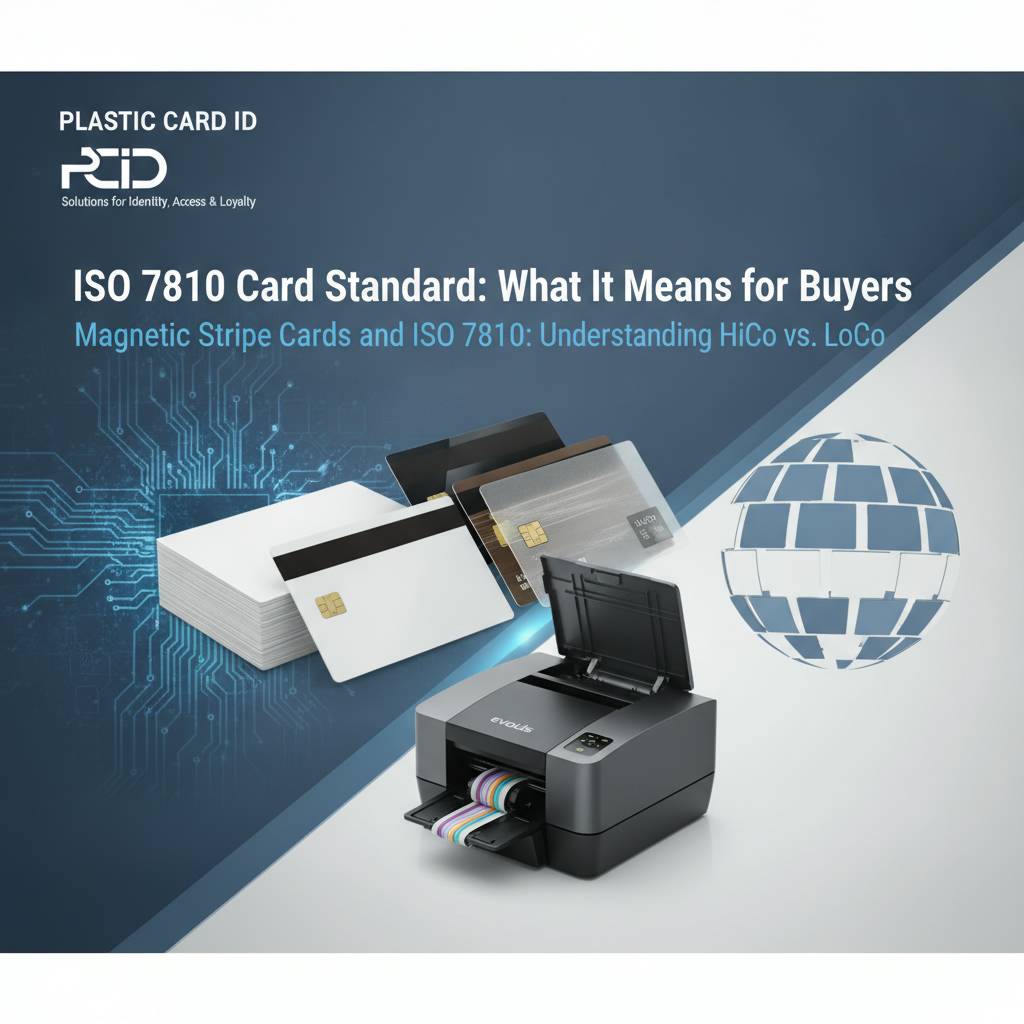
The magnetic stripe is laminated onto the card surface in a precise location defined by the standard - ensuring compatibility with the full ecosystem of card readers deployed across hotels, retail environments, gyms, and office facilities throughout the United States. Magnetic stripe cards combine the physical reliability of the ISO 7810 format with the functional power of encoded data storage.
HiCo vs. LoCo: Choosing the Right Stripe for Your Application
High-coercivity (HiCo) magnetic stripes are encoded at 2750 Oersteds, making them resistant to accidental erasure from everyday magnetic interference - such as proximity to other cards, phone cases with magnets, or routine wallet use. HiCo stripes are the right choice for cards that will be used repeatedly over months or years, such as employee access cards, loyalty cards, or hotel key card programs with extended stays.
Low-coercivity (LoCo) stripes are encoded at 300 Oersteds. They are easier to encode and re-encode quickly, making them well-suited for short-term use cases like event credentials, temporary visitor passes, or hotel keys that are issued for a single stay. Choosing between HiCo and LoCo is not a minor detail - it directly affects card lifespan and program reliability. Plastic Card ID supplies both formats, and the team can help buyers match the right stripe type to their specific operational needs. Reach out at 800.835.7919 for guidance.
How Magnetic Stripe Cards Support Loyalty and Gift Card Programs
Retailers and hospitality businesses that switch from paper-based programs to plastic magnetic stripe cards see measurable results. Retailers converting paper gift certificates to plastic gift cards routinely report sales increases in the range of 35-50%. The reason is straightforward: a plastic card looks and feels like something worth keeping. It lives in a wallet instead of a junk drawer. It gets used - and it gets shown to others.
Loyalty programs built on plastic magnetic stripe cards outperform paper punch card alternatives across virtually every metric: redemption rates, customer retention, average spend per visit, and program longevity. Physical cards create physical habits - and physical habits drive repeat business. The ISO 7810 CR80 format is the vehicle through which these results are delivered.
Encoding Capabilities and What They Mean for Card Programs
Magnetic stripe cards can carry a meaningful amount of data across three tracks. Track 1 holds alphanumeric data including names and account numbers. Track 2 is the most widely used track for machine-readable data in access and loyalty systems. Track 3 supports read/write operations. Understanding which tracks your card readers and software use ensures that your cards are encoded correctly from the start.
Organizations with card printers that include encoding modules can encode magnetic stripe cards directly at the point of printing - a capability that gives in-house card programs enormous operational flexibility. CPE offers a full lineup of encoding-capable printers alongside both HiCo and LoCo blank magnetic stripe cards, making it straightforward to build a complete, self-sufficient card program.
| Stripe Type | Coercivity | Best For | Durability |
|---|---|---|---|
| HiCo | 2750 Oe | Long-term loyalty, access, employee badges | High resistance to demagnetization |
| LoCo | 300 Oe | Hotel keys, event badges, short-term use | Lower resistance, ideal for short cycles |
RFID and Smart Chip Cards: Advanced Technology in the CR80 Format
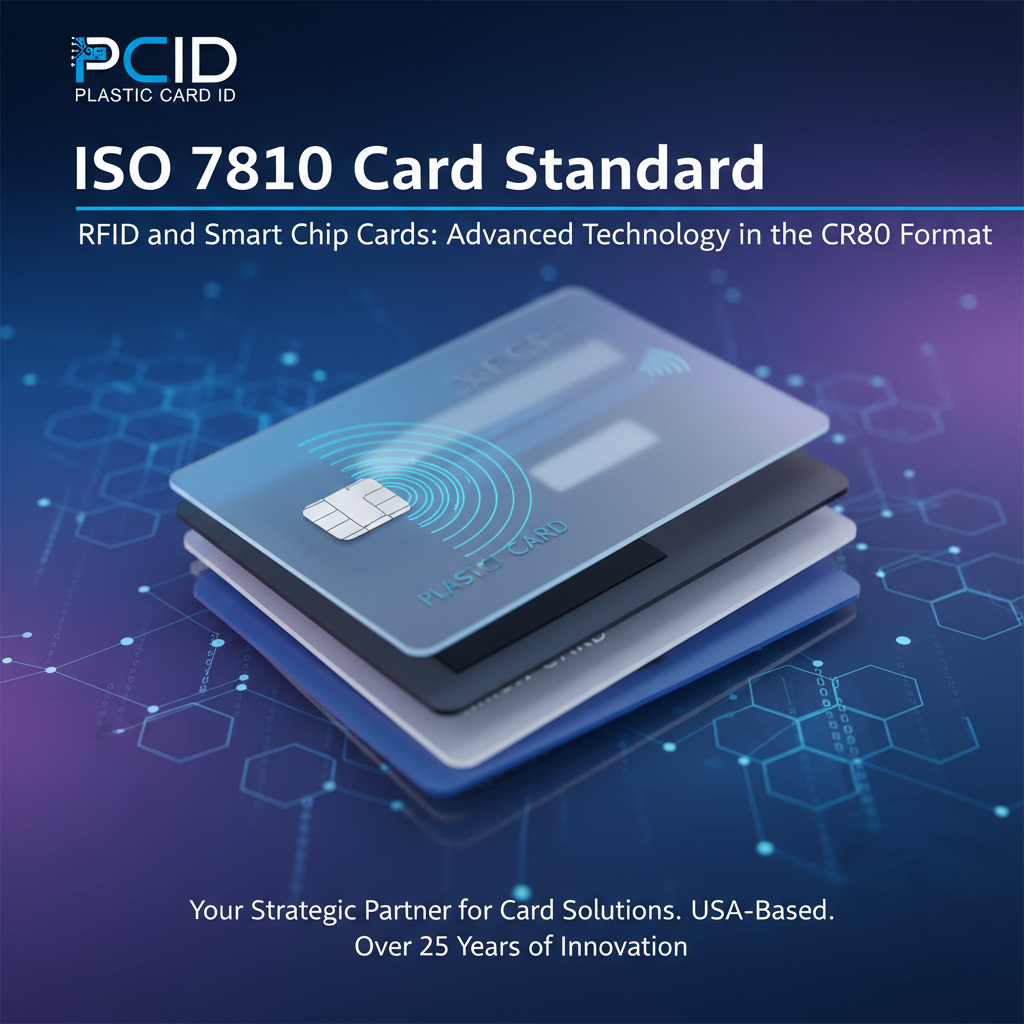 The ISO 7810 ID-1 format is not limited to simple printed or magnetically encoded cards. The same CR80 dimensions accommodate sophisticated contactless and contact-based smart card technologies - including RFID proximity cards and smart chip cards with embedded microprocessors. These advanced options bring powerful access control and data capabilities to the familiar card form factor.
For organizations managing access control, secure identity verification, cashless payment systems within closed environments, or casino player programs, the move from magnetic stripe to smart card technology can represent a significant upgrade in both security and functionality. The CR80 form factor makes this transition seamless - the card looks the same, but what it can do is dramatically expanded.
Proximity Cards and RFID for Access Control
Proximity cards use radio frequency identification technology to communicate with card readers without physical contact. Holding the card near a reader triggers authentication - a process that is faster, more hygienic, and less prone to wear than contact-based systems. These cards are widely used for office access control, parking facilities, campus security, and hotel door lock systems.
Plastic Card ID supplies a range of proximity and RFID cards including options with MIFARE DESFire technology - one of the most secure contactless smart card standards available for commercial access and transit applications. Organizations that require encrypted communication between card and reader will find MIFARE DESFire cards to be a robust and future-ready investment.
Smart Chip Cards and Closed-Loop Applications
Smart chip cards embed a microprocessor directly into the card body, enabling on-card data storage, processing, and cryptographic functions. In closed-loop environments - such as casino floors, corporate cafeterias, campus bookstores, or healthcare facilities - smart chip cards can serve as secure identity tokens, stored-value cards, or multi-function access and payment instruments simultaneously.
Casino player cards represent one of the most sophisticated applications of smart card technology in the CR80 format. They track play history, reward points, and player preferences - creating a personalized experience that keeps players engaged and returning. Smart card technology transforms a simple piece of plastic into a powerful data-driven relationship tool.
Hotel Key Cards: A Specific and Important Use Case
Hotel key cards are a fascinating intersection of ISO 7810 compliance, magnetic stripe technology, and RFID capability. Properties that use magnetic stripe door locks require LoCo or HiCo encoded key cards - while newer smart lock systems use RFID key cards programmed at check-in. Either way, the card must meet precise dimensional and material standards to function reliably in door lock hardware used by every major hospitality brand.
CPE supplies hotel key cards in both magnetic stripe and RFID formats, with the ability to support properties of any size - from boutique hotels issuing a few hundred cards per month to large resorts cycling through tens of thousands of keys annually. The combination of ISO 7810 compliance and program-scale flexibility is what makes this possible without custom engineering on the property's end.
Buyer Tips: Frequently Asked Questions About the ISO 7810 Standard
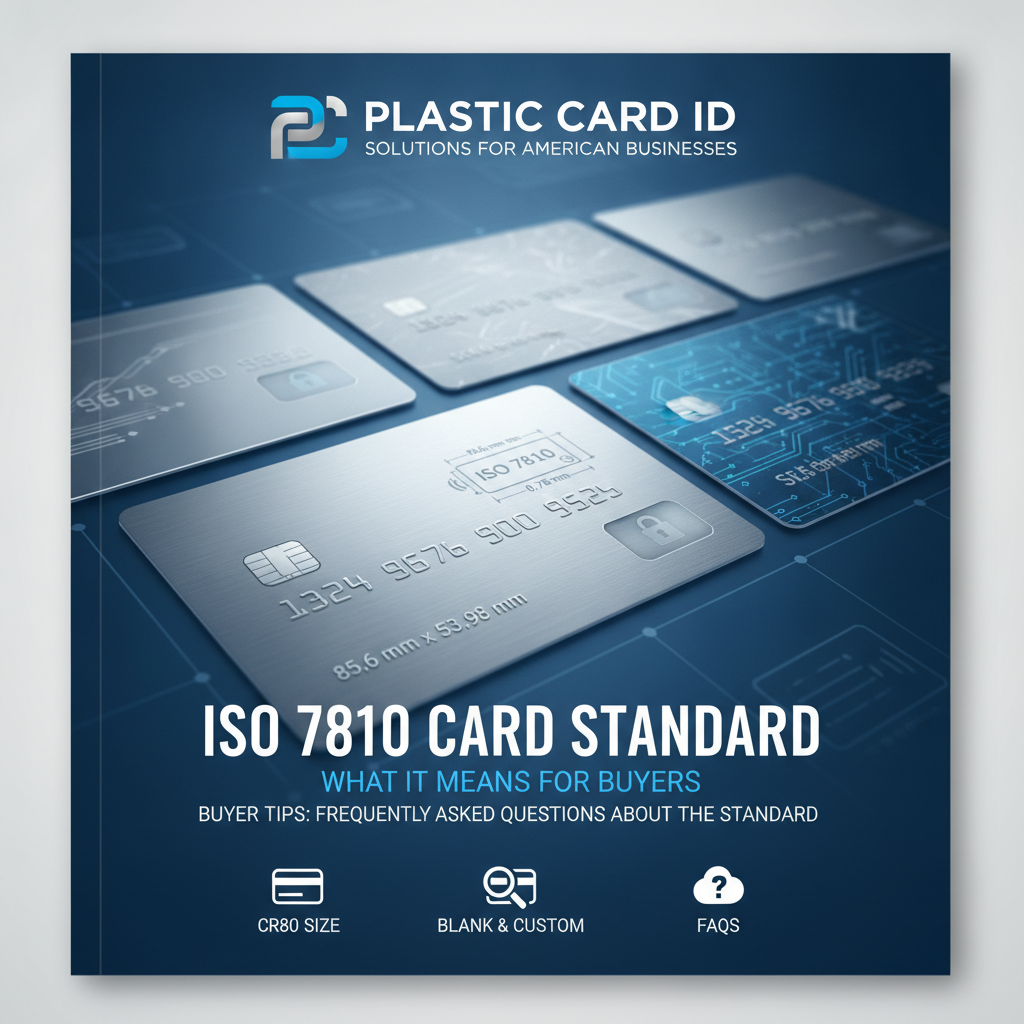 Buyers who are new to plastic card programs often arrive with similar questions. These questions matter because the answers directly affect card program performance, printer compatibility, and total cost of ownership. Here are the most common questions - answered with the clarity that Plastic Card ID brings to every client conversation.
Will Any CR80 Card Work in My Card Printer?
Almost certainly - with one important qualification. The card must meet the ISO 7810 ID-1 specification for dimensions and the 30 mil thickness standard. Off-specification cards - including bargain cards sourced from unreliable suppliers - may be fractionally thicker, thinner, or dimensionally inconsistent. These variations cause misfeeds, jam-prone print cycles, and premature printhead wear in Evolis, Zebra, and Fargo printers.
Sourcing ISO 7810-compliant cards is not about brand loyalty - it is about protecting your printer investment and your print quality. Every card supplied by Plastic Card ID is manufactured to specification, tested for printer compatibility, and backed by a supplier with 25 years of experience and over 50 million cards shipped to USA customers. Call 800.835.7919 to confirm compatibility with your specific printer model before ordering.
What Are the Most Common Card Types for Small Business Programs?
- Blank white PVC CR80 cards for in-house printing of employee badges, event credentials, and membership cards
- HiCo magnetic stripe cards for loyalty programs, gift card programs, and access control applications
- LoCo magnetic stripe cards for hotel keys, short-term visitor passes, and event wristband alternatives
- Proximity RFID cards for contactless access control in offices, warehouses, and facilities
- Colored PVC stock cards for visual differentiation between card tiers or departments without printing costs
- Clear and frosted PVC cards for premium loyalty or membership programs where visual design is a priority
Small businesses often start with blank white CR80 cards and a single-sided card printer, then expand into magnetic stripe encoding and RFID as their programs grow. CPE is structured to support that growth - with pricing that scales, and expertise that transfers at every stage of the program lifecycle.
How Does Card Thickness Affect Program Decisions?
The standard 30 mil thickness is the right choice for the vast majority of card programs. It is the thickness that wallets are designed for, that badge holders accommodate, and that card printers expect. However, some specialty applications use thicker or thinner cards. Laminated cards with overlaminates applied after printing can add a few mils of total thickness, which matters if those cards need to pass through readers with tight tolerances.
Card affixing programs - where cards are adhered to mailers or carrier sheets for direct mail distribution - may use slightly different card weights depending on the affixing method and postage requirements. Plastic Card ID offers card affixing and mailing services as part of a complete card program fulfillment solution, and the team can advise on thickness considerations specific to each delivery format.
The Full Plastic Card ID Catalog: One Source for Every Card Program Need
Running a card program without a reliable single-source supplier is genuinely inefficient. Managing separate vendor relationships for blank cards, printed cards, card printers, ribbons, cleaning kits, and card accessories introduces complexity, cost, and communication risk that compounds over time. Plastic Card ID was built specifically to eliminate that complexity - offering a complete catalog under one roof, with the expertise to match products to programs precisely.
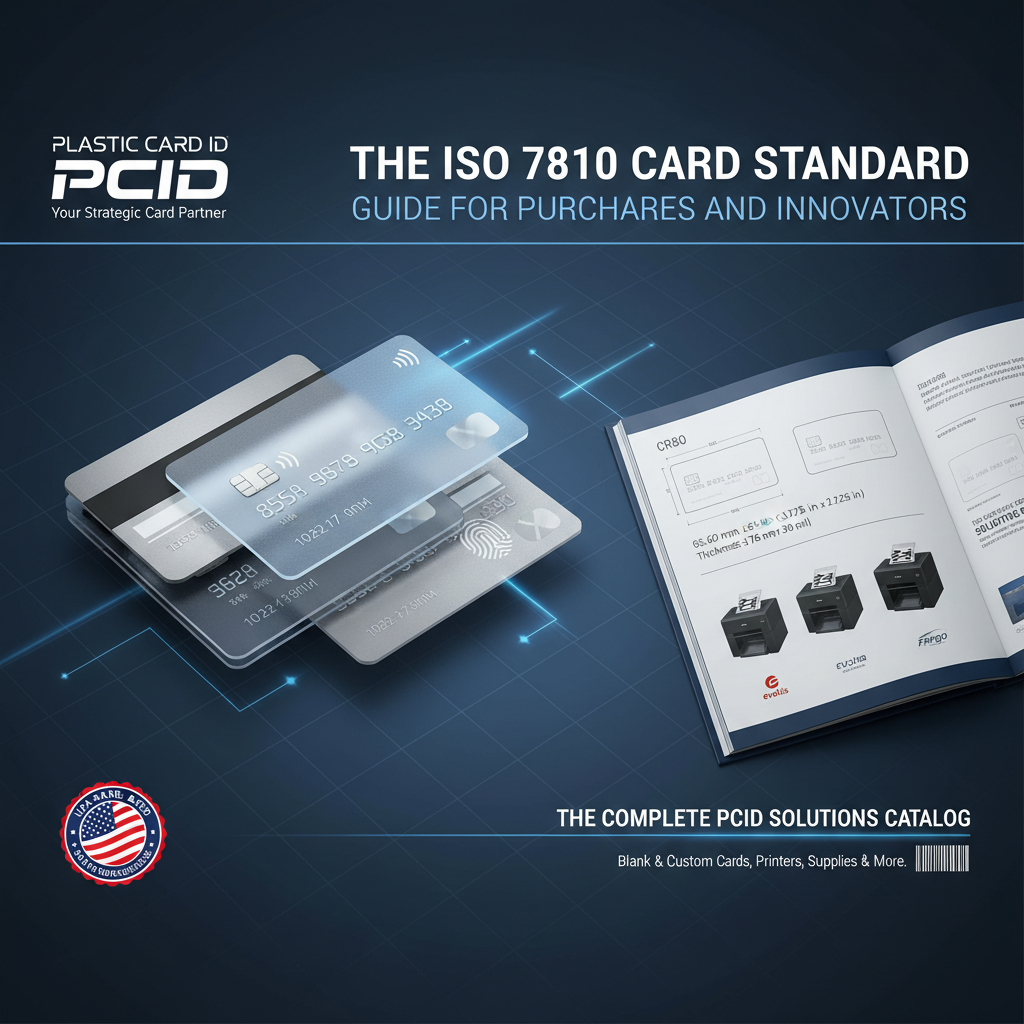
After 25 years and more than 100,000 customers served across the United States, the CPE catalog covers every segment of the plastic card market relevant to businesses and organizations. From commodity blank cards to luxury metal cards in stainless steel, brass, and gold - the range reflects the genuine diversity of card program requirements across industries.
Card Printers From the Industry's Leading Brands
A card program is only as capable as the printer behind it. Plastic Card ID supplies card printers from Evolis, Zebra, and Fargo - the three most respected names in the desktop and mid-volume card printing segment. Each brand brings different strengths: Evolis printers are known for compact design and ease of use; Zebra printers offer rugged reliability in demanding environments; Fargo printers are widely trusted for security-focused badge programs.
Choosing the right printer is as important as choosing the right cards - and the two decisions are deeply connected. Print volume, card type, encoding requirements, and single versus dual-sided printing all influence which printer delivers the best value for a given program. CPE's team matches buyers with the right hardware the first time, avoiding costly mistakes.
Ribbons, Cleaning Kits, and Program Accessories
A card printer without an adequate supply of ribbons is simply an expensive paperweight. Ribbons are consumables that define print quality, color accuracy, and card durability. Plastic Card ID supplies printer ribbons for all supported printer models - including YMCKO full-color ribbons, monochrome ribbons, and specialty overlay ribbons that add a protective topcoat to extend card life in high-contact environments.
Printer cleaning kits are equally important. Regular cleaning cycles remove debris, dust, and residue from printheads and card transport rollers - the two most wear-prone components in any card printer. Neglecting cleaning maintenance is the single most common cause of premature printer failure. Card sleeves and card carriers round out the accessories catalog, protecting finished cards during distribution and use.
Card Affixing, Mailing, and Fulfillment Services
For organizations running direct mail card campaigns - whether for loyalty program launches, gift card promotions, or membership renewals - the ability to have cards affixed to mailers and dispatched without managing the logistics in-house is a significant operational advantage. Plastic Card ID offers card affixing and mailing services that turn a card order into a complete, delivered campaign with minimal internal effort required from the buyer.
This service is particularly valuable for seasonal gift card promotions, annual membership renewals, and new customer acquisition campaigns where timing precision matters and mailing volume is substantial. Outsourcing card fulfillment to a supplier who already understands your cards is a smarter, faster path than building the capability from scratch. Call 800.835.7919 to discuss fulfillment options for your next campaign.
Ready to Build a Smarter Card Program? Start With Plastic Card ID
 The ISO 7810 standard is the invisible foundation beneath every effective plastic card program in the United States. Understanding it means understanding why card quality, dimensional precision, and supplier reliability matter - not as abstract specifications, but as practical factors that determine whether your program runs smoothly or struggles under the weight of avoidable problems.
Plastic Card ID brings together 25 years of expertise, a complete product catalog, and a genuine commitment to helping USA-based businesses run card programs that deliver real results. Whether you are launching a new loyalty program, upgrading an access control system, or scaling an existing card operation, the right partner makes every step faster, simpler, and more effective.
Contact Plastic Card ID today at 800.835.7919 - and put 25 years of card program expertise to work for your business.
Previous Page