ISO Standard Plastic Card Thickness: 30 Mil vs 20 Mil
Table of Contents []
- What Your Card Thickness Says About Your Business: Plastic Card ID Explains 30 Mil vs 20 Mil
- Understanding the ISO 7810 Standard and Why 30 Mil Dominates
- The Case for 20 Mil Cards: Genuine Uses That Make Sense
- Specialty Card Formats and Thickness Considerations
- Building a Smart In-House Card Program Around the Right Stock
- Serving Every Scale: From 50 Cards a Month to Mass Production
- Ready to Get Your Card Specifications Right? Plastic Card ID Is the Call to Make
What Your Card Thickness Says About Your Business: Plastic Card ID Explains 30 Mil vs 20 Mil
 Here is something most people never think about until they are holding a flimsy card that bends, scuffs, and quietly embarrasses their brand every time a customer pulls it out of their wallet. Card thickness is not a technical footnote. It is a statement. The moment someone holds your membership card, loyalty card, or employee badge, they form an impression - and that impression is shaped in part by how the card feels in their hand.
At Plastic Card ID, we have spent more than two decades watching businesses make this decision - sometimes well, sometimes not. With over 50 million cards shipped to more than 100,000 customers across the United States, we have developed a clear perspective on when each thickness makes sense, what the tradeoffs look like in the real world, and how to build a card program that does not leave money on the table.
| Feature | 30 Mil (CR80 Standard) | 20 Mil (Thin Card) |
|---|---|---|
| Thickness | 0.030 inches | 0.020 inches |
| ISO 7810 Compliant | Yes (ID-1 standard) | No |
| Wallet Compatible | Yes - standard slot fit | Looser, may shift |
| Card Printer Compatible | Yes - all standard models | Limited - check specs |
| Best Use Cases | ID badges, loyalty, membership, access, gift cards | Mailers, inserts, temporary passes |
| Perceived Quality | High - rigid, professional feel | Moderate - noticeably lighter |
| Cost Per Card | Slightly higher material cost | Lower material cost |
Understanding the ISO 7810 Standard and Why 30 Mil Dominates
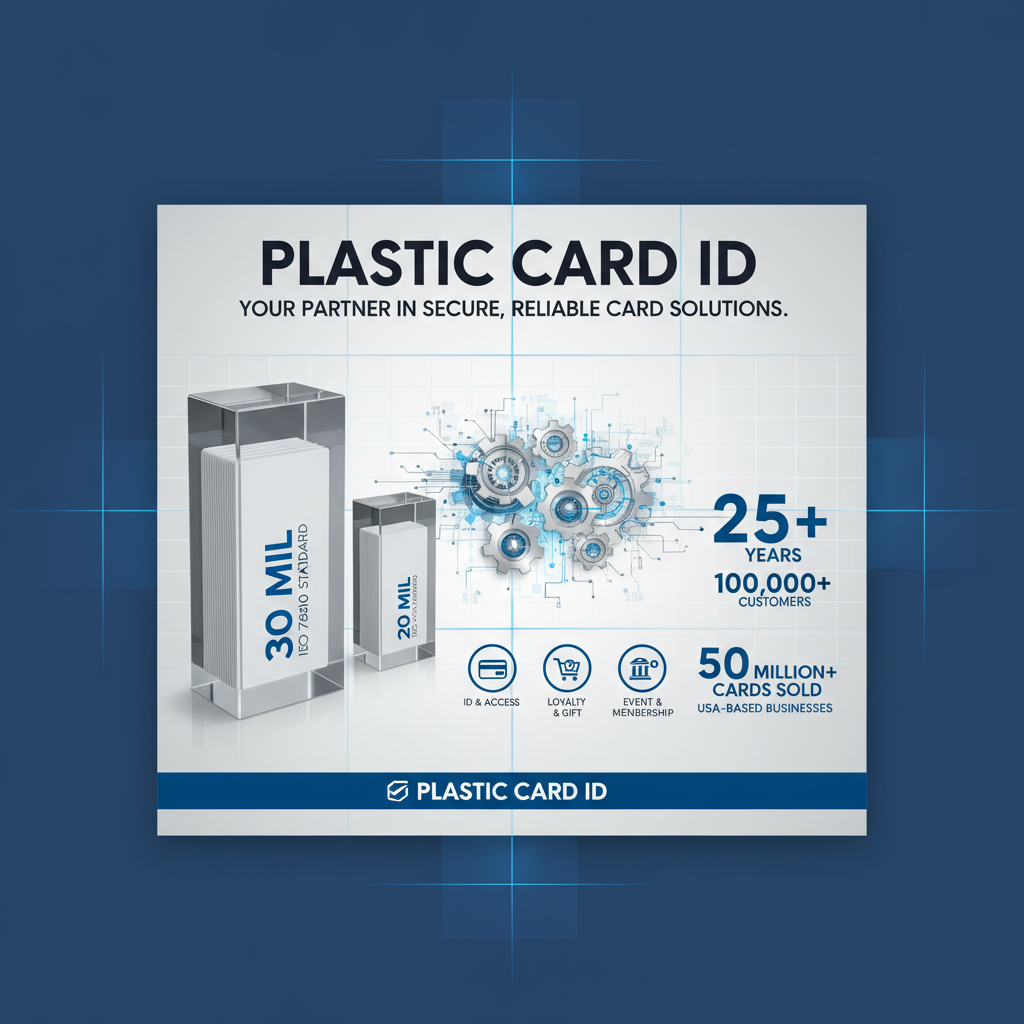 The ISO 7810 standard exists for a reason. When the international community agreed on a universal card size and thickness, they landed on what we call the CR80 format: 3.375 inches by 2.125 inches, at exactly 30 mil (0.030 inches) thick. That is not arbitrary. It is the result of engineering a card that fits ATMs, card readers, badge holders, and wallet slots around the world without friction or failure.
The 30 mil CR80 card is the workhorse of virtually every serious card program in the United States. Whether you are issuing employee IDs at a 20-person office or running a loyalty program across 300 retail locations, this is the format that printers are calibrated for, that laminate is designed to bond to, and that customers expect to feel when they pull your card from their wallet. Deviate from it without a specific reason, and you create friction where none should exist.
What "30 Mil" Actually Means in Practice
A mil is one-thousandth of an inch. So 30 mil equals 0.030 inches - roughly the thickness of a standard credit card. That may sound minor, but in the world of card printing and access control, that measurement is load-bearing. Cards that fall outside it can jam printers, misread in card readers, and fail to seat properly in standard badge holders.
When clients call CPE asking why their existing cards are causing print problems, the thickness mismatch is often the culprit. A card that is even slightly off can cause the print head to apply uneven pressure, leading to streaks, skips, or incomplete encoding on magnetic stripes. Precision in card thickness is not pedantic - it is operational.
How Card Thickness Interacts with Card Printers
Every card printer from Evolis, Zebra, and Fargo - the three leading brands carried by Plastic Card ID - is engineered around the 30 mil standard. Their feeder mechanisms, print heads, encoding modules, and output trays are all calibrated to handle cards within a tolerance of plus or minus two mils. A 30 mil card moves through cleanly. A 20 mil card may wobble, misalign, or trigger error codes.
This matters enormously for organizations running in-house card printing operations. If your printer is a Zebra ZC300 or a Fargo HDP5000, your card stock needs to match the printer's spec sheet. Running the wrong thickness is not just a quality issue - it can void your printer warranty and create costly downtime. Contact us at 800.835.7919 before purchasing card stock if you have any doubt about compatibility.
The Rigidity Factor: Why Stiffness Signals Professionalism
There is a psychological dimension to card rigidity that rarely gets discussed but always gets felt. When someone receives a card that has a satisfying snap to it - that slight resistance when you try to flex it - they subconsciously register it as quality. A card that bends too easily reads as cheap, even if the design printed on it is beautiful. This is not subjective opinion; it is backed by customer behavior research in retail contexts.
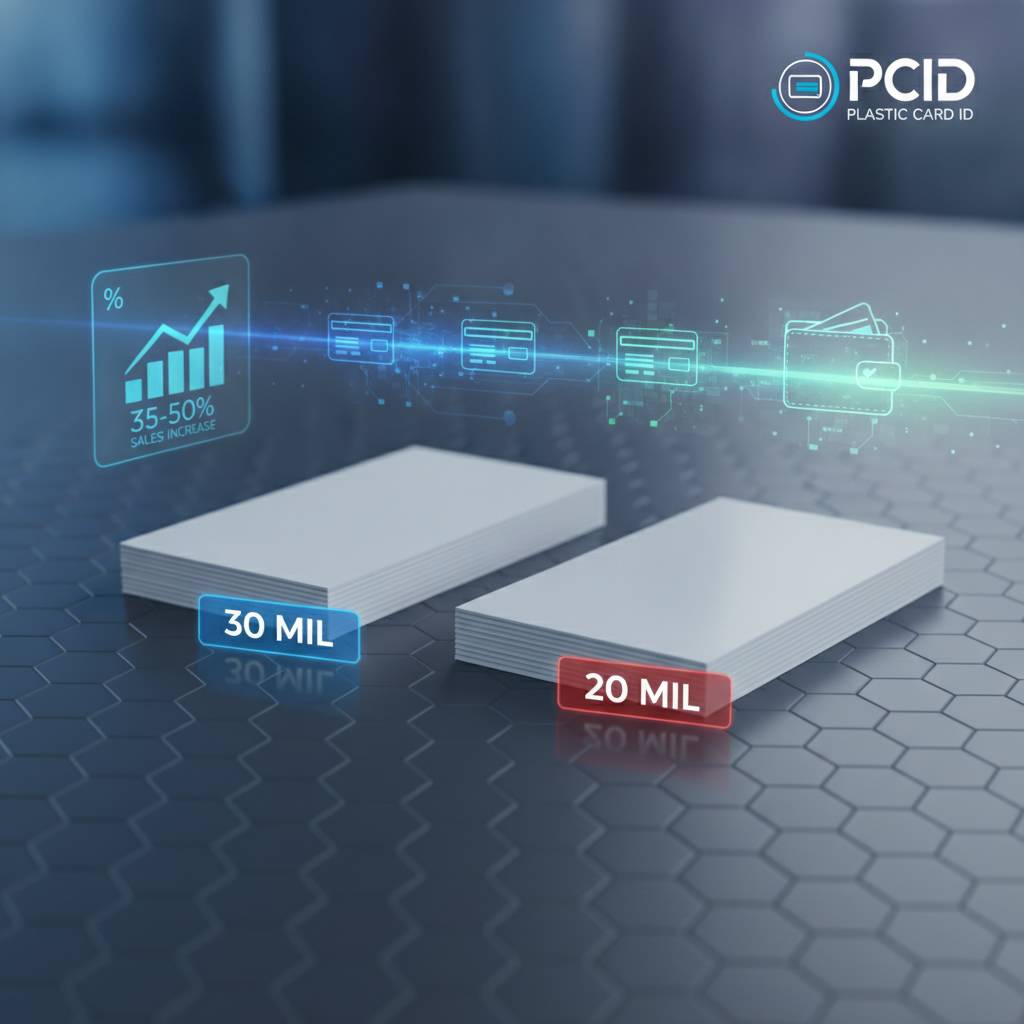
Retailers who switched from paper punch cards or thin plastic alternatives to standard 30 mil loyalty cards have reported sales increases ranging from 35 to 50 percent. The card itself becomes part of the brand experience. Customers who carry a stiff, well-made loyalty card are more likely to use it, remember it, and associate the issuing business with reliability and care.
The Case for 20 Mil Cards: Genuine Uses That Make Sense
It would be misleading to dismiss 20 mil cards entirely. They exist for real reasons, and in specific applications, they genuinely outperform their thicker counterparts. The key is knowing the difference between a legitimate use case and a cost-cutting impulse dressed up as a strategic decision.
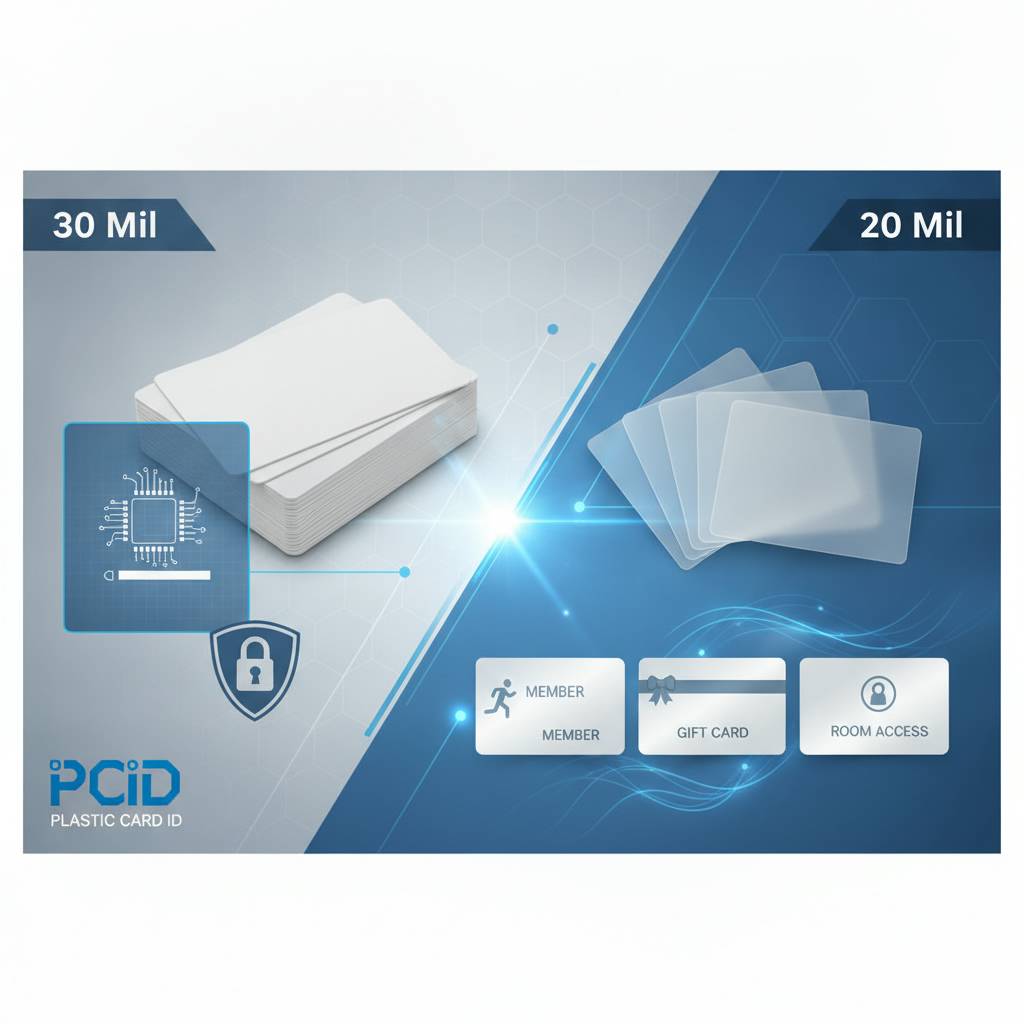
Twenty-mil cards are lighter, more flexible, and less expensive per unit to produce. For applications where a card is meant to be used briefly and then discarded - or where it needs to be mailed flat in a standard envelope without triggering additional postage thresholds - that flexibility becomes an actual feature rather than a compromise. CPE helps clients think through these decisions honestly, because the wrong card for the job costs more in the long run than any per-card savings.
Direct Mail Inserts and Temporary Passes
Imagine a hotel sending pre-arrival communication to guests, tucking a thin card into a tri-fold mailer. Or a theater company mailing event passes for a single-night performance. In both cases, the card's job is to be received, presented once, and replaced. Permanence is not the goal. Here, 20 mil cards do exactly what they need to do without the added material weight of a standard CR80.
Similarly, event organizers running single-day conferences or trade shows sometimes use 20 mil cards as temporary credential holders - lanyards are often designed to accommodate them, and the cards never need to survive more than eight hours of use. When permanence is not the point, thickness is not the priority. Understanding that distinction is half the battle in building a smart card program.
Mailer Card Programs: Thickness, Postage, and Logistics
The US Postal Service has specific thickness requirements for letter-rate mailing. Cards inserted into standard envelopes that push the total package past certain dimensions can trigger flat-mail rates - a potentially significant budget line item for programs mailing hundreds of thousands of pieces annually. For these scenarios, 20 mil cards can keep mailing costs predictable and contained.
That said, even in mailer programs, many organizations ultimately choose 30 mil cards because recipients keep them longer. A 30 mil gift card or loyalty card that arrives in the mail gets tucked into a wallet. A 20 mil version is more likely to end up in a junk drawer or discarded with the envelope. The card that gets kept is the card that works.
Membership and Loyalty Programs: A Side-by-Side Reality Check
Suppose you run a mid-sized gym and you are deciding between 20 mil and 30 mil membership cards. The 20 mil option saves you perhaps $0.03-$0.08 per card. Over 2,000 members, that is a maximum savings of $160. Now consider that a 30 mil card will outlast a 20 mil card by years under daily use conditions, reducing replacement card costs substantially. The math rarely favors going thin on cards that members carry regularly.
The loyalty card that lives in someone's wallet and gets swiped at the checkout counter needs structural integrity. It gets bent, rubbed, and compressed repeatedly. A 30 mil PVC card handles that abuse. A 20 mil card develops micro-cracking, surface wear, and edge damage that can cause magnetic stripe read errors within months. Durability is not a luxury in an active loyalty program - it is a cost-control strategy.
| Application | Recommended Thickness | Notes |
|---|---|---|
| Employee ID Badges | 30 Mil | Required for badge holders and most printers |
| Loyalty Cards (wallet-carried) | 30 Mil | Daily use demands durability |
| Gift Cards | 30 Mil | Standard retail display rack compatible |
| Access Control / RFID | 30 Mil | Chip/antenna requires standard housing |
| Mail-In Inserts | 20 Mil | Postage and envelope compatibility |
| Single-Day Event Passes | 20 Mil | Short-term use, cost efficiency makes sense |
Specialty Card Formats and Thickness Considerations
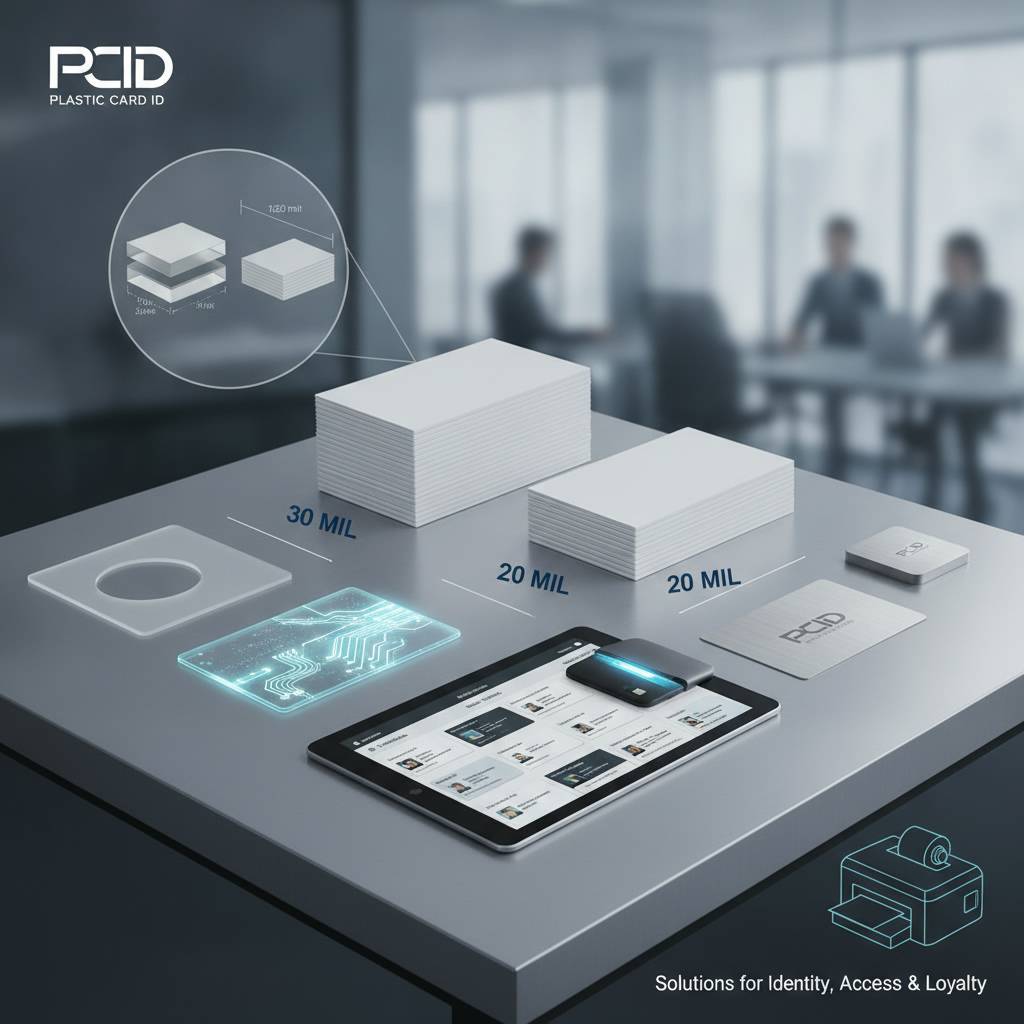 Not every card fits into the 30-or-20 binary. Plastic Card ID carries a range of specialty card formats where thickness interacts with materials and technology in ways that require a more nuanced approach. Clear cards, frosted cards, metal cards, and smart chip cards each come with their own set of specifications that can affect both how the card is manufactured and how it performs in the field.
RFID and proximity access cards, for example, embed an antenna and microchip between layers of PVC laminate. The resulting card typically lands at or near the 30 mil standard, but the internal construction is fundamentally different from a blank PVC card. The chip housing and antenna coil must be protected by the surrounding material, which means that deviating from standard thickness specifications can compromise read range, data integrity, and physical durability simultaneously.
RFID Smart Cards and the Physics of Proximity
A proximity card that is too thin risks exposing its internal antenna to physical stress. Repeated flexing - the kind a card endures in a wallet or when being tapped against a reader - can cause micro-fractures in the antenna wire. Once that antenna breaks, the card becomes a useless piece of plastic. The 30 mil form factor is not just a standard - it is a protective shell for the technology inside.
For organizations running access control systems using MIFARE DESFire, HID proximity cards, or similar contactless technologies, Plastic Card ID sources cards that meet the dimensional and material specifications required for long-term reliability. We serve facilities managers, corporate security teams, hotel operators, and university campuses who cannot afford card failures at the door. Reliability is not optional in access control.
Clear and Frosted Plastic Cards: A Different Kind of Specification
Clear and frosted PVC cards are among our most popular specialty offerings - particularly for clubs, boutique retailers, and hospitality brands that want a distinctive look. These cards are manufactured to the same 30 mil standard as opaque white cards, but the printing and lamination process differs significantly. Without the white base layer, colors appear differently, and certain printing techniques require adjustment to achieve the intended visual result.
The thickness specification matters here for a practical reason as well. Clear cards are often used in applications where the cardholder can see through them - displaying an underlying insert, for instance, or creating a visual layering effect. If the card deviates in thickness, laminates may bubble or peel. Consistency in material spec is what keeps specialty cards performing and looking exactly as intended.
Metal Cards: When Thickness Takes on a New Meaning
Luxury metal cards in stainless steel, brass, or gold occupy a different category entirely. These are not measured in mils the way PVC cards are - they are typically heavier and thicker overall, and they serve a distinct purpose: communicating exclusivity and permanence to the recipient. Casino VIP programs, private membership clubs, and premium brand experiences use metal cards as intentional artifacts, objects meant to be kept and displayed rather than simply carried.
Metal cards from Plastic Card ID are custom-crafted to client specification and are incompatible with standard card printers - they are finished products, not blank stock. Understanding this distinction matters when planning your program. If your goal is to issue 50 ultra-premium cards per year to your highest-tier clients, metal is a compelling option. If you need to print thousands of cards in-house each month, a 30 mil CR80 blank with a quality card printer is your architecture. Call us at 800.835.7919 and we will help you map the right solution to your specific program requirements.
Building a Smart In-House Card Program Around the Right Stock
 In-house card printing is one of the most powerful moves an organization can make for its card program. Rather than waiting on print runs, paying minimum order premiums, or being locked into a design that needs to change, you print what you need, when you need it, exactly as specified. But that flexibility only works if your card stock is right.
Blank CR80 cards at 30 mil are the foundation of every successful in-house card program. They are the raw material that becomes an employee badge when you print a photo and encode a magnetic stripe, or a loyalty card when you add a barcode, or an event credential when you print a name and date. The card itself is neutral potential. Your printer, your ribbon, and your design software are what shape it into something specific and functional.
Choosing Between HiCo and LoCo Magnetic Stripes
Magnetic stripe cards come in two variants that matter operationally: HiCo (high coercivity) and LoCo (low coercivity). HiCo stripes are harder to accidentally erase - they resist interference from everyday magnetic sources like bag clasps and phone cases. LoCo stripes are easier to encode and re-encode, making them useful for hotel key cards or temporary access passes that are reset between guests.
For loyalty programs, employee IDs, and membership cards intended to last months or years, HiCo is almost always the right call. The data encoded on a HiCo stripe will survive normal daily use without degradation. CPE supplies both variants in standard 30 mil CR80 format, compatible with all major card printer brands. Choosing the right stripe from the start prevents costly reprinting later.
Card Program Essentials: Ribbons, Cleaners, and Carriers
A card program is only as reliable as its maintenance regimen. Card printers accumulate dust, debris, and residue from card stock over time. Without regular cleaning using proper cleaning kits, print quality degrades, encoding errors increase, and printer lifespan shortens. Plastic Card ID supplies cleaning kits specifically matched to Evolis, Zebra, and Fargo printers so customers are never guessing about compatibility.
Printer ribbons similarly need to match both the printer model and the card stock being used. A ribbon calibrated for glossy laminated cards will perform differently on matte or frosted stock. Card carriers and sleeves protect finished cards during distribution - a small investment that prevents fingerprints, scratches, and surface contamination from undermining the quality of cards your team just spent time producing.
Frequently Asked Questions About Card Thickness
- Can I run 20 mil cards through my Zebra or Fargo printer? Possibly, but it depends on the specific model. Most standard card printers are calibrated for 30 mil stock. Running thinner cards can cause misfeeds, print misalignment, and encoding errors. Always verify compatibility before ordering card stock.
- Will 30 mil cards fit in standard wallet slots? Yes. The 30 mil CR80 format is the exact thickness of every credit card, debit card, and ID card in your wallet right now. It is the universal standard.
- Is there a noticeable difference in how 30 mil and 20 mil cards feel? Absolutely. Hold them back-to-back and the difference is immediately apparent. The 30 mil card has the satisfying rigidity of a professional credential. The 20 mil card is noticeably more flexible.
- Do RFID and smart chip cards come in 30 mil? Yes. The embedded technology is housed within the standard 30 mil card body. The chip and antenna layers are laminated into the card during manufacturing without affecting the outer dimensions.
- What is the price difference between 20 mil and 30 mil cards? Generally in the range of $5-$30 per 500-card pack depending on features. When amortized across the life of the card, the cost difference is negligible for most programs. CPE can provide current pricing on request.
Serving Every Scale: From 50 Cards a Month to Mass Production
Plastic Card ID does not have a minimum order that prices out smaller organizations. Whether you need 50 blank cards a month for a local gym membership program or 50,000 cards for a regional retail loyalty rollout, the same expertise, the same quality standards, and the same commitment to getting the specification right applies. This is by design - because the businesses that start small and scale are the clients we build the longest relationships with.

Over 100,000 customers have relied on CPE to supply their card programs over the years. Many of them started with a single box of blank CR80 cards and a desktop card printer. Today, some of them are running enterprise-scale programs with encoding, card affixing, and direct mail fulfillment handled right alongside production. The ability to grow into a card program without switching suppliers is a genuine operational advantage.
Value-Added Services That Extend What Cards Can Do
Beyond card stock and printers, Plastic Card ID offers card affixing and mailing services - a capability that transforms a card order into a complete direct marketing deployment. Rather than receiving a box of finished cards and then managing the stuffing, addressing, and mailing internally, clients can hand off the entire process. Cards go from production to mailbox without the client ever touching them.
Card carriers and sleeves are not just protective packaging - they are presentation tools. A loyalty card nestled in a branded carrier, mailed directly to a new customer with a welcome message, creates an entirely different first impression than a card handed across a counter. These details shape how recipients engage with the program from day one. The way a card arrives matters almost as much as the card itself.
Casino, Hospitality, and Institutional Programs
Certain industries operate card programs at scales and with technical requirements that demand specialized knowledge. Casino player tracking cards must encode seamlessly with proprietary loyalty platforms. Hotel key cards must reset cleanly between guests and survive the physical abuse of pocket and purse daily. University access cards must interoperate with building management systems, dormitory locks, and cafeteria readers simultaneously.
These are not scenarios where a generic supplier with a catalog and a checkout button will serve you well. Plastic Card ID brings 25 years of institutional knowledge to these conversations - understanding the technical requirements, the encoding protocols, and the physical specifications that make these programs work. We are a strategic partner in the truest sense, not just a card vendor.
Ready to Get Your Card Specifications Right? Plastic Card ID Is the Call to Make
 Card thickness is one of those decisions that seems small until it is not. Choose wrong, and you are dealing with printer jams, failed card reads, premature wear, or customer-facing cards that simply do not feel like they represent your brand properly. Choose right - 30 mil CR80 for virtually every serious card program - and you have laid a foundation that everything else can build on.
Plastic Card ID has been helping businesses across the United States make exactly this kind of decision for over 25 years. Our catalog covers blank PVC cards, magnetic stripe cards, RFID and proximity cards, smart chip cards, clear and frosted specialty formats, luxury metal cards, and every card printer, ribbon, cleaning kit, and accessory you need to run a program from start to finish. We are not a catalog - we are a partner.
Call 800.835.7919 to speak with a card specialist. Whether you are building a new program from scratch or optimizing an existing one, Plastic Card ID has the experience, the inventory, and the commitment to get it right - every card, every time.