Security Features Available on Blank Plastic Cards Explained
Table of Contents []
- What Plastic Card ID Knows About Security Features on Blank Plastic Cards
- Why Security Starts at the Card Material Itself
- Magnetic Stripe Cards: HiCo vs. LoCo Security Considerations
- RFID and Smart Chip Cards: The High-Security Tier
- Visual Security Features That Work in the Real World
- Choosing the Right Security Stack for Your Card Program
- Frequently Asked Questions About Security Features on Blank Plastic Cards
- Work With Plastic Card ID to Build a Secure Card Program That Lasts
What Plastic Card ID Knows About Security Features on Blank Plastic Cards
 Most people assume a blank card is just a starting point - a clean slate waiting for a logo and a name. But that thinking undersells what modern blank plastic cards can actually do before a single drop of ink is applied. The security architecture baked into a card at the manufacturing stage is often what separates a program that holds up under real-world pressure from one that gets exploited, duplicated, or abused within months of launch.
Plastic Card ID has spent over 25 years supplying blank and custom plastic cards to businesses, nonprofits, schools, casinos, hotels, and government-adjacent organizations across the United States. In that time, serving more than 100,000 customers and moving upward of 50 million cards, one truth keeps surfacing: the security features you choose at the card level define the entire program's integrity. This page breaks that down completely.
| Security Feature | Card Type | Best Use Case | Difficulty to Duplicate |
|---|---|---|---|
| Magnetic Stripe (HiCo) | CR80 PVC | Access control, loyalty, hotel keys | Moderate |
| RFID / Proximity Chip | Smart Card | Building access, time-tracking | High |
| MIFARE DESFire Encryption | Smart Card | Casino players clubs, secure ID | Very High |
| Holographic Overlaminates | CR80 PVC | Membership, employee ID | High |
| UV / Fluorescent Ink | CR80 PVC | Event credentials, ID cards | Moderate to High |
| Signature Panels | CR80 PVC | ID cards, membership | Low (visual deterrent) |
| Custom Die-Cut Shape | Specialty PVC | Brand differentiation, VIP cards | Moderate |
Why Security Starts at the Card Material Itself
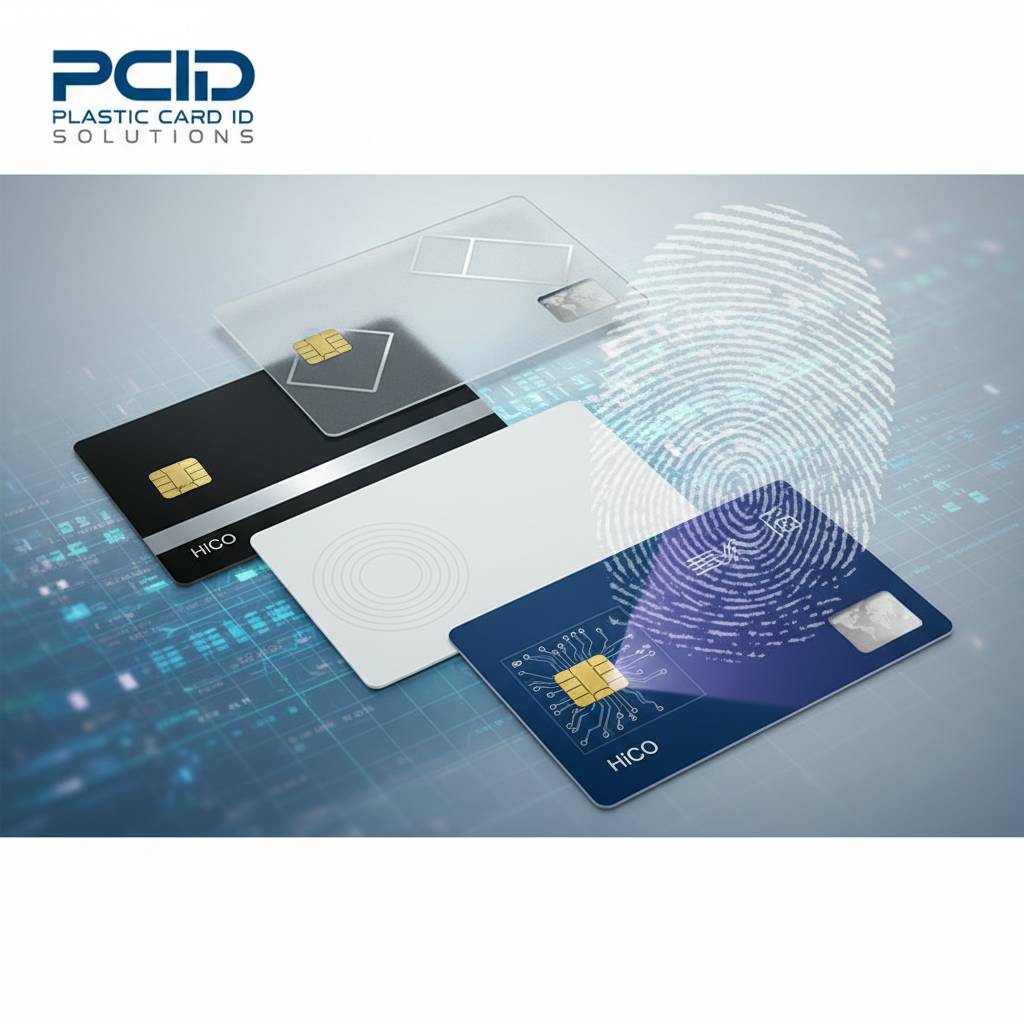 There is something almost counterintuitive about blank card security. The card has not been personalized yet - no name, no photo, no encoded data - and yet it may already carry multiple layers of protection. Durable 30 mil CR80 PVC construction, the ISO 7810 standard used worldwide, means the card resists bending, cracking, and casual tampering that would destroy paper-based alternatives in days. That physical resilience is the first and most fundamental security layer.
When CPE specifies cards with embedded security features at the blank stage, organizations get something invaluable: consistency across every card in a batch. Every access credential, every employee badge, every loyalty card starts from the same secure baseline. That matters enormously at scale. Buying 5,000 blank cards with integrated magnetic stripes or RFID chips means every single one of those cards carries identical, reliable technology before any printer or encoder ever touches them.
The Physical Durability Argument
PVC plastic at 30 mil thickness is not accidental. That specification exists because it mimics the dimensions of a standard credit card, fits every standard wallet slot and card reader on the market, and resists environmental stress that would compromise a paper or thin laminate alternative. A card that physically degrades is a card that can be manipulated at its edges, delaminated, or altered.
Physical integrity is itself a form of security. An ID badge that warps after a month in someone's back pocket introduces uncertainty into a verification workflow. Does the magnetic stripe still work? Is the photo still clearly visible? Blank CR80 cards from a quality supplier eliminate those questions from the start.
Card Substrate and Embedded Technology
Beyond the outer PVC layers, the substrate of a smart card or RFID card contains embedded antenna coils and integrated circuits that are physically impossible to replicate with consumer equipment. This embedded technology is non-negotiable for high-security environments. The chip is not printed on; it is molded in. Damage the card badly enough to extract the chip, and the chip no longer works.
That design philosophy - where the security feature and the card body are essentially one object - is what makes proximity cards and smart chip cards so attractive to organizations running access control programs. There is no "remove the sticker and transfer it" exploit available. The credential lives inside the card permanently.
Specialty Finishes as Visual Authentication
Clear and frosted plastic cards introduce an entirely different kind of security through visual uniqueness. A fully transparent CR80 card is immediately distinguishable from any standard white PVC card, making unauthorized substitution visually obvious. Frosted finishes add a tactile dimension that trained staff can verify by touch alone in high-traffic environments like event gates or building entrances.
Colored stock cards serve a similar segmentation function. When your organization uses specific colors to denote clearance levels, visitor status, or membership tiers, an off-color card is an instant red flag. This kind of visual security layer costs almost nothing extra but pays dividends in any environment where cards are checked quickly under real-world conditions.
Magnetic Stripe Cards: HiCo vs. LoCo Security Considerations
Ask anyone running a card program whether magnetic stripe technology is "still relevant" and the answer is almost always yes - particularly in the United States, where magnetic stripe readers remain ubiquitous in access control panels, time clocks, loyalty terminals, and hotel door lock systems. The question is not whether to use magnetic stripes; it is which kind, and how to use them securely.

High coercivity (HiCo) magnetic stripes are encoded at 4,000 oersteds of magnetic force, compared to the 300 oersteds of low coercivity (LoCo) stripes. That technical difference has real-world consequences. A HiCo stripe resists accidental erasure from proximity to common magnetic sources - smartphone cases, security tags, other cards - far more effectively than LoCo. For any card that will be carried daily and used repeatedly, HiCo is the only sensible choice.
Why HiCo Stripes Raise the Security Bar
The harder it is to accidentally alter encoded data, the harder it is to deliberately alter it with basic tools as well. HiCo stripes require specialized encoding equipment to write and rewrite, which means a casual skimming device or low-power encoder cannot easily overwrite the data already on the card. This is not an impenetrable defense, but it meaningfully raises the cost and complexity of any tampering attempt.
Organizations using HiCo magnetic stripe cards for access control benefit from this resistance to casual interference. An employee whose card is accidentally demagnetized by a common household item is an operational disruption; multiply that by hundreds of employees and you have a serious workflow problem. HiCo stripes reduce that risk substantially, which is why CPE consistently recommends them for professional card programs.
Layering Magnetic Stripe with Other Features
Magnetic stripes do not have to stand alone. Combining a HiCo stripe with a holographic overlaminate, for example, gives you encoded machine-readable security plus a visual anti-counterfeiting layer that is difficult to replicate without industrial printing equipment. For membership cards or employee ID programs, that combination hits a security threshold that satisfies most real-world threat models without exotic technology.
Many organizations also pair magnetic stripes with printed security elements - signature panels, sequential numbering, UV-reactive ink zones. None of these elements alone constitutes a complete security solution, but together they create a card that requires multiple simultaneous successes to forge. That layered approach is exactly how serious card programs protect themselves.
Encoding Practices That Reinforce Card Security
The encoded data itself can be part of the security strategy. Rather than encoding a simple readable employee ID number, sophisticated programs encode hashed or encrypted data strings that mean nothing without the corresponding software key. The card carries credentials; the system validates them. An intercepted card number is useless without the decryption layer on the back end.
Card printers from brands like Evolis, Zebra, and Fargo - all available through Plastic Card ID - support encoding workflows that allow organizations to implement these practices in-house. That means you are not shipping cards to a third party for encoding; you control the data, the timing, and the validation logic entirely within your own infrastructure.
RFID and Smart Chip Cards: The High-Security Tier
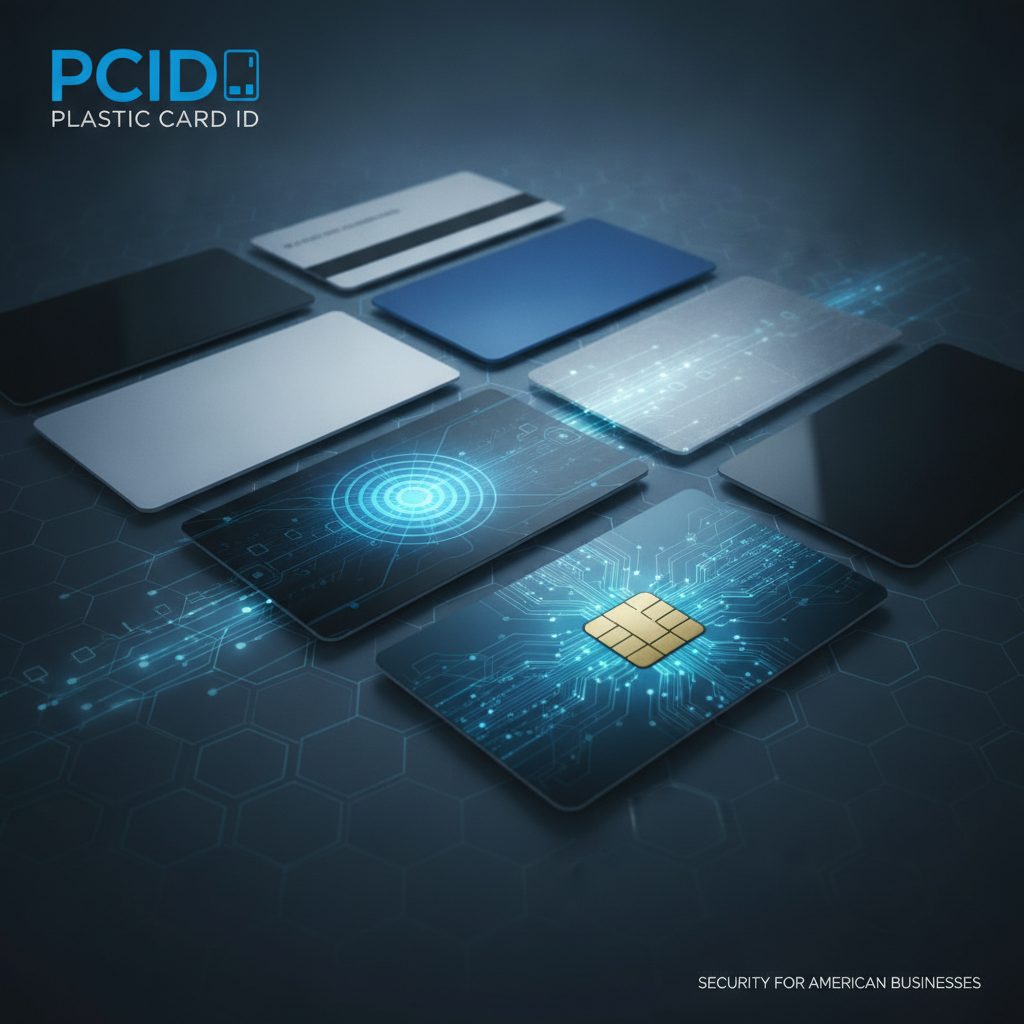 When magnetic stripe technology is not enough - and for high-value programs, it often is not - RFID and smart chip cards represent the next level of security architecture. These cards communicate wirelessly with readers, authenticate through encrypted protocols, and store significantly more data than a magnetic stripe could ever accommodate. For access control, time and attendance, casino player tracking, and identity verification, they are the industry standard.
Proximity cards operating at 125 kHz (the most common standard) use passive RFID technology: no battery, no moving parts, essentially no wear-out mechanism. They communicate with a reader at close range and transmit a unique identifier. The identifier itself can be programmed and reprogrammed at the system level, meaning a lost card can be deactivated without replacing the entire access control infrastructure.
MIFARE DESFire: Encryption Built Into the Card
MIFARE DESFire cards represent the current high-water mark for contactless card security in commercial applications. They use AES-128 or 3DES encryption for all read/write operations, meaning the data exchange between card and reader is cryptographically protected. Cloning a MIFARE DESFire card is not a casual undertaking - it requires knowledge of encryption keys that are stored in the card's secure memory and never transmitted in readable form.
Casinos, hospitals, university campuses, and corporate headquarters with serious physical security requirements commonly specify MIFARE DESFire technology. Plastic Card ID supplies these cards as part of a complete card program solution, and the team understands how to configure them for different deployment environments. If your threat model includes sophisticated adversaries - not just employees sharing badges - this is the technology level to be discussing.
Hotel Key Cards and Hospitality Security
Hotel key cards are a specialized RFID application where the security requirement is different from, say, corporate access control. Hotel cards are temporary credentials: they must work reliably for a guest's stay and then become inactive automatically. The card itself does not need to be physically recalled - the system simply stops recognizing it after checkout. That is a meaningful operational security advantage.
Blank hotel key cards are programmed at check-in using the property's own encoder and front desk software. Because the programming happens on-site and the cards are standard RFID blanks, the property maintains full control over their credential system. Lost key cards present minimal security risk because deactivation takes seconds from the front desk terminal.
Smart Cards for Identity and Access Control Programs
Contact smart chip cards - the kind with a visible gold or silver chip on the card face - store data on an integrated circuit that communicates when inserted into a chip reader. For identity programs requiring document-like reliability, smart chip cards provide a level of tamper evidence that magnetic stripes and even RFID cannot fully match. Physical damage to the chip is immediately visible and renders the card non-functional.
Organizations running government-adjacent ID programs, contractor credentialing systems, or multi-application card platforms often specify contact smart chips for exactly this reason. The chip can store biometric references, access permissions, time-limited credentials, and audit logs - all on a single card that fits in a standard wallet.
Visual Security Features That Work in the Real World
 Not every security threat requires a chip or an encoder to counter. Visual security features - elements that make a card visually distinctive, difficult to replicate, or easy for trained staff to authenticate quickly - remain essential components of any serious card program. They work in environments where readers are not available, where internet connectivity cannot be assumed, or where a quick visual check is all the situation allows.
Think about an event credential at a large conference. Thousands of attendees, dozens of entry points, staff who may have had two hours of training. Visual differentiation is your primary security tool in that scenario. Color coding by day, UV ink that glows under a handheld light, or a holographic overlay that catches ambient light differently than a plain card surface - these are the features that prevent badge sharing and unauthorized access at scale.
Holographic Overlaminates and Foil Elements
Holographic overlaminates are thin films applied over a printed card surface that produce a shifting, three-dimensional optical effect. They are extremely difficult to reproduce without specialized industrial equipment, and their visual complexity is immediately recognizable to trained staff. Many organizations treat the presence of a holographic element as a primary authentication signal - if the card does not shimmer correctly, it is suspect.
Custom holographic designs tied to a specific organization's branding further raise the replication bar. A generic holographic overlaminate is at least difficult to copy; a custom one specific to your conference, your membership organization, or your facility is essentially impossible to source without going through the original supplier.
UV and Fluorescent Ink Security Zones
UV-reactive ink prints invisibly under normal lighting but fluoresces brilliantly under ultraviolet light - the same technology used in currency authentication. For card programs, this means security information can be embedded on the card surface without cluttering the visible design. A logo, serial number, or validation mark printed in UV ink confirms authenticity for anyone with a UV flashlight without tipping off anyone who does not know to look.
Event credentials, employee ID cards, and membership cards all benefit from UV security zones. The cost addition is minimal; the deterrent effect is significant. And because most counterfeiters are targeting the easily observable elements of a card, an invisible feature they may not even know exists is often the one that catches them.
Signature Panels and Sequential Numbering
Signature panels are not high-tech, but they serve a genuine purpose. A card with a factory-applied signature panel - a slightly raised, chemically treated surface - is designed to show tamper evidence if altered. Attempts to erase, chemically strip, or re-sign a signature panel leave detectable marks. This is a low-cost, high-visibility deterrent for programs where card presentation and signature verification are part of the authentication workflow.
Sequential numbering, whether printed visibly or encoded magnetically, enables audit trails. If card number 4,372 is presented at a location that saw card 4,372 used 20 minutes ago across town, the system catches the anomaly. That kind of serialization is a fundamental security practice for any card program managing valuable access or privileges.
Choosing the Right Security Stack for Your Card Program
No single security feature is right for every program. The right combination depends on your threat model - who might try to exploit or duplicate a card and why - as well as your operational environment, your budget, and the technical capabilities of your staff and infrastructure. Getting this analysis right at the start saves significant money and frustration later, and it is exactly the kind of strategic conversation Plastic Card ID has been having with clients for over two decades.
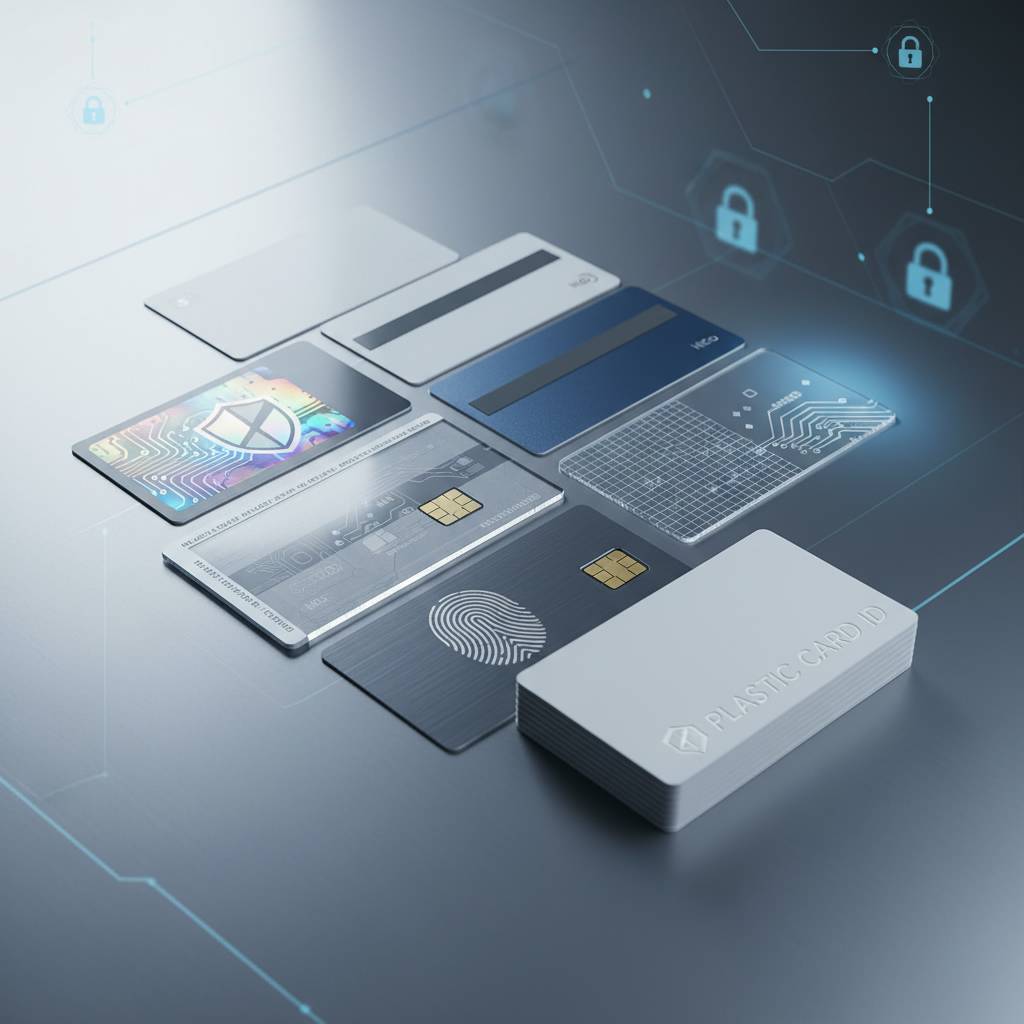
- Low-volume, low-risk programs (50-500 cards/month): Standard CR80 blank PVC with printed design, optional signature panel, colored stock for visual differentiation.
- Mid-tier programs with daily use and moderate access control needs: HiCo magnetic stripe, optional holographic overlaminate, sequential numbering.
- High-security programs - facilities, casinos, healthcare: Proximity RFID or MIFARE DESFire smart cards, combined with printed security elements for visual authentication backup.
- Event and temporary credential programs: UV ink, color coding by day or tier, clear or frosted stock for visual distinctiveness.
- Hotel and hospitality: Blank RFID hotel key cards encoded on-site for maximum operational control and fast deactivation.
- Luxury and VIP programs: Metal cards in stainless steel, brass, or gold finishes - the physical weight and material composition alone are extremely difficult to replicate.
For organizations printing and encoding cards in-house, the card printer you select matters as much as the card itself. Evolis, Zebra, and Fargo printers - all available through CPE - each offer different capabilities in terms of encoding support, printing resolution, lamination options, and throughput. Matching your card stock to your printer's specifications ensures that the security features perform exactly as designed.
Scaling Security Across Large Card Programs
When production volumes climb into the tens of thousands, consistency becomes its own security concern. Every card in a batch of 20,000 needs to behave identically - same stripe coercivity, same chip response time, same visual finish. Manufacturing variance at scale can introduce security gaps that individual-card testing would never catch. Sourcing from a supplier with proven quality control at volume is not optional; it is foundational.
Plastic Card ID has fulfilled large-scale orders for organizations ranging from regional retail chains to hotel groups to university systems. The infrastructure for quality-controlled bulk production at that scale is not something assembled overnight - it is built over 25 years of continuous operation and client feedback. For large programs, that track record matters.
Working With a Card Program Partner
The difference between buying cards from a commodity supplier and working with CPE as a strategic partner is the depth of conversation that happens before the order is placed. What are your access control readers currently compatible with? What is your anticipated card replacement cycle? Do you need card affixing and mailing services, or do you distribute in person? These questions shape the card specification, and getting them right the first time eliminates costly reprints, incompatible hardware, and security gaps discovered after deployment.
Value-added services - printer ribbons, cleaning kits, card carriers, sleeves, and card affixing and mailing - mean that a full card program can be sourced from a single relationship. That operational simplicity has real value, particularly for organizations without a dedicated procurement department. One supplier, one point of contact, one conversation when something needs to change.
Contacting the Team Directly
For specific technical questions about card security features, compatibility with existing readers, or recommendations for a new program, speaking directly with a knowledgeable representative is always the fastest path to an accurate answer. Call 800.835.7919 to discuss your program requirements with someone who has seen virtually every card program configuration imaginable across 25-plus years of industry experience.
Whether your program is just getting started or you are evaluating an upgrade from magnetic stripe to smart card technology, the conversation is worth having before you commit to a specification. The right card security stack costs less than the wrong one - and Plastic Card ID has the experience to tell the difference.
Frequently Asked Questions About Security Features on Blank Plastic Cards
 Over the years, Plastic Card ID has fielded thousands of questions from organizations designing card programs for the first time or upgrading existing ones. The questions below reflect the real concerns that come up most often - and the answers reflect hard-won practical experience, not generic marketing copy.
Can I Add Security Features to Cards I Already Have?
Some features can be added at the printing and encoding stage - magnetic stripe encoding, sequential numbering, UV ink printing, and laminate application are all possible after the card is manufactured, provided your card printer and supplies support them. Embedded features like RFID chips and contact smart chips must be present in the blank card before any printing or encoding begins - they cannot be added after the fact.
This is why specifying the right blank card matters so much at the outset. If you anticipate needing RFID capability in the future, ordering smart card blanks now - even if you are not using the chip yet - preserves that option without requiring a complete card refresh when the time comes.
What Is the Most Cost-Effective Security Upgrade?
For programs currently using plain white CR80 blanks with no security features, the single highest-impact, lowest-cost upgrade is typically switching to HiCo magnetic stripe cards. The per-card cost increase is minimal compared to plain PVC, and the operational and security benefits - encoded data, reader compatibility, resistance to accidental erasure - are substantial. For visual security, UV ink printing adds similarly outsized value relative to its cost.
The calculus changes for higher-security programs where the value of what a card protects is significant. At that level, the cost comparison is not HiCo vs. plain card - it is RFID smart card vs. the cost of a single security incident. Framed correctly, the investment in better card security almost always pencils out.
How Does Card Security Integrate With My Existing Systems?
Compatibility is always the first technical question to resolve. Magnetic stripe cards encode data in one of three standard tracks, and most commercial readers are compatible with standard track formats. RFID and proximity cards communicate at specific frequencies (most commonly 125 kHz for standard proximity or 13.56 MHz for smart cards), and your existing readers must match. Buying the wrong card for your reader is a surprisingly common and entirely avoidable mistake.
CPE can help you identify the correct card specification for your existing infrastructure before any order is placed. That compatibility check - verifying stripe track format, RFID frequency, chip protocol - is one of the most valuable services the team provides, and it costs nothing to have the conversation.
Work With Plastic Card ID to Build a Secure Card Program That Lasts
 Security features on blank plastic cards are not an afterthought. They are engineering decisions made at the card specification stage that determine how well your program holds up against the pressures of daily use, unauthorized duplication, and operational scaling. Every serious card program deserves a serious card specification - and arriving at the right one requires experience, technical knowledge, and an honest assessment of your specific needs.
Plastic Card ID brings all three. With over 100,000 customers served, more than 50 million cards delivered, and a catalog spanning everything from basic CR80 blanks to MIFARE DESFire smart cards, luxury metal cards, and hotel key card systems, the depth of available expertise is difficult to overstate. Whether you are running 50 cards a month or 50,000, the right security stack exists for your program - and CPE knows how to help you find it.
Call Plastic Card ID today at 800.835.7919 to talk through your card program requirements, get expert guidance on security feature selection, and start building a card program designed to last.
Previous Page