Cheap Blank Plastic Cards vs Quality: What to Look For
Table of Contents []
- Cheap Blank Plastic Cards vs Quality: What Every Smart Buyer Should Know Before Ordering
- Understanding the CR80 Standard and Why It Is Non-Negotiable
- Magnetic Stripe Cards: HiCo vs LoCo and Why It Matters to Your Program
- RFID, Proximity, and Smart Chip Cards: When Advanced Technology Meets Quality Requirements
- Specialty Card Stock: Clear, Colored, and Custom Options Worth Understanding
- Buyer Tips: How to Evaluate a Blank Card Supplier Before You Commit
- Ready to Build a Better Card Program? Plastic Card ID Is Here to Help
Cheap Blank Plastic Cards vs Quality: What Every Smart Buyer Should Know Before Ordering
 You need blank plastic cards. Simple enough, right? You search online, you find prices ranging from suspiciously low to reasonably mid-range, and suddenly the question that matters most is staring you down: is cheap actually cheap, or is it quietly expensive? That distinction - the gap between upfront cost and total program cost - is exactly where most buyers go wrong, and where a little knowledge pays off enormously.
At Plastic Card ID, we have spent over 25 years supplying blank and custom plastic cards to businesses across the United States. More than 100,000 customers and 50 million cards later, we have seen every flavor of card quality, every category of buyer mistake, and every outcome that follows. This guide exists to give you the clarity that most suppliers would rather you not have.
| Feature | Budget Cards | Quality Cards |
|---|---|---|
| ISO 7810 CR80 Compliance | Sometimes | Always |
| Consistent Thickness (30 mil) | Inconsistent | Guaranteed |
| Surface Uniformity for Printing | Variable | Consistent |
| Printer Compatibility | May jam or misread | Designed to feed cleanly |
| Magnetic Stripe Encoding Reliability | Unreliable | Reliable HiCo or LoCo |
| Long-Term Durability | Cracks, fades, warps | Wallet-tough longevity |
Understanding the CR80 Standard and Why It Is Non-Negotiable
 Every legitimate blank plastic card - whether it is destined to become an employee badge, a loyalty card, a hotel key, or a membership credential - starts as a CR80 card. That designation means 3.375 inches by 2.125 inches and exactly 30 mil thick. That is the ISO 7810 standard, the same form factor as a standard credit card, and it is not arbitrary. Every card printer on the market is built to handle this exact size and thickness.
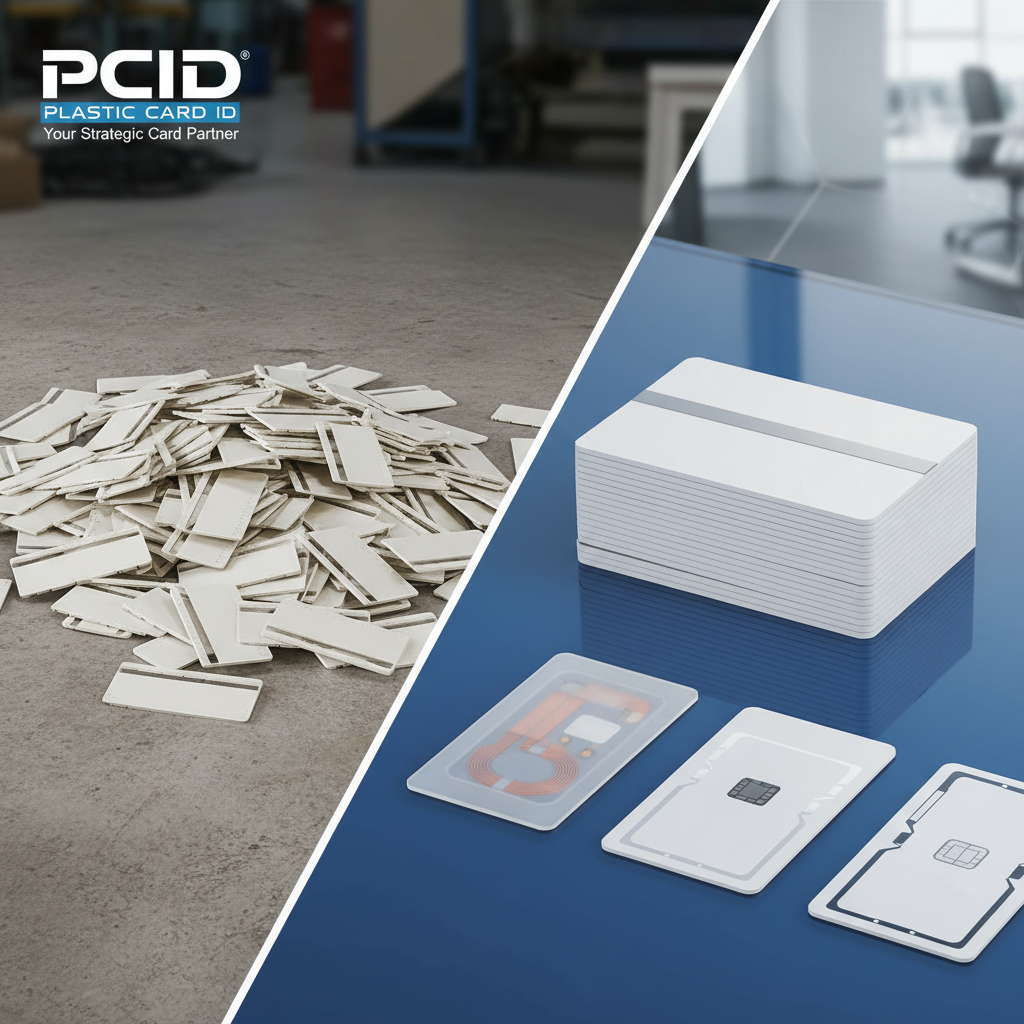
When a supplier cuts corners on material consistency, those dimensional tolerances go out the window. Cards may be slightly thicker or thinner than spec. Hopper feeds jam. Rollers fail to grip. Print heads misalign by a fraction and produce streaks. What looks like a printer problem is actually a card quality problem - and the buyer absorbs the cost in wasted ribbons, technician time, and delayed card programs.
What ISO 7810 Compliance Actually Means in Practice
Compliance is not just a line on a spec sheet. It means the card passed dimensional and material consistency testing, which translates directly into clean, jam-free feeding through card printers from Evolis, Zebra, Fargo, and every other major brand. When Plastic Card ID ships blank PVC cards, every card in that order meets this standard - no exceptions, no sorting through the batch for usable cards.
Consider what happens in a high-volume card issuance environment - say, a university issuing 2,000 student ID cards at the start of a semester. Even a one percent jam rate means 20 manual interventions. With non-compliant cards, that figure climbs into alarming territory, turning an afternoon print run into a two-day ordeal and burning through expensive ribbon panels at the same time.
The Hidden Cost of Dimensional Inconsistency
Ribbon panels on a dye-sublimation card printer typically cost between $0.50-$1.50 per card printed, depending on the printer model and ribbon type. When a card jams mid-print, that panel is usually destroyed. Multiply this by a consistent jam rate from cheap, off-spec cards, and the "savings" from buying the lower-priced card stock evaporate - and then some. The card price is never the only number that matters.
Beyond printer damage, there is the cost of reprinting. Badge stock, staff time, and potential delays to operations all stack up. Organizations running ongoing card programs - loyalty programs, access control, event badging - cannot absorb that kind of inefficiency on a recurring basis.
Surface Quality and Its Effect on Print Output
Even when a card is dimensionally correct, surface contamination, inconsistent coating, or micro-pitting in the PVC can cause mottled dye-sublimation prints, poor ink adhesion in direct-to-card printing, or smearing in retransfer printing. The surface of a blank PVC card is as important as its dimensions. CPE sources cards with the consistent gloss and matte finishes your card printer expects.
When you hold a well-made blank PVC card, it is smooth and uniform across the entire surface. A budget card may feel similar but show inconsistencies under strong light - tiny texture variations that translate into visible print quality differences once your printer's dye heads pass over them.
Magnetic Stripe Cards: HiCo vs LoCo and Why It Matters to Your Program
Magnetic stripe cards occupy a massive slice of the blank card market. From hotel key cards to loyalty point trackers to time-and-attendance systems, the magnetic stripe remains one of the most reliable and cost-effective data encoding technologies in active use today. But not all magnetic stripes perform equally, and ordering the wrong type can mean cards that fail in the field - sometimes immediately, sometimes after a few weeks of use.
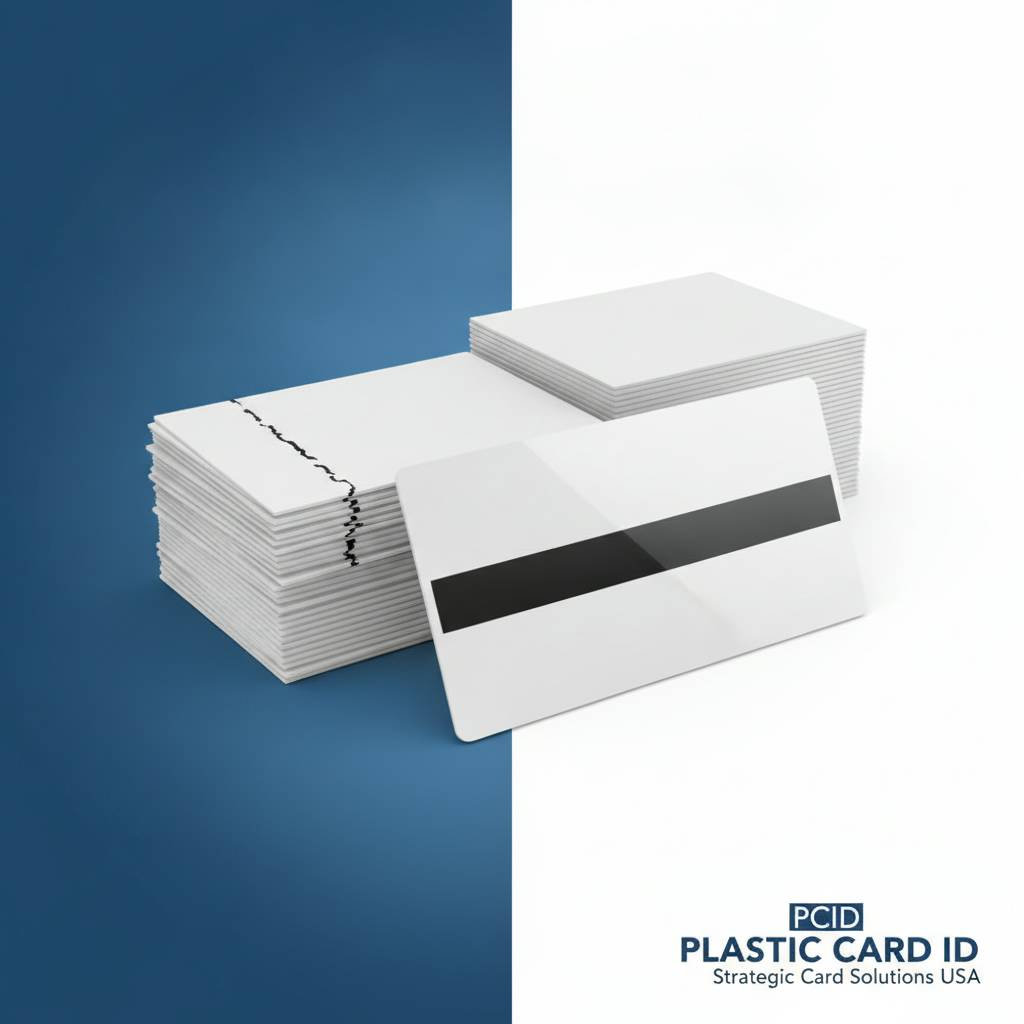
The fundamental distinction is coercivity, measured in oersteds. High-coercivity (HiCo) stripes are rated at approximately 2750 Oe and are significantly more resistant to accidental erasure from everyday magnetic fields - purses with magnetic clasps, proximity to other cards, cell phones. Low-coercivity (LoCo) stripes at around 300 Oe are easier to encode but far more susceptible to data loss from ambient magnetic exposure.
Choosing the Right Stripe for Your Application
Hotel key cards and access control cards in environments with frequent badge use should almost always be HiCo. The marginal additional cost is negligible compared to the operational headache of cards failing at doors, requiring constant re-encoding at the front desk or security station. Loyalty cards that live long-term in wallets alongside other cards and magnetic closures need that same durability.
LoCo cards do have legitimate use cases - short-term event credentials, discount cards with a fixed expiration, or applications where the encoding system is designed for LoCo and cannot write the higher coercivity field. The key is knowing which you need before you order, not after your first round of field failures.
What Cheap Magnetic Stripe Cards Actually Look Like in Performance
Budget magnetic stripe cards often use inconsistent stripe application. The oxide layer may be thinner in spots, the bonding inconsistent, or the stripe may not be perfectly centered within tolerance. These variables mean encoding errors during initial issuance - your encoder throws errors, your card personalization software flags cards, and your team spends time troubleshooting encoding equipment that is actually fine.
At Plastic Card ID, HiCo and LoCo magnetic stripe cards are manufactured to consistent specifications with clean stripe application verified for encoding reliability. When you run 500 or 5,000 cards through your encoder, they should all write cleanly the first time. That reliability is what differentiates a card supplier from a strategic card program partner.
Magnetic Stripe Encoding and Your Existing Card Printer
Most mid-range and professional card printers from Zebra, Evolis, and Fargo include optional magnetic stripe encoding modules. These modules apply a precise write field calibrated for standard HiCo or LoCo stripes. When the card stock deviates from that calibration expectation, encoding becomes unreliable - and diagnosing the source of the problem can consume significant time before anyone thinks to test the cards themselves rather than the encoder.
Reach out to Plastic Card ID at 800.835.7919 to confirm which magnetic stripe specification is correct for your printer model and application before placing your order. Getting this right upfront avoids program delays and unnecessary return shipments.
RFID, Proximity, and Smart Chip Cards: When Advanced Technology Meets Quality Requirements
 Contactless cards - proximity cards, RFID cards, and smart chip cards - bring the quality conversation to a more technically demanding level. These cards contain embedded electronics: an antenna, a chip, sometimes both. The physical PVC laminate that encases these components must be manufactured to tight tolerances or the card fails not just functionally but structurally - delaminating, cracking along the chip boundary, or developing read-range inconsistencies.
MIFARE DESFire cards, used in high-security access control and transit applications, are a precise example. The chip specifications are defined, but the quality of the card body that protects and connects that chip varies significantly by manufacturer. A cheap MIFARE card may technically contain the right chip and still underperform because the antenna etching is imprecise, the laminate layers are inconsistent, or the card is simply too thin or too flexible to maintain reliable contactless communication in demanding read environments.
Proximity Cards and Access Control Systems
125 kHz proximity cards (the HID-compatible format widely used in commercial access control) need to present a consistent antenna geometry to the reader. Even small deviations in antenna etching - a common cost-cutting area in budget card manufacturing - reduce read range and reliability. In an access control environment, an inconsistent read range means employees swiping repeatedly at readers, creating bottlenecks at entry points and generating support tickets that point to the reader rather than the card.
CPE stocks proximity access cards engineered for reliable read performance at standard distances. These cards are tested for compatibility across common access control system readers and are the type of product you can deploy at scale with confidence - whether that is 50 cards for a small office or several thousand for a multi-building campus installation.
Smart Chip Cards and Contactless Technology
The smart card sector - particularly contactless smart cards using NFC-compatible protocols like MIFARE - is one of the fastest-growing segments in identity, loyalty, and access management. These cards carry memory, can store encrypted credentials, and support read/write operations across a range of applications from casino player tracking to hotel room access. Quality here is measured not just by chip specification but by card durability under daily tap-and-go use conditions.
A card that delaminates at the chip boundary after three months of use is a failed card program, regardless of how low the per-unit price was at the time of purchase. Plastic Card ID sources smart card stock from manufacturers with documented lamination integrity standards, because in contactless applications, the card body and the chip are inseparable parts of the same performance equation.
Casino Player Cards and Specialty RFID Applications
Casino environments represent one of the most demanding card program contexts in existence. Player cards must survive high-volume, high-frequency handling - swiped, inserted, and tracked across thousands of interactions. The card body must resist surface wear, maintain magnetic stripe reliability (often combined with RFID in casino cards), and hold print quality under continuous handling.
Specialty applications like these illustrate why Plastic Card ID functions as a strategic program partner rather than a simple card vendor. Understanding application requirements, recommending the right card specification, and providing volume pricing that makes high-quality cards economically viable - that is what 25 years of category expertise looks like in practice.
| Card Type | Best Applications |
|---|---|
| Blank White PVC (CR80) | Employee badges, membership cards, loyalty cards, event credentials |
| HiCo Magnetic Stripe | Long-term loyalty, access control, time and attendance |
| LoCo Magnetic Stripe | Short-term event cards, hotel keys (some systems), discount programs |
| Proximity / RFID | Commercial access control, building entry, parking management |
| MIFARE Smart Chip | Hotel room access, casino player cards, secure identity programs |
| Clear / Frosted PVC | Premium membership, VIP credentials, design-forward loyalty programs |
Specialty Card Stock: Clear, Colored, and Custom Options Worth Understanding
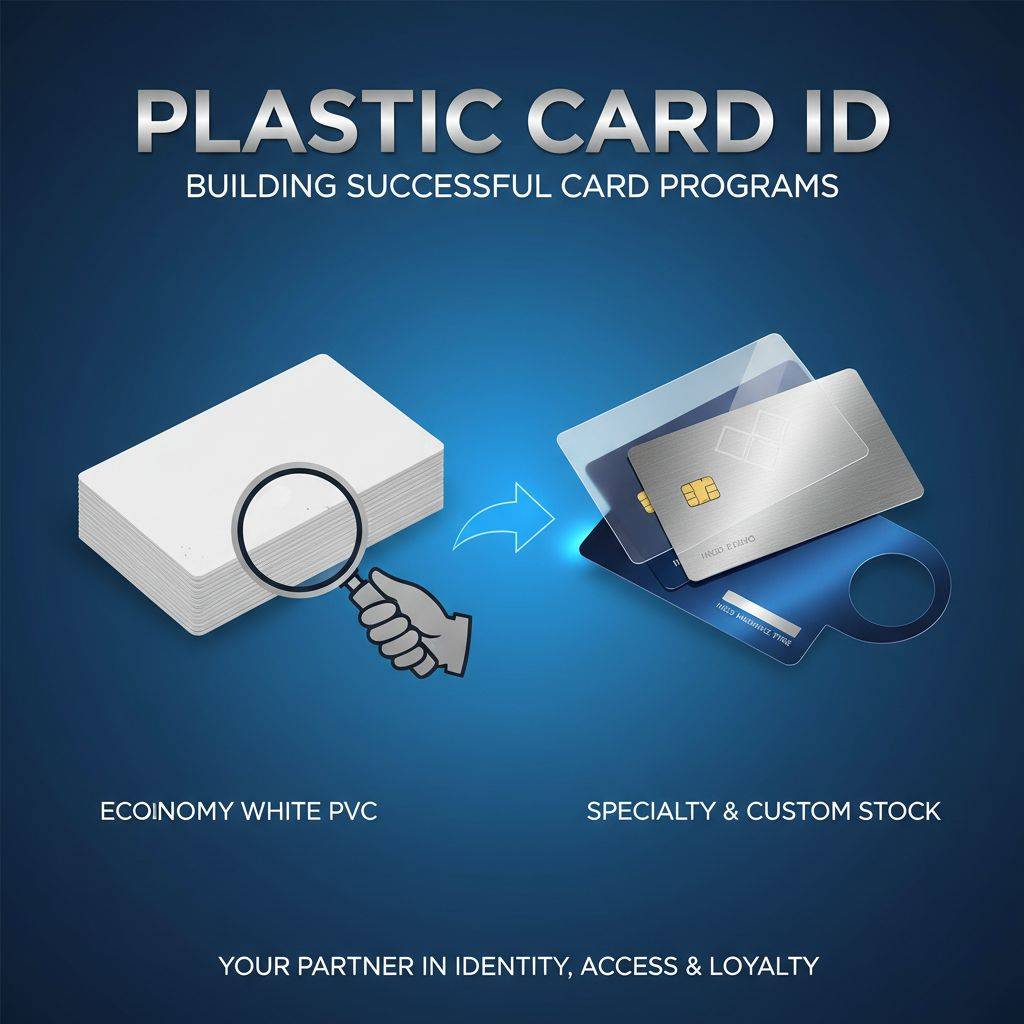 Not every card program calls for a standard white PVC blank. Clear plastic cards, frosted cards, and pre-colored stock offer visual differentiation that matters enormously in gift card and loyalty contexts. When a retail customer reaches into their wallet and pulls out a card that looks and feels distinctly premium, the brand perception effect is immediate and measurable. Retailers who switch from paper gift cards to plastic see sales increases of 35 to 50 percent. The card itself does marketing work that paper simply cannot replicate.
Clear and frosted card stock require the same dimensional precision and surface quality as standard white PVC - in some ways more so, because the transparency or translucency of the material makes any surface defects or thickness inconsistencies visible in a way that an opaque white card would conceal. Sourcing clear cards from a quality supplier is not optional if visual quality is part of your program's value proposition.
Pre-Colored Stock and Brand Alignment
Pre-colored blank cards - available in black, gold, red, blue, and a range of other colors - allow organizations to align card stock color with brand identity before a single line of printing is applied. For membership programs, VIP tiers, and loyalty programs with multiple card tiers, this color differentiation communicates value hierarchy instantly. A black card in a premium tier conveys status in a way that a printed-on-white card approximates but never quite matches.
Plastic Card ID carries colored stock options that are manufactured with consistent color saturation across production runs. When you reorder six months later, the new cards should match the original batch. With budget color card suppliers, batch-to-batch color consistency is one of the first things to suffer when manufacturing shortcuts are taken.
Custom Die-Cut Shapes and Luxury Metal Cards
The standard CR80 rectangle is the default for good reason - it fits every wallet, every badge holder, every card printer. But certain applications call for something different. Custom die-cut shapes - for key tags, mini cards, or brand-specific forms - fall outside standard blank stock and require custom production. These serve specific loyalty, retail, and promotional applications where the card shape is part of the brand experience.
At the premium end of the spectrum, luxury metal cards in stainless steel, brass, and gold provide a tactile weight and permanence that elevates membership and VIP programs into a different category of customer experience entirely. These cards are not for every program, but for the right application - a high-end club membership, an exclusive rewards tier, a premium corporate credential - the metal card delivers a brand statement no paper or plastic alternative can match.
Choosing the Right Stock for Your Print System
Clear and colored card stock, while visually distinct from standard white PVC, must still be compatible with your card printer's print method. Dye-sublimation printing on clear stock requires specific ribbon and settings calibration - colors appear differently on a clear substrate than on white, because there is no white backing to reflect the dye back to the viewer. Understanding these nuances before ordering specialty stock prevents expensive misprints and wasted ribbon.
The team at CPE can help match your card stock selection to your specific printer model and print method, ensuring the specialty cards you order actually work with your existing equipment from day one.
Buyer Tips: How to Evaluate a Blank Card Supplier Before You Commit
The blank plastic card market has no shortage of suppliers willing to sell you a thousand cards at a price that feels compelling. Evaluating those suppliers before committing your card program to their product requires asking the right questions - and knowing which answers are red flags versus green lights. Your card program is only as reliable as the cards it runs on.
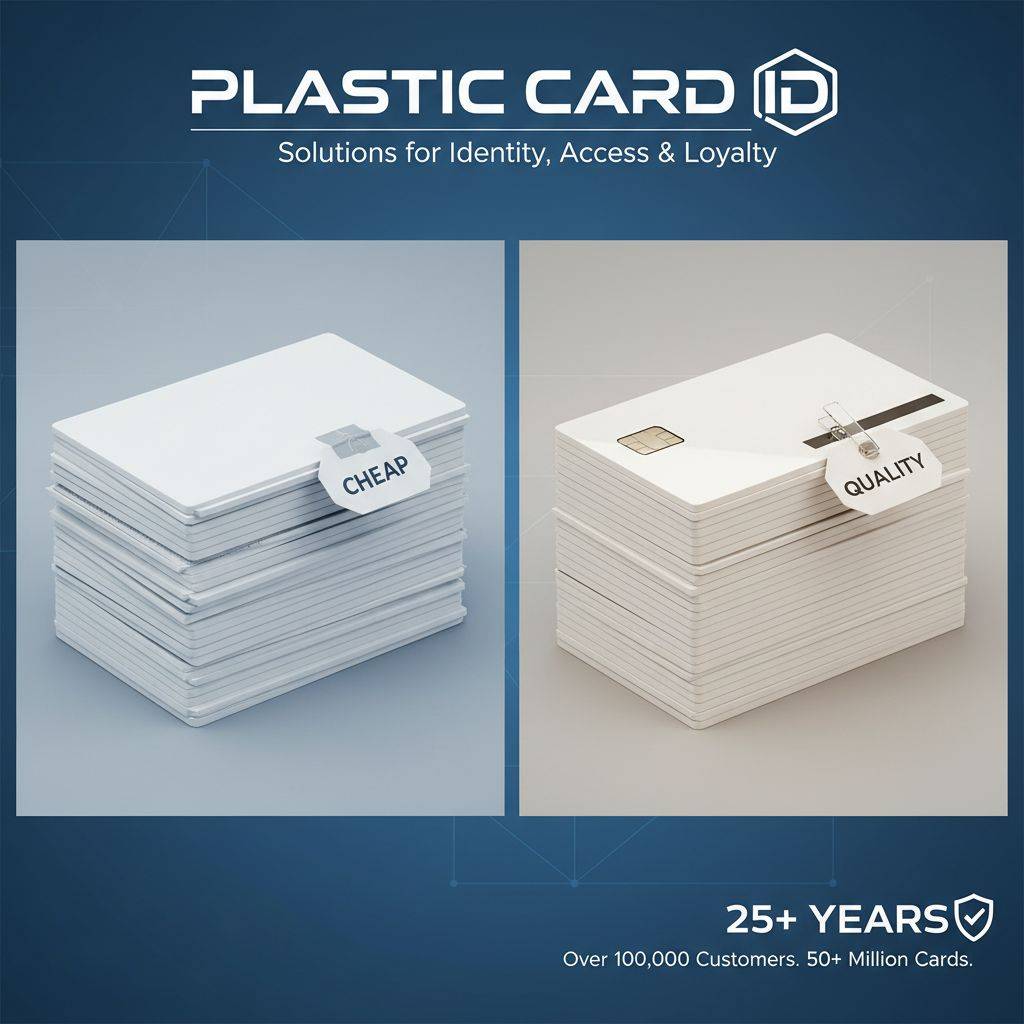
Here is a structured approach to supplier evaluation that protects your program from quality surprises after your first order ships.
Key Questions to Ask Any Blank Card Supplier
- Are your blank PVC cards certified to ISO 7810 CR80 standard at 30 mil thickness?
- What is your batch-to-batch dimensional consistency tolerance?
- Are your magnetic stripe cards available in both HiCo and LoCo, and what is the coercivity rating?
- Do you test for printer compatibility with Evolis, Zebra, and Fargo equipment?
- What is your return and replacement policy for cards that cause equipment jams or encoding failures?
- Can you provide volume pricing for ongoing programs, not just one-time orders?
- Do you stock card printers, ribbons, and accessories to support a complete in-house card program?
A supplier who can answer these questions with specifics - not vague reassurances - is a supplier operating with genuine product knowledge. Evasive or generic answers about "meeting industry standards" without naming those standards should prompt further scrutiny before you place a significant order.
At Plastic Card ID, these questions have direct, specific answers because our product specifications are precise and our quality controls are documented. That transparency is part of what has made long-term relationships with over 100,000 customers possible.
Evaluating Price vs Total Program Cost
A blank white PVC card from a quality supplier may cost marginally more per unit than a budget option - often the difference is a few cents per card at standard quantities. But when that price difference is weighed against ribbon waste from jams, reprint costs, encoding failures, and card program disruptions, the quality card almost always wins the total cost comparison decisively. Per-card cost is the starting point of the analysis, not the endpoint.
For high-volume programs, Plastic Card ID offers tiered pricing that makes quality cards economically competitive with budget suppliers even on a pure per-unit basis. When volume reaches tens of thousands of cards, the pricing gap between quality and budget stock narrows substantially - sometimes to the point where there is no meaningful difference at all once reorder ease and consistency are factored in.
The Value of a One-Stop Card Program Supplier
Sourcing blank cards from one supplier, ribbons from another, a card printer from a third, and cleaning kits from a fourth introduces coordination friction that grows over time. When a print quality issue arises, each supplier points to another as the likely cause. A one-stop supplier who provides cards, printers, ribbons, cleaning kits, card carriers, and sleeves has a unified stake in your program's success - and the technical integration knowledge to troubleshoot across the full system.
CPE carries card printers from Evolis, Zebra, and Fargo alongside the full consumable and accessory catalog those printers require. Whether your program runs 50 cards per month or tens of thousands, the supply chain behind it can be managed through a single relationship built on 25 years of program support experience.
Ready to Build a Better Card Program? Plastic Card ID Is Here to Help
 The difference between a card program that runs smoothly for years and one that generates constant headaches almost always traces back to card quality decisions made at the beginning. Choosing quality blank plastic cards from the right supplier is the single highest-leverage decision in building a reliable, cost-effective card program. Everything else - printer performance, encoding reliability, print quality, cardholder experience - depends on it.
Plastic Card ID has been that right supplier for over 100,000 businesses and organizations across the United States, across every industry, at every scale. From the straightforward blank CR80 card to advanced MIFARE smart cards and luxury metal credentials, the catalog and the expertise are here to support whatever your program requires.
Call Plastic Card ID today at 800.835.7919 to speak with a card program specialist who can help you identify the right card specification, confirm compatibility with your existing equipment, and get your program running on the quality foundation it deserves.
Previous Page