Blank Proximity Cards Explained: How They Work
Table of Contents []
- Blank Proximity Cards Explained: What Every Business Should Know Plastic Card ID
- What Are Blank Proximity Cards, Really?
- How Proximity Cards Work: The Technology Underneath
- Why Buy Blank Proximity Cards Instead of Pre-Printed?
- Applications: Where Blank Proximity Cards Power Real Programs
- Selecting, Ordering, and Managing Your Proximity Card Inventory
- Get Your Blank Proximity Card Program Running with Plastic Card ID
Blank Proximity Cards Explained: What Every Business Should Know Plastic Card ID
 Walk up to a door, hold a card near a reader, and the lock clicks open. No swipe, no PIN, no fumbling with keys. That seamless moment - so routine now in offices, hotels, and campuses across the country - is powered by proximity card technology. But what exactly are blank proximity cards, how do they work, and why does buying them blank (rather than pre-encoded) give your organization a genuine operational advantage? Those are the questions worth unpacking.
Plastic Card ID has spent over 25 years supplying plastic cards to businesses of every size across the United States. With more than 50 million cards sold and over 100,000 customers served, the team has seen proximity card programs in virtually every configuration imaginable - from a single reader controlling one door to sprawling enterprise access systems spanning hundreds of checkpoints. That depth of experience means you get more than cards. You get answers.
| Card Type | Frequency | Typical Range | Common Use |
|---|---|---|---|
| 125 kHz Proximity (HID-compatible) | Low Frequency (LF) | Up to 4 inches | Door access, time & attendance |
| 13.56 MHz Smart Card (MIFARE) | High Frequency (HF) | Up to 4 inches | Secure access, cashless vending |
| MIFARE DESFire | High Frequency (HF) | Up to 4 inches | High-security enterprise access |
| Blank Printable Proximity Cards | LF or HF | Varies by reader | In-house ID access combo |
What Are Blank Proximity Cards, Really?
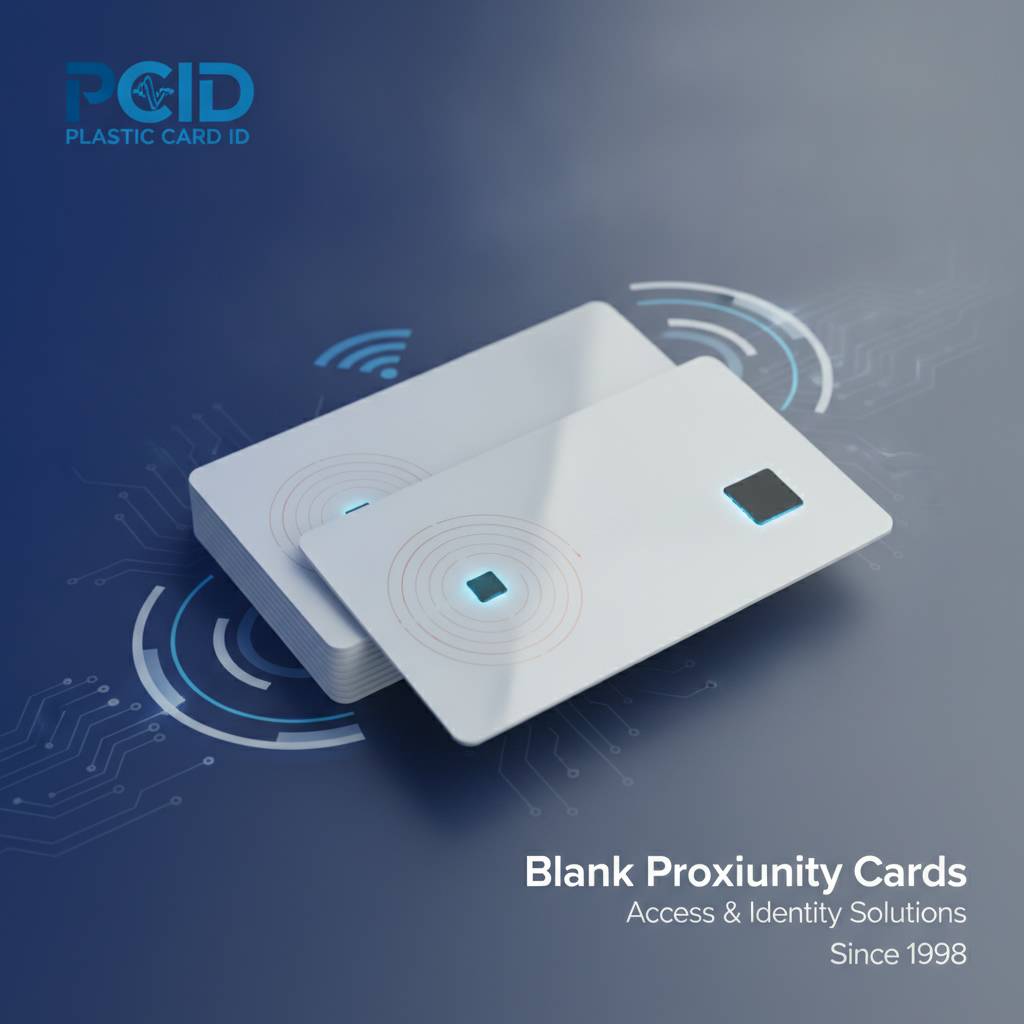 Strip away the jargon and a proximity card is elegantly simple: a standard CR80 plastic card (the same size as your driver's license) with a radio frequency antenna and a small chip embedded inside. No battery required. The card draws energy from the reader's electromagnetic field, wakes up, transmits a unique ID code, and the reader grants or denies access - all in a fraction of a second. The "blank" designation means the card has no printed personalization yet. The chip is either pre-encoded with a unique facility code and card number, or it arrives completely unenrolled, ready for your access control system to write credentials onto it.
That distinction matters more than most buyers realize. Blank proximity cards give you total control over credential assignment, employee onboarding timelines, and card design. You are not locked into whatever a pre-printed card says. You print a photo ID, a name, a department designation, your logo - all in-house, on your schedule, using a card printer from brands like Evolis, Zebra, or Fargo. The access control function and the visual identification function live on the same card, which simplifies your entire program.
The CR80 Standard and Why It Matters
All standard proximity cards conform to the ISO 7810 CR80 specification: 3.375 inches wide, 2.125 inches tall, and 30 mil thick. That uniformity means every proximity card fits the same badge holders, lanyards, printers, and card readers without special accommodations. When CPE stocks and ships these cards, that standardization is already baked in.
The 30 mil thickness is particularly important for proximity cards because the antenna must be laminated inside the card body without compromising the card's rigidity or printability. A card that warps, bubbles, or delaminates ruins both the visual ID and the RFID function. Quality blank proximity cards are engineered to maintain flatness through thousands of wallet insertions and years of daily use.
Low Frequency vs. High Frequency: Choosing the Right Card
The 125 kHz low-frequency (LF) proximity card is the most widely deployed access card in North America. It is compatible with HID-style readers installed in the majority of office buildings, manufacturing facilities, and campuses built over the last two decades. If your building already has proximity card readers and you need replacement or additional cards, there is a very good chance a standard 125 kHz blank card will integrate without any system reconfiguration.
High-frequency cards operating at 13.56 MHz - including MIFARE Classic, MIFARE DESFire, and related standards - offer more sophisticated capabilities. These cards can store data on the chip itself, not just transmit a fixed ID code. That makes them suitable for cashless vending, multi-application environments, and high-security deployments where the card functions as both an access credential and a data carrier. Choosing between LF and HF starts with knowing what your reader infrastructure supports.
What "Blank" Actually Includes
When you order blank proximity cards, you typically receive cards that are white (or occasionally a custom color) on both printable surfaces, with the RFID inlay already embedded. Some are sold with a pre-programmed facility code, others are shipped completely unenrolled. Printable blank proximity cards are compatible with dye-sublimation card printers, allowing full-color photo ID printing directly onto the card surface.
What you do not get with a blank card is any printed branding, employee data, or barcodes. All of that comes from your in-house printing process. This is exactly the point. In-house printing gives organizations per-card costs that drop significantly at scale, immediate card issuance without waiting on outside vendors, and the ability to reprint or replace a single card on demand rather than ordering a minimum batch.
How Proximity Cards Work: The Technology Underneath
The internal architecture of a proximity card is a marvel of compact engineering. Embedded within the PVC layers is a copper or aluminum antenna - a flat coil - connected to a microchip. When the card is brought within range of a compatible reader, the reader emits a radio frequency field. The card's antenna harvests that energy, powers the chip, and the chip broadcasts its stored ID number back to the reader. No contact, no swipe, no battery. The entire exchange takes less than 100 milliseconds.

This passive RFID design is what makes proximity cards so durable and reliable over years of daily use. There is nothing mechanical to break, no battery to replace, and no exposed contacts to wear down. The sealed PVC card body protects the antenna and chip from moisture, bending, and everyday abuse. A well-made proximity card can easily perform reliably for five to ten years under normal use conditions - a key reason organizations prefer them over paper-based alternatives that degrade quickly and offer zero access control functionality.
The Reader-Card Communication Process
Every time an employee badges through a door, a precise sequence unfolds. The reader broadcasts continuously on its designated frequency. The card, once within range, harvests enough power from that field to activate the embedded chip. The chip sends back a Wiegand or OSDP format signal containing the facility code and card number unique to that credential. The access control panel checks that number against its enrolled credential list and opens the door or triggers an alert.
The Wiegand protocol, while decades old, remains the dominant standard in North American access control wiring. Most 125 kHz proximity cards are Wiegand-compatible out of the box, which is why they integrate so seamlessly with legacy reader infrastructure. Newer OSDP-based readers and HF smart cards are increasingly common in security-conscious deployments, but the underlying read-and-respond logic is essentially the same.
Range, Read Distance, and Practical Considerations
Standard proximity cards read at distances of two to four inches from the reader face. That might sound limited, but it is intentional. A card that reads from fifteen feet away creates significant security vulnerabilities - someone could badge through a door without intending to, or an unauthorized reader could harvest credentials from a distance. The short read range of proximity cards is a feature, not a limitation.
Practical read distance also depends on card orientation, the specific reader hardware, and whether the card is inside a badge holder or wallet. Most access control readers are calibrated for direct presentation - the user holds the card up to the reader intentionally, which is the correct operational posture for any secure facility. Clip-on badge holders that present the card face-out provide consistently clean reads and should be considered standard equipment alongside any proximity card program.
Combining Access Control with Visual ID on One Card
One of the most compelling use cases for blank printable proximity cards is the combined access-and-ID card. Rather than issuing an employee two separate credentials - a photo ID badge and an access control card - a single printed proximity card serves both purposes. The photo, name, title, and department are printed on the surface. The RFID chip handles door access. One card. One badge holder. One workflow.
This consolidation simplifies issuance, reduces per-employee credential costs, and eliminates the confusion of managing two separate card programs. When an employee leaves, you deactivate a single credential in your access control software and collect one card. The physical card itself can be reprinted for a new employee if the access credentials are re-enrolled, giving the card body a second useful life.
Why Buy Blank Proximity Cards Instead of Pre-Printed?
 The case for blank over pre-printed is compelling across nearly every organizational scenario. Pre-printed cards require sending employee photos, names, and personal data to an outside printing vendor - a potential data handling concern. They require lead times measured in days or weeks. They are inflexible when employees change departments, names, or photos. And ordering pre-printed cards in small quantities typically carries premium pricing that makes large batches economically attractive even when you do not need the volume immediately.
Blank proximity cards reverse every one of those friction points. Cards arrive fast, often with next-business-day shipping options. Printing happens in-house on demand. Employee data never leaves your facility. And the per-card cost of blank cards is substantially lower than outsourced printed cards at any comparable volume. For organizations running ongoing card programs - adding staff regularly, replacing lost cards, issuing temporary visitor credentials - the economics of in-house card printing become obvious very quickly.
Cost Analysis: Blank vs. Pre-Printed Programs
Consider a mid-sized manufacturer onboarding 20 new employees per month. Outsourcing those photo ID proximity cards at $8-$15 per card adds up to $1,920-$3,600 per year in printing costs alone, not counting reprint fees for mistakes, replacements for lost cards, or rush charges for urgent hires. An in-house printing setup with a quality card printer and a supply of blank proximity cards typically reduces that per-card cost to $2-$4 after amortizing hardware, which translates to real savings in the first year and growing returns every year after.
The math shifts even more favorably when you factor in the hidden costs of outsourced printing: the administrative burden of sending card orders, the delay in receiving finished cards, the cost of temporary credentials issued while waiting, and the reprint cycle when a card comes back with an error. In-house card production eliminates every one of those friction costs. CPE supplies the cards, the printers, the ribbons, and the cleaning kits to make that transition seamless.
Inventory Control and Program Flexibility
Blank proximity cards can be stocked in meaningful quantities without risk of obsolescence. A box of 100 blank cards sitting in a supply cabinet is useful for any hire, any department, any access level - because the card only becomes a specific person's credential when it is printed and enrolled. Pre-printed cards, by contrast, are immediately obsolete if an employee never starts, a department is renamed, or your branding changes.
This flexibility is particularly valuable for organizations with variable headcount, seasonal workers, or frequent visitors needing temporary access. A blank card can become a 30-day visitor credential in minutes. That same card type, from the same stock, serves as a permanent employee badge for a long-term staff member. One SKU. Infinite configurations. That is the genuine operational power of building your card program around blank stock.
Pairing Blank Proximity Cards with the Right Card Printer
- Evolis Primacy 2: A reliable, high-throughput single-sided or dual-sided printer well-suited for mid-size organizations printing 50-500 cards per month.
- Zebra ZC300: A compact, budget-conscious option for smaller programs with lower monthly volumes, featuring solid print quality and a small footprint.
- Fargo HDP5000: A retransfer printer that delivers photographic-quality prints and exceptional durability - preferred for high-security ID programs where image quality is paramount.
- Zebra ZXP Series 9: A high-volume workhorse capable of printing thousands of cards per day, appropriate for enterprise programs, universities, and large facilities.
- Evolis Tattoo2: An entry-level single-sided printer for organizations just launching an in-house card program with modest initial volumes.
Matching printer to program volume is critical. An underpowered printer in a high-demand environment becomes a bottleneck. An oversized enterprise printer for a small program represents unnecessary capital expense. Plastic Card ID helps organizations identify the right hardware for their specific volume, card type, and feature requirements - it is part of being a strategic partner, not just a card vendor.
Applications: Where Blank Proximity Cards Power Real Programs
 The range of industries running proximity card programs would surprise most people. Manufacturing plants use them for shift-based access to production floors. Healthcare facilities use them to control medication storage room entry and track who accessed restricted areas and when. Schools and universities issue combined student ID and building access cards from the same blank proximity stock. Corporate campuses manage parking garages, fitness centers, server rooms, and executive suites - all with tiered access levels written to the same card format.
Hotels represent a distinct use case: hotel key cards are proximity-based (or magnetic stripe, depending on lock hardware) and issued at check-in for the duration of a stay. Casinos issue player loyalty cards that combine proximity access with membership tracking. Government contractors use MIFARE DESFire-based cards for compliance with federal security standards. The common thread is that blank proximity cards adapt to almost any institutional requirement with the right pairing of chip type, printer, and access control software.
Corporate Access Control Programs
A corporate campus running 500 employees across three buildings is a textbook proximity card environment. Each employee carries a single printed proximity card on a lanyard. The card photo and name are visible for visual verification at reception. The RFID chip handles every door interaction - lobby entry, stairwell access, parking structure, server room, restricted R&D areas. Access levels are assigned in software, not baked into the physical card, so revoking or modifying access is instant and requires no new card issuance unless the physical card is lost.
Temporary contractors present a common challenge in these environments. Blank proximity cards make solving it straightforward. A contractor batch can be printed at check-in, enrolled with limited-access credentials valid for exactly the contract period, and collected upon departure. The blank card stock handles both the permanent employee population and the transient one, using the same hardware and the same card format throughout.
Healthcare and Education Deployments
Healthcare environments demand audit trails. Who entered the pharmacy at 2:47 AM? Which staff member badged into the pediatric ward? Proximity card access control systems create that record automatically, associating every entry event with a specific credential. Combined with a photo ID printed on the same card, the system provides both an electronic audit log and a visual verification capability - two layers of accountability from a single credential.
University campuses face a similar complexity at larger scale. Tens of thousands of students, faculty, and staff need access to dormitories, labs, athletic facilities, and administrative offices - often with access levels that change each semester. Blank proximity card programs at this scale are managed through enterprise credential management software that can issue, modify, and revoke thousands of cards simultaneously. The physical blank card stock remains constant; the software handles the complexity.
Event, Visitor, and Temporary Credential Programs
Short-term proximity credentials get overlooked in most proximity card discussions, but they represent a significant slice of real-world usage. Conference centers issue daily access cards to event attendees. Corporate visitor management programs print and enroll a proximity card for each visitor, giving them building access strictly limited to public areas for exactly the duration of their visit. The card is collected at departure and either reprinted for the next visitor or stored for reuse.
This temporary credential use case actually highlights one of the most underappreciated benefits of blank proximity cards: the card body itself is reusable in low-security applications where enrollment history is not retained. A card reprinted with a new visitor's information and enrolled fresh in the access system is functionally a new credential. That reusability can meaningfully extend the value of your per-card investment in visitor credential programs where high volumes make cost-per-credential a real operational concern.
Selecting, Ordering, and Managing Your Proximity Card Inventory
Buying blank proximity cards requires knowing three things before you place an order: your reader frequency (125 kHz LF or 13.56 MHz HF), whether you need pre-programmed facility codes or unenrolled blank chips, and whether the cards need to be printable (flat white surface compatible with dye-sublimation printing) or purely functional. Getting any of those wrong means ordering cards that do not work in your readers, cannot be enrolled in your system, or cannot be printed with your existing hardware.
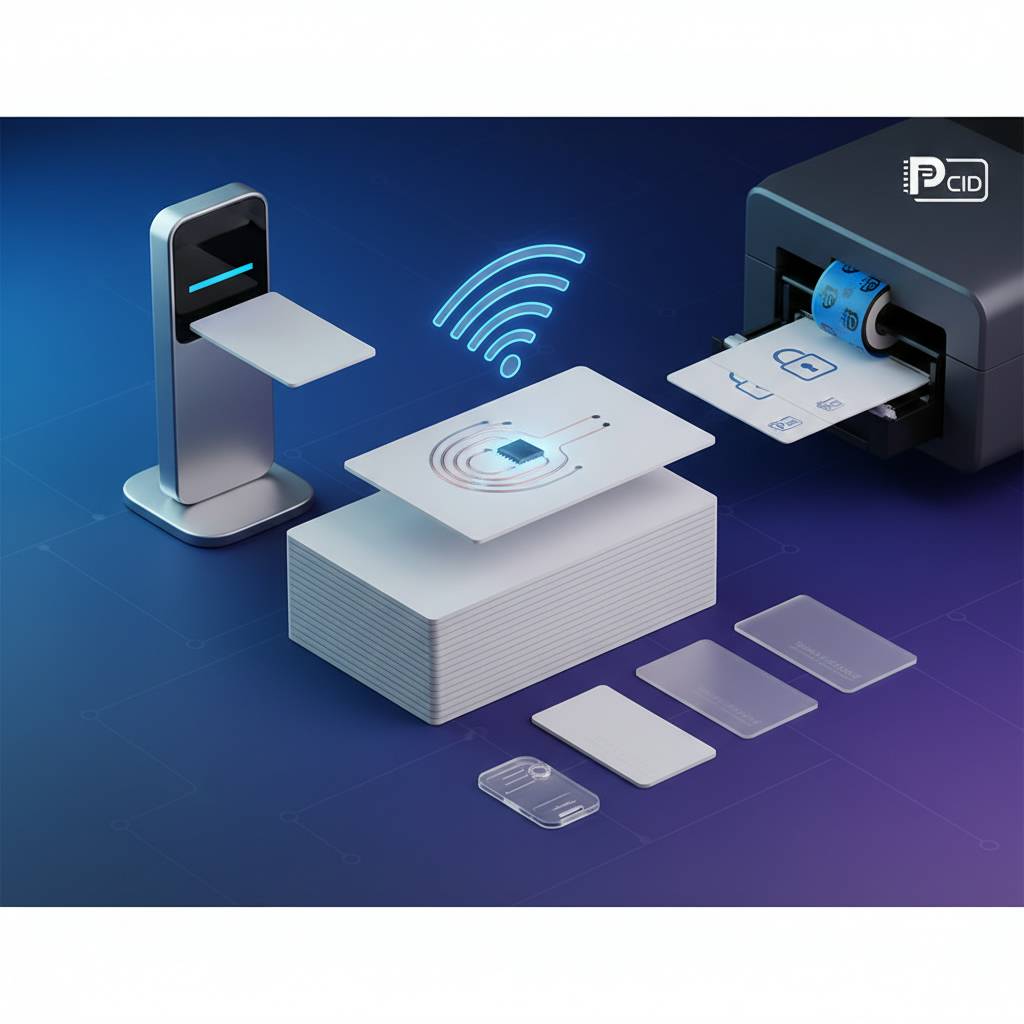
When you work with CPE, those questions get answered before the order is placed. That upfront qualification process is what prevents the expensive mistake of receiving 500 cards that do not interact with your access control readers. It is also why the relationship matters more than the transaction. A card supplier who simply fulfills orders without understanding your system can quietly cost you thousands in incompatible inventory and delayed program launches.
Minimum Orders, Volume Pricing, and Stocking Strategies
Blank proximity card programs can be launched at volumes as modest as 50 cards, making them accessible to small businesses, nonprofits, and government offices with limited initial needs. Volume pricing becomes notably more attractive in increments of 250, 500, and 1,000 units. For organizations with predictable ongoing demand, stocking three to six months of expected card volume reduces per-unit cost and ensures supply availability without the risk of running out during a hiring surge.
Carrying excess blank proximity card inventory is low-risk compared to carrying pre-printed card inventory. Blank cards do not become outdated when you rebrand, reorganize, or hire people whose names do not match anything pre-printed. They sit in a cabinet, waiting to become exactly the credential your next hire or visitor needs. That inventory flexibility is a genuine advantage of blank-stock card programs that organizations often undervalue when building their initial budget.
Contact Plastic Card ID for Expert Guidance
Navigating blank proximity card options - frequency, chip type, printability, encoding, volume - is genuinely complex if you are approaching it for the first time. The experienced team at Plastic Card ID brings over 25 years of card program expertise to every conversation, helping USA-based organizations make the right card selection the first time and build programs that scale without friction.
Whether you are replacing an existing card program, launching a new one, or upgrading from a less functional credential type, the guidance you need is a phone call away. Reach the Plastic Card ID team directly at 800.835.7919 to discuss your proximity card requirements, get volume pricing, and identify the right printer and card combination for your specific application.
Supplies, Accessories, and Ongoing Support
A complete proximity card program requires more than just cards. Printer ribbons, cleaning kits, badge holders, lanyards, card sleeves, and card carrier envelopes for mailed credentials are all part of the operational picture. CPE stocks all of these supplies and ships them alongside card orders so organizations can consolidate their purchasing and avoid the operational friction of sourcing card program consumables from multiple vendors.
Cleaning kits in particular deserve emphasis. Card printers produce significantly better image quality and last far longer when cleaned on the recommended maintenance schedule - typically every ribbon change or every 500 cards, depending on the printer model. Neglecting printer maintenance is the single most common cause of premature print head failure, and print heads are expensive to replace. A modest investment in cleaning kits preserves a much larger investment in printer hardware.
Get Your Blank Proximity Card Program Running with Plastic Card ID
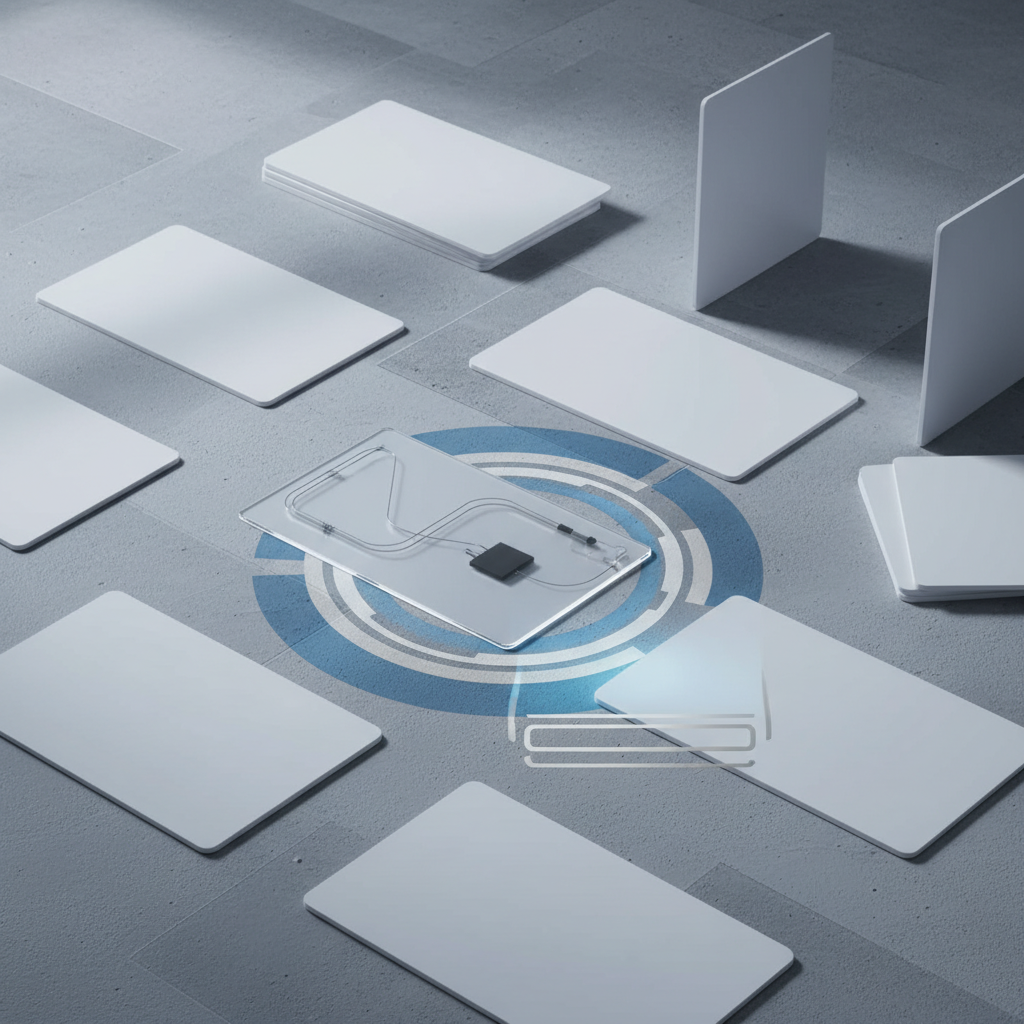 Blank proximity cards are not a commodity purchase. The chip type, frequency compatibility, printability, and encoding specification all determine whether the cards you buy actually work in your environment. Getting those specifications right from the start is the difference between a card program that runs smoothly for years and one that generates returns, reprints, and reader compatibility headaches from day one.
Plastic Card ID has helped over 100,000 USA-based customers build card programs that work - from the first card issued to the millionth. The combination of deep product knowledge, a comprehensive catalog spanning every proximity card type, and the full supporting ecosystem of printers, ribbons, and accessories makes Plastic Card ID the most capable partner for any organization serious about running an effective proximity card program.
Call Plastic Card ID today at 800.835.7919 to get expert guidance on blank proximity cards, volume pricing, printer recommendations, and everything your card program needs to succeed.
Previous Page