Blank Plastic Cards for Photo ID Programs: Best Options
Table of Contents []
- Why Plastic Card ID Is the Go-To Source for Blank Plastic Cards for Photo ID Programs
- The CR80 Standard: Understanding the Blank Card That Powers Most Photo ID Programs
- Magnetic Stripe Cards: Adding Function to Your Photo ID Program
- RFID and Smart Chip Cards for Secure Photo ID Programs
- Card Printers, Ribbons, and Supplies: The Complete Photo ID Ecosystem
- Frequently Asked Questions About Blank Plastic Cards for Photo ID Programs
- Partner With Plastic Card ID for Your Photo ID Program Today
Why Plastic Card ID Is the Go-To Source for Blank Plastic Cards for Photo ID Programs
 Walk into almost any organization that takes identity seriously - a school district, a hospital, a corporate campus, a government facility - and you will find plastic ID cards at the center of their daily operations. These are not decorative novelties. They are functional tools that authenticate, authorize, and identify the people who carry them. Choosing the right blank card stock for your photo ID program is not a trivial decision, and it is one that thousands of American organizations have trusted Plastic Card ID to help them get right for over 25 years.
What makes a blank plastic card the right fit for a photo ID program? It starts with physical specifications, but it does not end there. Card thickness, surface finish, compatibility with your printer's print head, coercivity of the magnetic stripe - these details compound quickly. Organizations that skip the research phase often end up with faded prints, delaminating overlaminates, or cards that simply will not encode. Plastic Card ID exists precisely to eliminate that guesswork and help you build a program that works from day one.
With more than 50 million cards shipped to over 100,000 customers across the United States, Plastic Card ID brings genuine field-tested expertise to every order. Whether you are printing 50 employee badges per month or running a mass-production photo ID operation in the tens of thousands, the right blank card foundation changes everything downstream - print quality, card longevity, encoding reliability, and the professional impression your card makes when it is worn on a lanyard or handed across a front desk.
| Card Type | Best Use Case | Key Feature | Typical Volume |
|---|---|---|---|
| Blank PVC CR80 (30 mil) | Employee ID, student badges | ISO standard, universal fit | 50-50,000 per run |
| Magnetic Stripe (HiCo) | Access control photo ID | High durability encoding | 100-20,000 per run |
| RFID / Proximity Cards | Secure facility access | Contactless authentication | 50-10,000 per run |
| Smart Chip Cards | Government, healthcare ID | Encrypted data storage | 100-5,000 per run |
| Clear / Frosted PVC | Premium ID, VIP credentials | Distinctive visual identity | 50-5,000 per run |
The CR80 Standard: Understanding the Blank Card That Powers Most Photo ID Programs
 The CR80 format is not arbitrary. It is an ISO 7810 standard - the same footprint as a standard credit card, measuring 3.375 inches by 2.125 inches at 30 mil thickness. That standardization matters enormously when you are building a photo ID program, because it means your blank cards will fit every CR80-compatible card printer on the market, every card holder, every lanyard clip, and every badge reel without a second thought. Standardization is the silent infrastructure of a smooth-running ID program.
Not all blank PVC cards are created equal, even within the CR80 spec. Surface finish varies - glossy cards produce vibrant, high-contrast photo reproduction that makes ID photos look sharp and professional. Matte-finish cards reduce glare and are often preferred in healthcare and education settings where cards are frequently handled under fluorescent lighting. Plastic Card ID stocks both, giving your organization a choice that aligns with your specific printing environment and aesthetic expectations.
Why Thickness Matters More Than You Think
Thirty mil is the standard, but composite cards at 20 mil exist for specific applications like temporary visitor passes or event credentials. Choosing a card that is too thin for your printer's feed mechanism causes jams and print misalignment. Choosing a card that is too thick can damage print heads on printers calibrated for standard stock. Getting the thickness right is the first decision every successful ID program manager makes.
At Plastic Card ID, every product listing specifies exact thickness, surface type, and printer compatibility, so you are never left guessing whether a card will work with your Evolis Primacy, Zebra ZC300, or Fargo HDP5000. That level of specification detail reflects a company that has been troubleshooting real-world card program challenges for decades, not one that simply resells commodity stock.
Surface Coating and Its Impact on Photo ID Print Quality
A blank card's surface coating interacts directly with the dye-sublimation process your ID card printer uses. Cards with improper coatings produce washed-out photos, streaking, or color banding that makes IDs look unprofessional at best and unusable at worst. Printer-grade PVC card stock is engineered to absorb and lock dye at the molecular level, producing the crisp, fade-resistant photo IDs your organization needs.
CPE carries card stock that is tested for compatibility with major card printer brands. When you call 800.835.7919, a knowledgeable representative can match you to the exact card stock that will perform optimally in your specific printer model - a service that generic office supply sources simply cannot provide.
Blank vs. Pre-Printed: When In-House Printing Wins
Some organizations assume that ordering pre-printed cards from a commercial printer will produce better-looking IDs. In reality, organizations that print photo IDs in-house using quality blank PVC cards and a modern card printer achieve comparable or superior results - with complete control over the production timeline. A new employee can have a finished, professional ID card within minutes of completing onboarding paperwork.
That speed and control translates directly into operational efficiency. No waiting for batch print orders to arrive from an outside vendor. No minimum order quantities forcing you to stockpile cards you may never use. In-house photo ID printing with quality blank cards is one of the smartest operational investments a growing organization can make.
Magnetic Stripe Cards: Adding Function to Your Photo ID Program
A blank PVC card is a canvas. Add a magnetic stripe, and it becomes a multi-functional credential that can carry access control data, time and attendance records, or library checkout information in addition to serving as a visual photo ID. This dual functionality is why magnetic stripe combo cards are among the most popular items in Plastic Card ID's catalog for organizations building serious photo ID programs.
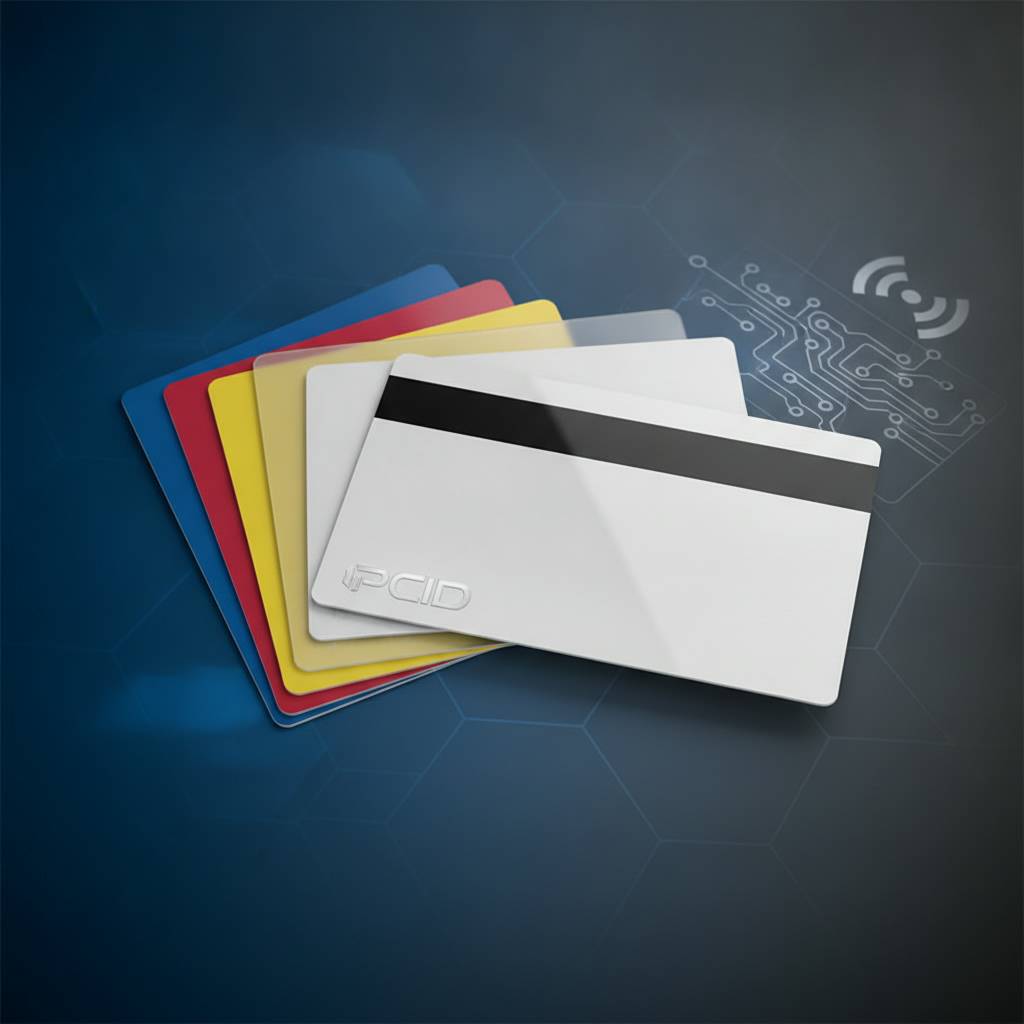
The distinction between HiCo (High Coercivity) and LoCo (Low Coercivity) magnetic stripes is one that every ID program manager should understand before placing an order. HiCo stripes require a stronger magnetic field to encode and are significantly more resistant to accidental erasure from everyday proximity to magnets in wallets, phone cases, and bag closures. For employee IDs and access control credentials that need to remain reliable for 1-3 years, HiCo is almost always the correct choice.
HiCo vs. LoCo: Making the Right Call
LoCo magnetic stripe cards encode at lower field strengths and are better suited for short-term applications - event credentials, single-day visitor passes, temporary access cards. They cost slightly less per card and work fine in environments where longevity is not the priority. HiCo cards are the workhorse for any photo ID that will see daily use in access readers, time clocks, or library systems over an extended period.
When you are building a multi-year employee ID program, the small per-card premium for HiCo stripe cards pays for itself immediately in reduced card replacement costs and fewer access control failures. Plastic Card ID stocks both variants in quantity, allowing organizations of any size to order the right product for their specific deployment scenario.
Encoding In-House vs. Encoding at Order
Many organizations receive blank magnetic stripe cards and encode them in-house using a card printer equipped with an encoding module. This approach offers maximum flexibility - you can encode each card individually with employee-specific data at the time of issuance. Alternatively, some applications call for batch encoding at a fixed value, which can also be handled during the in-house printing process using card printer software.
Contact 800.835.7919 if you are unsure whether your existing printer supports magnetic stripe encoding or if you need guidance on selecting a printer that handles both photo ID printing and mag stripe encoding in a single pass. CPE's team has helped organizations across every sector navigate this exact decision thousands of times.
Multi-Technology Cards for Advanced Photo ID Programs
The most sophisticated photo ID programs combine a printed photo ID with magnetic stripe encoding and contactless RFID or smart chip technology in a single card. These multi-technology cards allow a single credential to serve as a visual ID, a door access card, and a time and attendance token simultaneously. The operational consolidation this enables can significantly reduce infrastructure costs and simplify the employee or student experience.
Plastic Card ID supplies multi-technology blank cards that support this kind of layered credential architecture. Organizations moving from siloed systems - one card for access, a separate badge for identity - to unified credentials find the transition simpler and more cost-effective than they expected, particularly when they have a partner with deep catalog depth and technical experience guiding the selection process.
| Feature | HiCo | LoCo |
|---|---|---|
| Coercivity | 2750 Oersteds | 300 Oersteds |
| Durability | High - resists accidental erasure | Moderate - suitable short-term |
| Best Application | Employee ID, long-term access | Events, visitor, temporary passes |
| Cost | Slightly higher | Slightly lower |
RFID and Smart Chip Cards for Secure Photo ID Programs
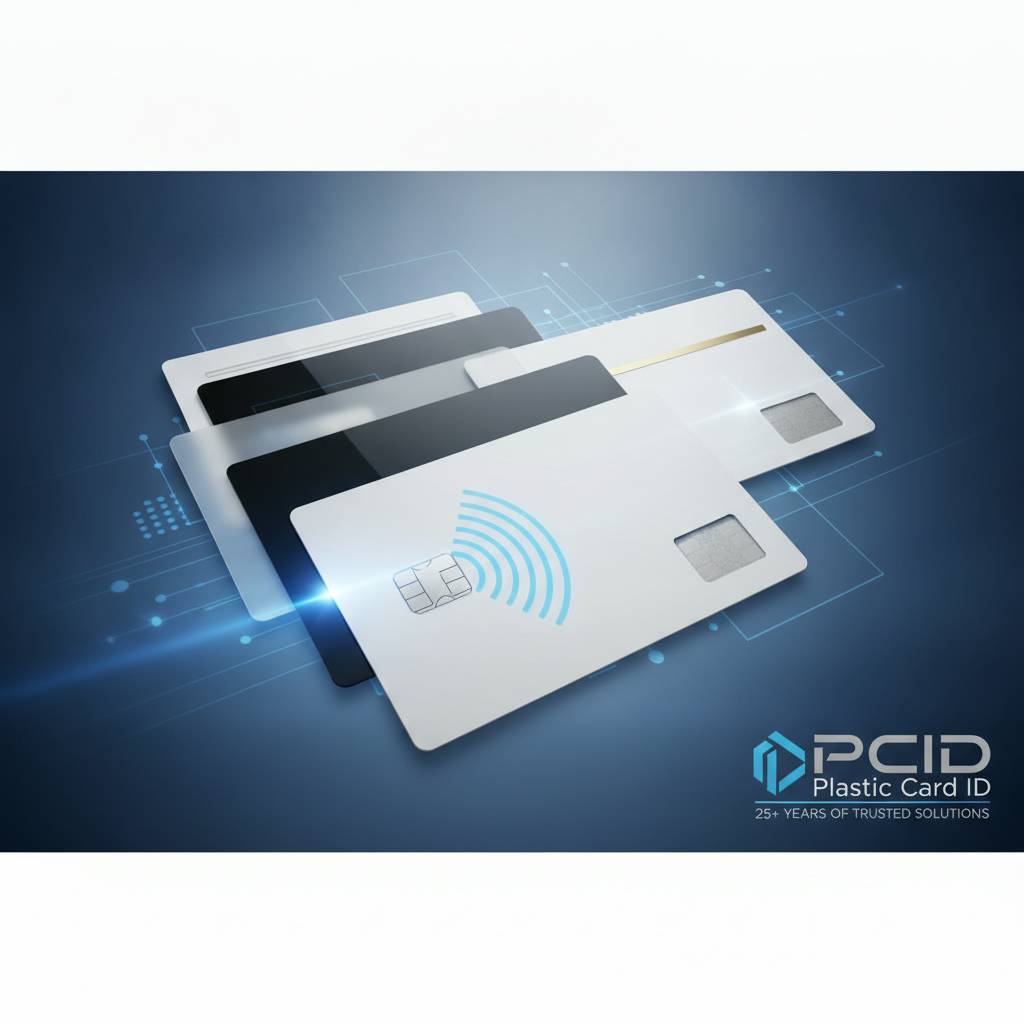 When physical card appearance is important but so is contactless functionality, RFID and smart chip cards represent the logical next step in photo ID program evolution. These cards carry embedded antennas or microprocessors that communicate with readers without physical contact, enabling faster throughput at access control points and supporting encrypted data storage that magnetic stripes simply cannot match.
Plastic Card ID supplies a range of RFID and proximity cards, including MIFARE DESFire options that support advanced encryption for high-security environments. Whether you are managing access to a corporate headquarters, a multi-building university campus, or a government facility with tiered access zones, the right contactless card can serve simultaneously as a printed photo ID and a sophisticated electronic credential.
Proximity Cards vs. Smart Chip Cards
Proximity cards communicate at 125 kHz and are widely used in access control systems that prioritize compatibility with existing infrastructure. They are read-only in most implementations, meaning the card simply transmits a fixed ID number to the reader. Smart chip cards, by contrast, operate at 13.56 MHz, support read/write functionality, and can store encrypted data - making them suitable for applications that require more than simple door-open authentication.
For organizations already running a 125 kHz access control system, proximity cards offer a seamless path to combining photo ID with access control without replacing existing readers. For organizations building new systems or upgrading, smart chip technology offers considerably more capability at a modest per-card premium that typically justifies itself within the first year of operation.
Printing Photo IDs on RFID and Smart Chip Cards
One of the most common questions Plastic Card ID receives is whether RFID cards can be printed on just like a regular blank PVC card. The answer is yes - provided you are using the correct card printer and ribbon combination. RFID and smart chip cards have embedded components that create a slight surface variation, and certain printer models handle this better than others. Matching your contactless card to the right printer is critical for both print quality and chip integrity.
Evolis, Zebra, and Fargo all produce printer models specifically designed to handle smart card printing without damaging embedded antennas or chips. Plastic Card ID stocks all three brands and can help you identify the printer model that handles your specific RFID card format correctly, protecting your card investment from the very first print run.
MIFARE DESFire and High-Security Photo ID Applications
MIFARE DESFire cards are the choice for organizations where data security on the card itself matters as much as physical access control. Government agencies, financial institutions using internal ID systems, healthcare organizations protecting patient data environments, and defense contractors with strict credential management requirements all benefit from the layered encryption architecture that DESFire technology provides.
These cards support AES 128-bit encryption and mutual authentication between card and reader, making credential cloning exponentially more difficult than with standard proximity cards. When your photo ID program exists within a broader security infrastructure that demands these protections, Plastic Card ID has both the product and the expertise to help you source and deploy the right cards at the right scale.
Card Printers, Ribbons, and Supplies: The Complete Photo ID Ecosystem
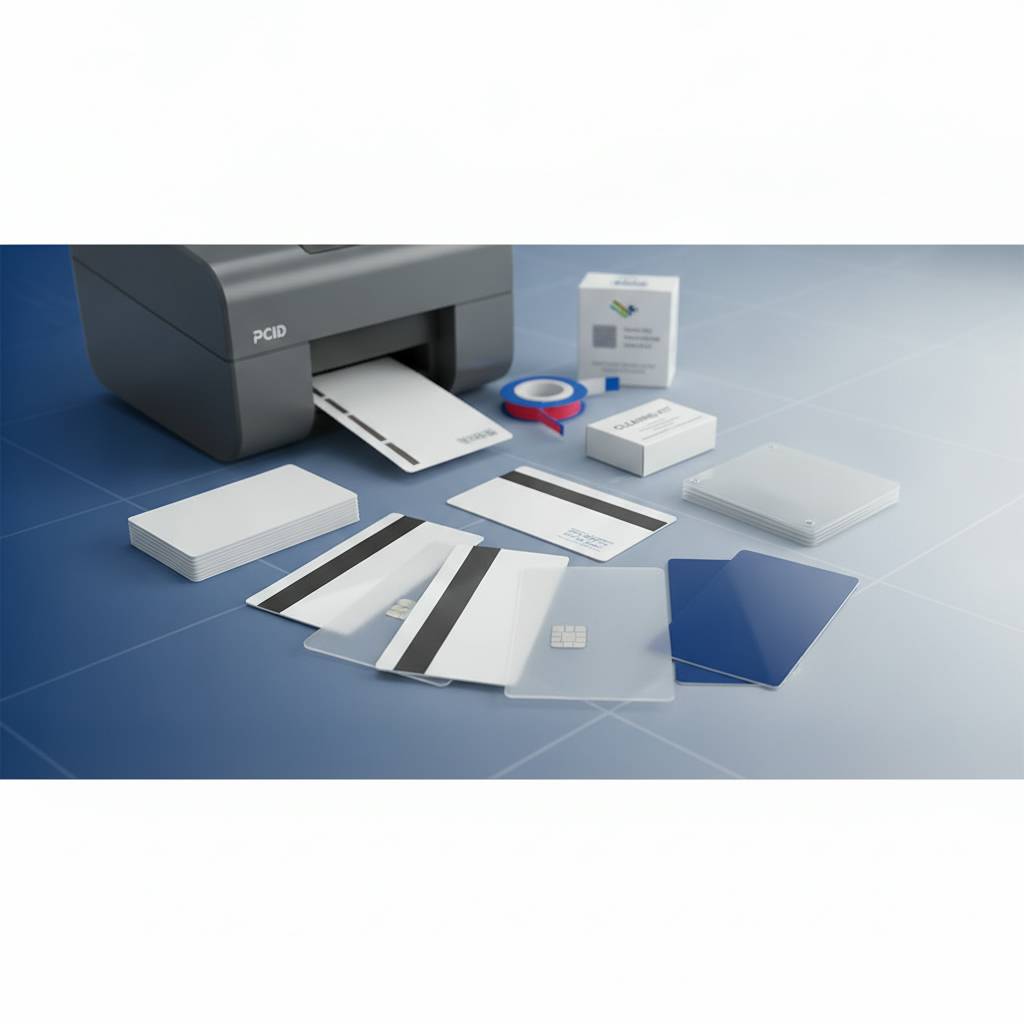 Blank cards are one half of the photo ID equation. The other half is the printer, ribbon, and supporting supplies that transform blank stock into finished credentials. Plastic Card ID operates as a true one-stop shop, supplying not just the cards themselves but the entire operational ecosystem required to run a successful in-house photo ID program.
Evolis, Zebra, and Fargo represent the three dominant brands in desktop card printing, each with distinct strengths depending on your volume requirements and technical environment. Choosing the right printer for your specific blank card stock and encoding requirements is a decision that benefits enormously from the kind of hands-on expertise Plastic Card ID has built over a quarter century of real-world card program support.
Choosing the Right Printer for Your Blank Card Stock
Single-sided printing is appropriate for basic employee ID badges where the reverse of the card remains blank or carries a simple encoded stripe. Dual-sided printing allows organizations to maximize card real estate - printing a photo, name, title, and barcode on the front while placing emergency contact information, access zone details, or organizational policies on the back. Dual-sided printing with quality blank PVC stock produces finished IDs indistinguishable from commercially produced cards.
Retransfer printing technology, used in Fargo's HDP-series printers, prints to a film that is then fused to the card surface rather than printing directly onto the card. This produces edge-to-edge printing with superior image quality and is the preferred method for organizations issuing high-security IDs where print quality and durability are both mission-critical requirements. Contact 800.835.7919 to discuss which printer configuration best matches your program's scope.
Ribbons and Consumables That Match Your Cards
A printer ribbon mismatch is one of the most common causes of poor photo ID quality. YMCKO ribbons - which include Yellow, Magenta, Cyan, Black resin, and Overlay panels - are the standard for full-color photo ID production on blank PVC cards. KO ribbons are appropriate when you need black-text-only printing with an overlay, such as for simple access cards where photo printing is not required.
Plastic Card ID stocks OEM and compatible ribbons for Evolis, Zebra, and Fargo printers, ensuring you always have the consumables on hand to keep your photo ID program running without interruption. Ordering ribbons and blank cards together from a single source simplifies procurement, reduces shipping costs, and ensures compatibility between your consumables and your card stock.
Card Carriers, Sleeves, and Program Accessories
- Card carriers allow organizations to mail finished ID cards to remote employees or satellite locations securely and professionally.
- Card sleeves protect printed photo IDs from surface scratches, humidity, and the general wear that comes with daily handling.
- Cleaning kits extend printer life and maintain print head performance by removing dye and debris buildup that accumulates with regular use.
- Card affixing and mailing services through Plastic Card ID allow larger organizations to outsource the physical distribution step entirely.
- Lanyards, badge reels, and hard badge holders complete the daily-use experience for employees and students carrying printed photo IDs.
Every accessory Plastic Card ID supplies is selected because it serves a functional role in the card program lifecycle. Nothing in the catalog exists for show. When an organization sources everything - cards, printers, ribbons, and accessories - from a single strategic partner, the result is a photo ID program that runs more reliably and costs less to maintain than one cobbled together from multiple uncoordinated vendors.
Frequently Asked Questions About Blank Plastic Cards for Photo ID Programs
After 25 years and over 100,000 customers, Plastic Card ID has heard virtually every question about blank card selection, printer compatibility, encoding technology, and program setup. The questions below reflect the most common areas of uncertainty for organizations launching or expanding photo ID programs.

If your specific question is not addressed here, the fastest path to a confident answer is a direct conversation with CPE's team. Every representative is trained on the full product catalog and equipped to help organizations of any size make well-informed decisions without needing to navigate complicated procurement processes alone.
What Quantity Should I Order to Get Started?
Plastic Card ID supplies blank PVC cards for photo ID programs in quantities ranging from small starter packs appropriate for organizations printing 50 cards per month up to bulk quantities in the tens of thousands for enterprise deployments. There is no minimum order requirement that prices small organizations out of quality card stock. Organizations growing their programs over time often start with smaller quantities and scale up as their printing volume increases.
Bulk ordering does reduce per-card cost meaningfully, and for organizations with predictable issuance volumes, ordering 500-1000 cards at a time rather than 100 at a time produces significant savings over a 12-month period. CPE's team can walk you through the volume pricing tiers and help you identify the ordering cadence that balances unit cost against storage requirements.
Will These Blank Cards Work With My Existing Card Printer?
CR80 30-mil blank PVC cards are compatible with virtually every desktop card printer currently in service in the United States. However, specialty cards - RFID, smart chip, clear PVC, or non-standard thickness - require additional compatibility verification. Printer compatibility is one of the most important checks before placing any blank card order, and it is something Plastic Card ID takes seriously at every customer interaction.
When you reach out to CPE with your printer model and card type requirements, the team will confirm compatibility before your order ships. This process prevents the frustration and lost productivity of receiving card stock that performs poorly in your specific hardware environment.
Do You Supply Blank Cards for Specialized ID Applications?
Plastic Card ID supplies blank and custom cards for an extensive range of specialized photo ID applications, including casino player cards, hotel key cards, healthcare employee credentials, university student IDs, government contractor badges, and event staff credentials. Clear and frosted PVC cards serve premium credential applications where visual distinction matters. Custom die-cut shapes and luxury metal cards in stainless steel, brass, and gold are available for organizations that want their credential to make an unmistakable statement.
The catalog depth that Plastic Card ID maintains is one of the primary reasons organizations come back year after year rather than sourcing from commodity resellers. When your program evolves and your requirements become more sophisticated, your supplier should be able to grow with you without requiring you to start the vendor relationship process over from scratch.
Partner With Plastic Card ID for Your Photo ID Program Today
 Building a photo ID program that works reliably at any scale is not about finding the cheapest blank cards available. It is about partnering with an organization that understands the full card program lifecycle - from selecting the right blank stock to maintaining the printer fleet that produces finished credentials year after year. Plastic Card ID has been that partner for organizations across every industry in the United States for over 25 years, and the depth of that experience shows in every recommendation, every product match, and every order shipped.
Blank plastic cards for photo ID programs are the foundation. What gets built on that foundation - the encoding, the printing, the distribution, the day-to-day management of credentials at scale - depends entirely on getting that foundation right. CPE has the product depth, the technical expertise, and the long-term client relationships to prove that the right foundation makes everything built on top of it more reliable, more professional, and more cost-effective.
Ready to Build or Upgrade Your Photo ID Program?
Whether you are launching a brand-new in-house photo ID program or sourcing replacement blank cards for an existing printer, Plastic Card ID is ready to help you find exactly what you need. With over 50 million cards shipped and a catalog that spans every major card technology in use today, there is no photo ID challenge too specific or too large for this team to handle.
Call 800.835.7919 today and speak directly with a card program specialist who can match your organization to the right blank card stock, printer, ribbon, and accessories - and help you build a photo ID program that runs smoothly from issuance to everyday use. The call takes minutes. The results last for years.
Contact Plastic Card ID now at 800.835.7919 and take the first step toward a professional, reliable, and scalable photo ID program your organization can depend on.