Glossy vs Matte Finish Blank Plastic Cards Compared
Table of Contents []
- Glossy vs Matte Finish Blank Plastic Cards: Which Surface Is Right for Your Program? Plastic Card ID
- Understanding Card Finish: More Than a Cosmetic Choice
- Blank Glossy Plastic Cards: Best Use Cases and Program Fits
- Blank Matte Plastic Cards: Where Understated Wins
- Technical Specifications: What to Know Before You Order
- Choosing Between Glossy and Matte: A Practical Decision Framework
- Why Businesses Across the USA Choose Plastic Card ID
Glossy vs Matte Finish Blank Plastic Cards: Which Surface Is Right for Your Program? Plastic Card ID
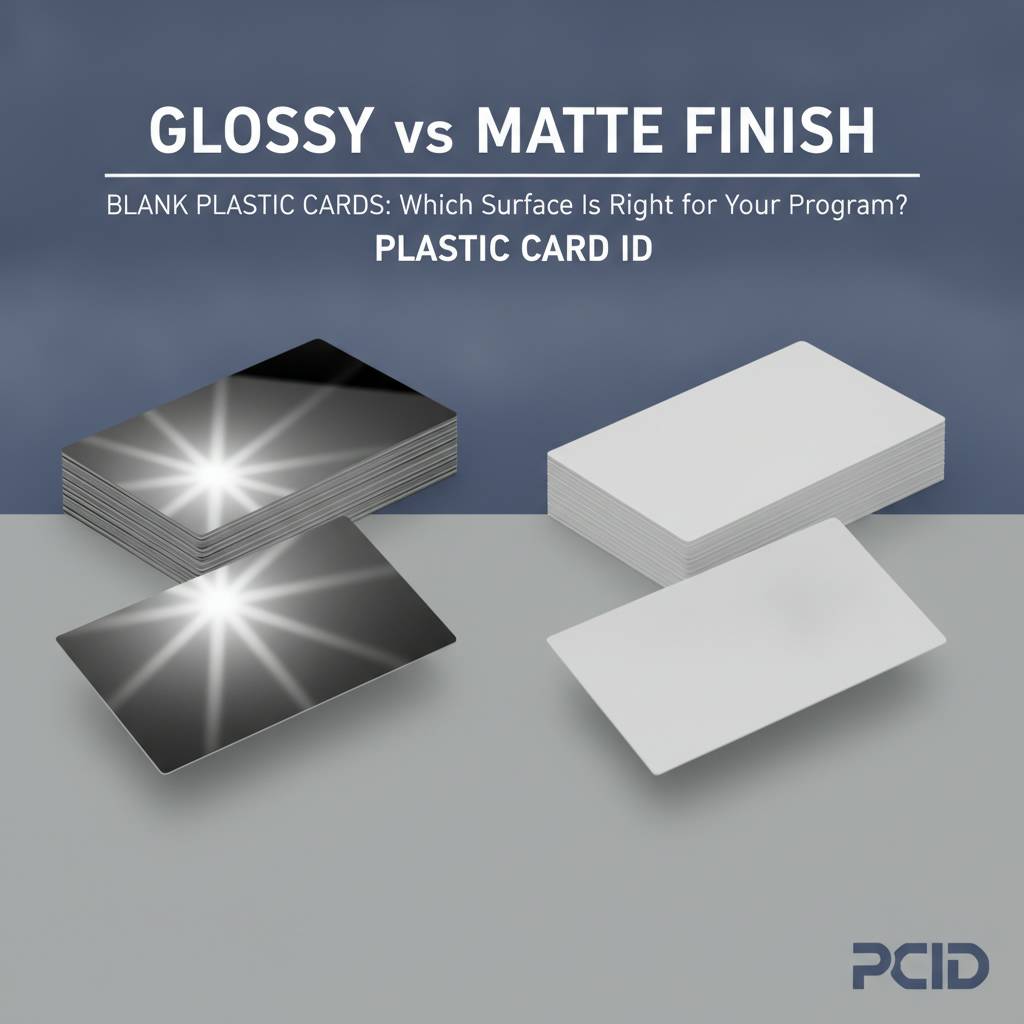 Walk into any professional environment and the cards people carry say something before a word is spoken. The finish on a plastic card is not just aesthetic - it influences how the card photographs, how ink adheres, how it holds up in daily use, and whether it projects authority or approachability. If you are sourcing blank plastic cards and wondering whether glossy or matte is the smarter choice, you have landed in exactly the right place.
The surface finish of a CR80 card quietly shapes every downstream decision: printer compatibility, lamination type, overcoating options, and even how end users perceive the organization behind the card. CPE has helped more than 100,000 businesses navigate exactly these kinds of choices - and the glossy vs matte question comes up constantly, from scrappy startups issuing their first loyalty cards to enterprise operations printing tens of thousands of access credentials each month.
| Feature | Glossy Finish | Matte Finish |
|---|---|---|
| Light Reflection | High shine, reflective | Low glare, diffused |
| Color Vibrancy | Colors appear bolder | Colors appear softer |
| Fingerprint Visibility | More visible | Less visible |
| Writing on Surface | Difficult without coating | Easier with proper pen |
| Print Quality (Dye-Sub) | Vivid, photo-quality | Clean, professional |
| Typical Use Cases | Gift cards, loyalty, VIP | ID badges, access cards |
| Scratch Resistance | Scratches more visible | Scratches less noticeable |
Understanding Card Finish: More Than a Cosmetic Choice
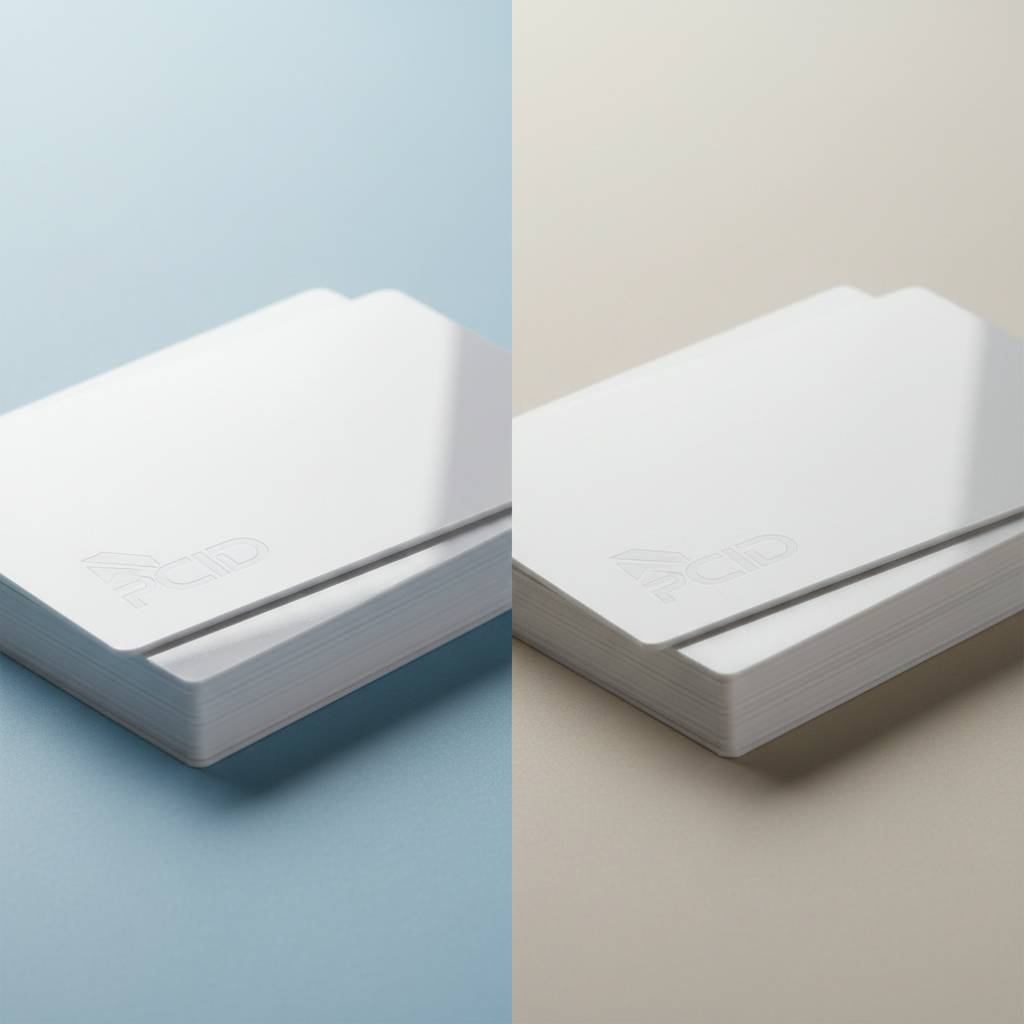 Most people treat finish selection as a branding call, and it partly is - but the decision runs deeper than aesthetics. Surface texture affects ink adhesion, dye-sublimation transfer quality, laminate bonding, and even scanner readability when barcodes or magnetic stripes are involved. Getting the finish right from the start prevents expensive reprints and compatibility headaches down the line.
Blank CR80 plastic cards - the standard 30 mil, ISO 7810-compliant format - are available in both glossy and matte surfaces, and the choice locks in certain printing behaviors before you ever load a card into a printer. Dye-sublimation ribbons, for example, interact very differently with a high-shine PVC surface versus a textured matte one. The results can be stunning or disappointing depending on whether the combination was intentional.
What Glossy PVC Cards Actually Deliver
A glossy card surface reflects light in a way that makes printed colors appear more saturated and vibrant. Photography-style portrait printing, full-bleed graphic designs, and bold brand color blocks all benefit from this reflective quality. If your card program is visually competitive - think gift cards, VIP memberships, or loyalty programs in retail environments - glossy is typically the power move.
The tradeoff is real, though. Glossy surfaces pick up fingerprints, smudges, and fine scratches more readily than matte equivalents. Cards handled constantly - like employee ID badges worn on lanyards all day - will show wear faster on a high-gloss surface unless an overlaminate protective layer is applied. The shine also creates minor glare under fluorescent lighting, which occasionally causes issues with barcode scanning if print registration is slightly off.
What Matte PVC Cards Actually Deliver
Matte finish cards have a subtly textured surface that scatters light rather than reflecting it. The result is a clean, understated appearance that many organizations find more professional-looking for identity credentials. Security badges, access control cards, corporate ID programs, and healthcare credentials often look more authoritative in matte than in gloss.
From a functional standpoint, matte cards resist visible fingerprinting better, and some users find them easier to write on with a ballpoint pen or permanent marker - useful in programs where handwritten elements (dates, room numbers, temporary permissions) are part of the workflow. Dye-sublimation printing on matte surfaces produces sharp, readable text and clean photo rendering, though colors will appear slightly less punchy than on gloss.
Printer Compatibility Considerations
Card printers from manufacturers like Evolis, Zebra, and Fargo are calibrated for specific card surface types. Dye-sublimation ribbon sets - YMCKO being the most common - are engineered to transfer color onto a surface with specific absorption characteristics. Using a gloss-calibrated ribbon on a matte card, or vice versa, can yield undersaturated prints, poor adhesion, or surface delamination.
The solution is straightforward: match your ribbon selection to your card finish and confirm compatibility with your specific printer model. CPE carries ribbons for Evolis Primacy, Zenius, Badgy, Zebra ZC300, ZC100, and Fargo HDP5000 series printers - and the team is available to help you match supplies to card stock before you commit to a bulk order. Call 800.835.7919 if you want to work through the compatibility specifics before ordering.
Blank Glossy Plastic Cards: Best Use Cases and Program Fits
Glossy cards dominate certain segments of the market for good reason. Retail environments are intensely visual, and a glossy gift card sitting in a point-of-sale display needs to compete visually with dozens of other products. The reflective surface catches light, draws the eye, and signals perceived value - all before the design has done its job. Retailers who switch from paper certificates to plastic gift cards with glossy finishes routinely see sales increases in the 35-50% range. That is not a coincidence.

Beyond gift cards, glossy stock excels in loyalty programs, club memberships, hospitality VIP tiers, and any card program where the physical object functions as a brand ambassador. The card a customer carries in their wallet is a daily impression of your organization - and glossy stock ensures that impression is vivid, consistent, and premium-feeling every single time.
Loyalty and Gift Card Programs
Loyalty cards on glossy PVC stock outperform paper punch cards in measurable ways. They survive the wallet environment - heat, pressure, slight moisture - that destroys paper alternatives within weeks. More importantly, they look like something worth keeping. A card a customer values enough to carry is a card that drives repeat visits. That simple truth is why organizations invest in plastic over paper.
Gift cards benefit from glossy stock for slightly different reasons. The purchasing moment involves a visual presentation - the card is often the product itself, displayed and selected on the basis of appearance. Full-color dye-sublimation printing on glossy CR80 stock produces photo-realistic results that communicate brand investment and product quality instantly. Blank glossy stock allows in-house design and printing teams to control the final output and update card designs seasonally without minimum order constraints.
Casino and Hospitality Applications
Casino player cards and hotel key cards frequently use glossy stock as their baseline surface, with selective matte or soft-touch overlaminate applied in premium tiers to create contrast textures. The standard player card in a casino rewards program needs to feel like something valuable - glossy PVC delivers that tactile and visual signal effectively and durably.
Hotel key cards require reliable encoder compatibility above all else, but the surface finish still matters for guest experience. A well-printed glossy key card with crisp room number graphics and brand colors signals operational quality throughout a guest's stay - a small detail that accumulates into overall impression scores. CPE supplies hotel key card stock ready for magnetic stripe encoding, compatible with standard RFID key systems.
Marketing and Event Credentials on Glossy Stock
Trade show credentials, conference passes, event VIP cards, and promotional give-away cards all perform exceptionally well on glossy stock. The material photographs well for social sharing, survives a full day of event handling, and can carry variable data - personalized names, QR codes, barcode sequences - printed in-house using standard card printer setups.
Event-specific programs benefit from blank glossy stock because design flexibility is maximal. Your team designs the card, loads blank stock into the printer, and outputs finished credentials on demand - no waiting for pre-printed stock to arrive, no minimum order per design, no wasted cards from last-minute attendee changes. In-house production with blank glossy stock keeps event card programs agile and cost-effective at any scale.
Blank Matte Plastic Cards: Where Understated Wins
 There is a professional context in which a glossy card looks slightly out of place - and it tends to involve identity, authority, and access. A matte-finish employee ID badge issued by a hospital, university, or government contractor carries a different visual register than a glossy loyalty card. It reads as institutional, deliberate, and serious. Matte finish communicates permanence and professionalism in a way that gloss simply cannot replicate.
Access control programs, corporate ID systems, membership organizations with formal structures, and healthcare providers all tend to default toward matte for this reason. The card is not marketing collateral - it is a credential. Its finish should reflect that function. Matte stock also pairs cleanly with proximity card technology and smart chip embedding, where the card itself is less about appearance and more about encoded permissions and identity verification.
Employee ID and Access Control Programs
Employee ID badges on matte stock present cleanly under fluorescent office lighting without glare. Photo ID printing on matte surfaces produces sharp portrait rendering with excellent text legibility - important when security personnel are visually verifying identity quickly. For high-volume ID programs running hundreds or thousands of cards per month, matte stock is typically the cost-efficient and operationally reliable choice.
Access control cards - whether proximity format, RFID, or smart chip - are often produced on matte PVC because the finished card's appearance is secondary to its functional payload. The card's job is to communicate electronically with readers, grant or deny access, and survive daily use in pockets and cardholders. Matte stock holds up to this daily handling cycle with fewer visible signs of wear than glossy alternatives.
Healthcare and Education ID Programs
Hospitals, clinics, universities, and school districts issue large volumes of ID cards annually. The functional demands are significant: photo ID printing, name and department data, potentially a magnetic stripe or barcode for system integration, and durability across a full school year or employment period. Matte finish blank cards handle all of these requirements while maintaining a professional appearance that institutional contexts demand.
Education programs specifically benefit from matte stock's resistance to visible wear. Student IDs travel in backpacks, pockets, and cheap cardholders - they take physical abuse daily. The slightly textured matte surface conceals light scratching better than glossy alternatives, extending the visual lifespan of each card without requiring additional protective laminate layers that add per-card cost.
Membership Organizations and Professional Associations
Professional associations, trade unions, alumni networks, and member-based organizations issue cards that carry a specific social signal: you belong, you have earned this, this organization is legitimate. Matte finish aligns with that register. It does not shout - it confirms. A matte membership card reads as established and authoritative rather than promotional.
For these programs, blank matte stock allows the organization's design and administrative teams to control card production in-house. Member data, membership tier, and expiration information can all be printed variable on a card-by-card basis using a desktop card printer. The result is a professional credential issued exactly when needed, at a fraction of the per-unit cost of outsourced card production. Contact CPE at 800.835.7919 to discuss blank matte card stock in quantities matched to your membership scale.
Technical Specifications: What to Know Before You Order
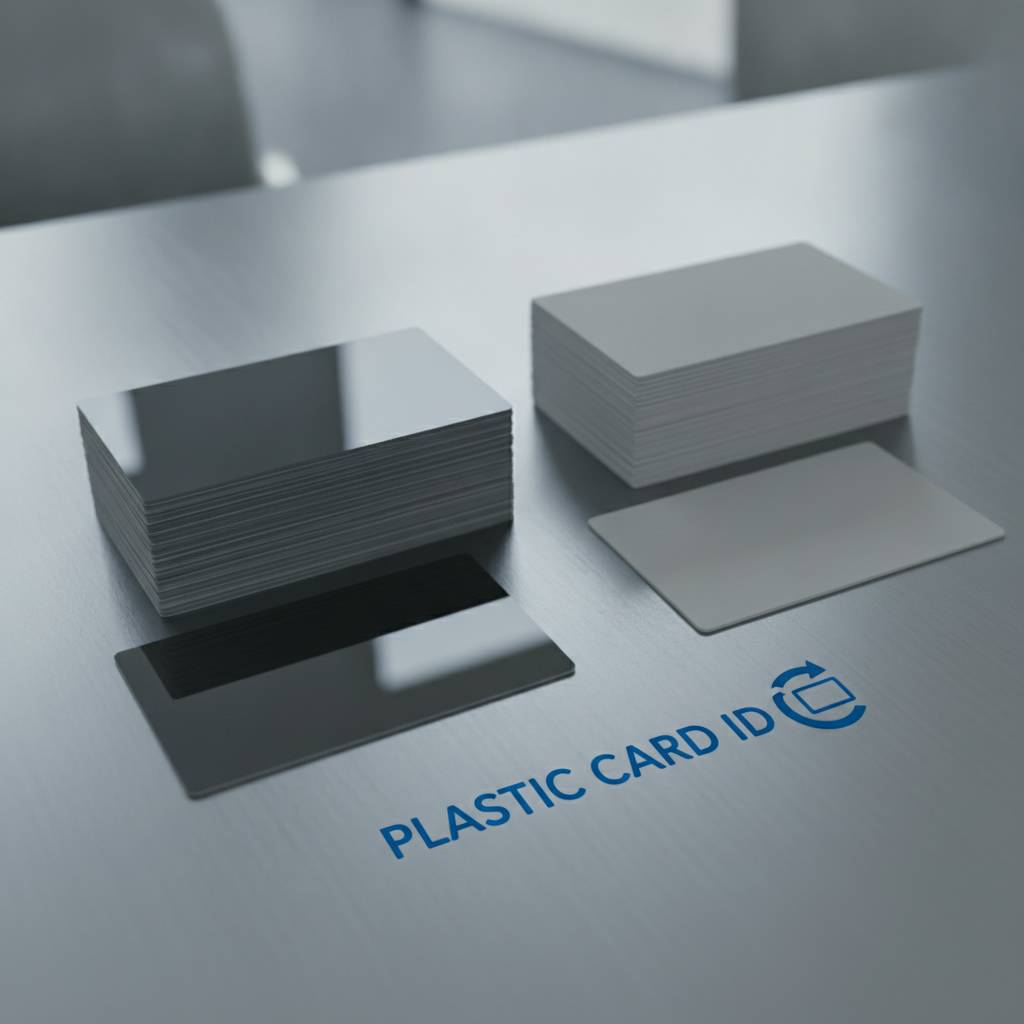 Blank plastic cards, regardless of finish, share the same fundamental CR80 geometry: 3.375 inches wide by 2.125 inches tall, 30 mil thick. This is the ISO 7810 ID-1 standard - the same footprint as a standard credit card, and the format compatible with virtually all commercial card printers and cardholders. Surface finish is applied during manufacturing and is a property of the base PVC stock itself, not a post-processing coating.
Both glossy and matte cards are available across the full range of card configurations CPE supplies - plain white PVC, colored stock, pre-encoded magnetic stripe (HiCo at 2750 Oe or LoCo at 300 Oe), proximity and RFID configurations, and smart chip variants. Finish selection is independent of functional encoding - you can have a HiCo magnetic stripe card in either finish, a proximity card in either finish, and so forth.
Magnetic Stripe Options Across Both Finishes
HiCo magnetic stripe cards are appropriate for applications requiring data retention across environmental stress - parking garages, transit systems, access control environments where cards are frequently swiped on powered readers. LoCo cards are cost-effective for shorter-lifecycle programs like hotel key cards and event passes where the card has a defined useful life. Both HiCo and LoCo stripe configurations are available on glossy and matte base stock.
Stripe placement and track configuration (Tracks 1, 2, and 3) remain consistent across finish types. If your card program encodes variable data - account numbers, member IDs, access levels - the magnetic stripe encoding process is unaffected by the PVC surface finish. Your card printer's magnetic encoding module writes to the stripe independently of how the card surface interacts with the print head.
RFID and Smart Chip Cards
Proximity cards (125 kHz) and RFID smart cards (13.56 MHz, including MIFARE DESFire and other contactless standards) are available in both glossy and matte PVC finishes. The embedded antenna and chip are encapsulated within the card laminate structure and are not affected by surface texture. For access control programs requiring contactless technology, finish selection remains a purely aesthetic and functional-surface decision.
MIFARE DESFire cards, used in sophisticated multi-application access control and campus systems, represent the higher end of the contactless card ecosystem. These cards carry encrypted credentials, support multiple application sectors on a single card, and integrate with enterprise-grade access management platforms. They are available through CPE in configurations suited to small business deployments and large institutional programs alike.
Specialty Stock: Clear, Frosted, and Colored Cards
- Clear plastic cards offer a fully transparent base, creating distinctive visual effects when printed with partial designs or used as overlay cards on printed inserts.
- Frosted cards deliver a semi-opaque, soft-texture appearance that functions similarly to matte in light diffusion but with a distinctive premium aesthetic.
- Colored PVC stock - available in black, gold, silver, and other colors - provides a base that eliminates the need for full-card background printing, reducing ribbon consumption and per-card cost.
- Custom die-cut shapes allow card programs to break the CR80 rectangle for promotional and marketing applications where distinctive physical format is part of the brand statement.
- Luxury metal cards in stainless steel, brass, and gold are available for premium membership tiers, VIP programs, and executive credential applications where a plastic card simply will not project the desired level of prestige.
Choosing Between Glossy and Matte: A Practical Decision Framework
The most efficient way to resolve the glossy vs matte question is to work backwards from card function and end-user context. A card that markets, rewards, or represents value to a consumer almost always benefits from glossy finish. A card that identifies, authorizes, or grants access to an employee or member almost always performs better in matte. When in doubt, request samples of both finish types and run a short test print run on your target printer before committing to bulk stock.
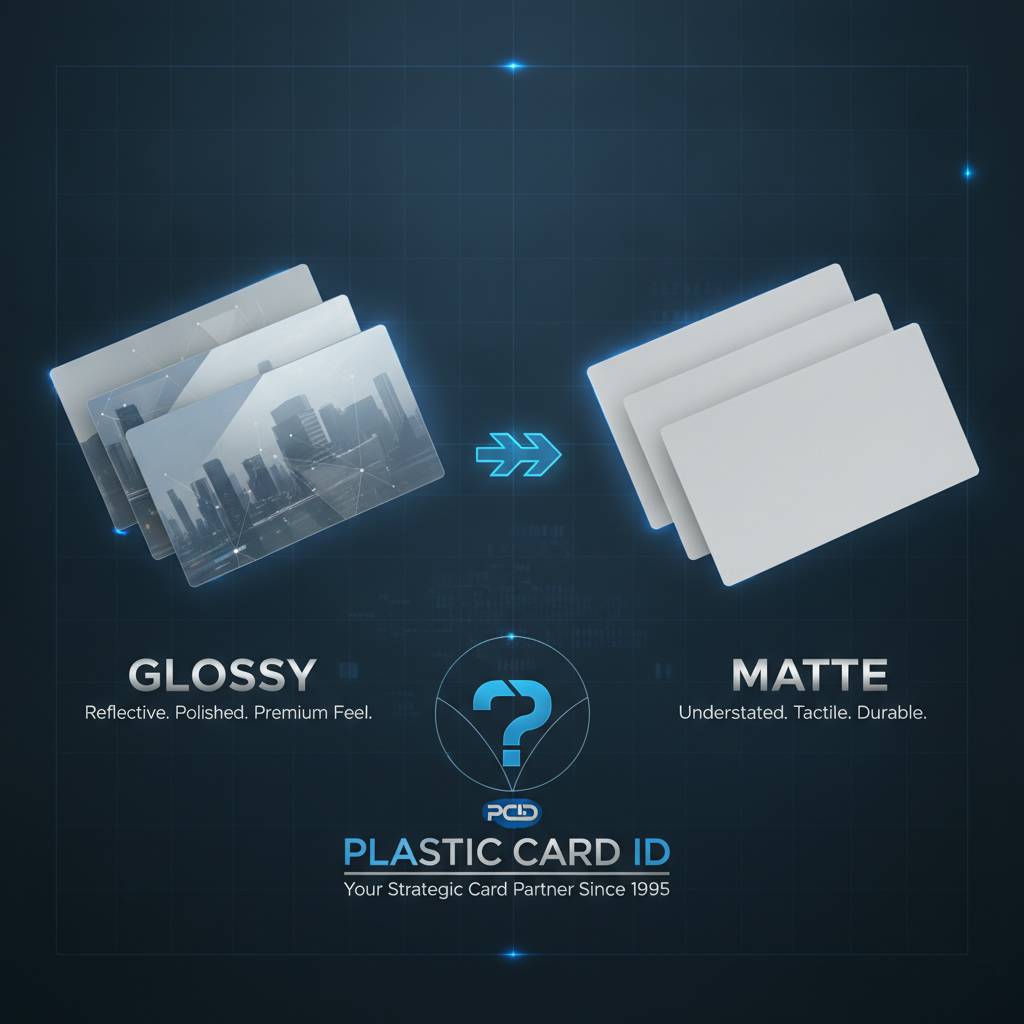
Budget is rarely the deciding factor - glossy and matte blank PVC cards are priced comparably at equivalent quantity breaks. The real decision variables are print quality consistency, durability expectations, printer compatibility, and the professional register the finished card needs to project. Getting these variables aligned correctly upfront prevents costly downstream corrections.
Questions to Ask Before Selecting Card Stock
- What card printer model will be used, and what finish does the manufacturer recommend for that printer's ribbon set?
- Will the card carry a full-color photo, or primarily text and logo data?
- How much daily handling will the card endure - wallet carry, lanyard wear, frequent swiping or scanning?
- Is the card a consumer-facing marketing object, or an institutional credential issued to employees and members?
- Will a protective overlaminate be applied, and if so, does it interact differently with glossy versus matte base stock?
- What quantity will be issued initially, and what is the monthly reorder frequency likely to be?
Ordering Strategies for Smart Buyers
Organizations new to in-house card production should start with a smaller introductory quantity - typically 500 to 1,000 cards - to validate the print setup before committing to a full program stock order. Both glossy and matte stock are available in quantities from as low as 100 cards up to tens of thousands, with per-card pricing that scales down meaningfully as volume increases. Locking in a finish type early and ordering consistently in that finish streamlines reordering and prevents visual inconsistency across card batches.
Organizations running multiple card programs simultaneously - say, a loyalty card in glossy and an employee badge in matte - should maintain separate stock inventories and label card boxes clearly. Mixing finish types within a print run produces inconsistent results and is the single most common source of in-house card printing complaints. Simple inventory discipline eliminates the problem entirely.
Value-Added Supplies to Order Alongside Card Stock
CPE supplies everything your card program needs beyond the cards themselves. Printer ribbons matched to your printer model and card finish, cleaning kits to maintain print head performance, card sleeves and cardholders to extend card life in daily use, card carriers for mailing new credentials to remote employees or members, and card affixing and mailing services for programs that require fulfillment support. Sourcing all program supplies from a single partner simplifies procurement and ensures supply compatibility.
Printer maintenance is not optional in a high-volume card program. Residue accumulates on print heads over time, degrading color accuracy and increasing the risk of printing defects. Regular cleaning with manufacturer-recommended cleaning kits maintains consistent output quality and protects the hardware investment. CPE stocks cleaning kits for all major printer lines and can help you establish a maintenance schedule appropriate to your print volume.
Why Businesses Across the USA Choose Plastic Card ID
 More than 100,000 businesses and organizations across the United States have trusted Plastic Card ID with their card programs - from single-location small businesses issuing 50 loyalty cards a month to multi-site enterprises managing tens of thousands of access credentials. The breadth of that client base means the team has encountered virtually every card program challenge that exists, and can apply that accumulated knowledge directly to your program's specific needs.
The difference between a supplier and a strategic partner shows up in moments of ambiguity - when you are not sure which finish to order, when a printer is producing unexpected output, when a program scales faster than anticipated and you need to adjust quickly. Over 25 years and more than 50 million cards sold, Plastic Card ID has developed the expertise and the relationships to support programs through those moments without disruption.
Comprehensive Card and Printer Catalog
The Plastic Card ID catalog spans every major category of plastic card - blank white CR80 glossy and matte, colored stock, magnetic stripe configurations, proximity and RFID cards, smart chip variants, clear and frosted stock, and specialty formats including metal cards and custom die-cut shapes. Card printers from Evolis, Zebra, and Fargo are available alongside the full range of compatible ribbons, overlaminates, and maintenance supplies.
Everything a card program needs, from blank stock to finished credentials to ongoing supply replenishment, is available from a single source. That consolidation reduces procurement overhead, simplifies vendor management, and ensures that every component in your card program is sourced from a team that understands how it all works together.
Scalable Programs for Every Organization Size
There is no minimum order size that makes a card program worth supporting. A yoga studio issuing 75 membership cards per quarter receives the same quality of product and service attention as a national retailer printing 50,000 gift cards per month. Scalability in both directions - starting small and growing, or managing large volumes with consistent reliability - is core to how Plastic Card ID operates.
As programs grow, the per-card economics improve. Bulk pricing tiers reward volume, and organizations that establish consistent reorder patterns can often lock in pricing that makes in-house card production dramatically more cost-efficient than outsourced card fulfillment at comparable quality levels. The economics favor building the in-house capability, and Plastic Card ID provides the supplies and support to make that investment worthwhile.
Expert Support Available When You Need It
Questions about glossy vs matte finish, printer compatibility, magnetic stripe encoding specifications, RFID configuration options, or order quantities are answered by people who work with plastic cards every day - not by a generic customer service script. Real expertise on the other end of the line makes a meaningful difference when a program decision has downstream operational consequences.
Whether you are setting up your first in-house card program, upgrading an existing one, or troubleshooting a printing inconsistency, the team at Plastic Card ID is ready to help. Reach out to discuss your program requirements, get product recommendations specific to your use case, and request samples before placing your first order. Call 800.835.7919 - the conversation costs nothing and the guidance is worth significantly more than that.
Ready to find the right blank plastic card stock for your program? Whether glossy finish fits your loyalty and gift card needs, or matte is the right call for your ID and access control credentials, Plastic Card ID has the stock, the printers, and the supplies to build your program right. Call Plastic Card ID today at 800.835.7919 and talk to a team that has helped over 100,000 organizations across the USA get their card programs working exactly as they should.
Previous Page