Minimum Order Quantities for Blank Plastic Cards
Table of Contents []
- What Plastic Card ID Wants You to Know About Minimum Order Quantities for Blank Plastic Cards
- Blank Card Types and Their Minimum Order Landscape
- How to Calculate the Right Quantity for Your Program
- Card Printers and the Relationship Between Equipment and Order Quantities
- Real-World Card Programs and What Quantity Strategies Look Like in Practice
- Frequently Asked Questions About Minimum Orders for Blank Plastic Cards
- Partner With Plastic Card ID for Every Stage of Your Card Program
What Plastic Card ID Wants You to Know About Minimum Order Quantities for Blank Plastic Cards
 Here is something that surprises a lot of first-time buyers: the question is rarely "can I order a small quantity?" and almost always "what does the right quantity actually look like for my program?" Minimum order quantities for blank plastic cards are not just a purchasing hurdle - they are a planning signal. They tell you something about how a supplier operates, what their production economics look like, and whether they are genuinely built to serve businesses like yours.
Plastic Card ID has been in this space for over 25 years, supplying blank and custom plastic cards to businesses across the United States. With more than 100,000 customers served and over 50 million cards sold, they have seen every kind of card program - from boutique membership clubs ordering 50 cards a month to regional retailers running mass-production gift card campaigns in the tens of thousands. That range of experience shapes how they think about minimum orders, pricing tiers, and what genuinely serves a buyer at each stage of growth.
This page breaks down everything you need to know - from how minimums work across different card types, to what the per-card economics actually look like at various quantities, to the real-world reasons why ordering smarter, not just cheaper, is the move that protects your program long-term.
Why Minimums Exist and What They Signal
Plastic card production involves setup, quality control, material sourcing, and packaging - none of which scales to zero. Minimum order quantities exist because below a certain threshold, the cost of fulfilling an order exceeds what any reasonable per-card price can cover. A supplier willing to sell you five cards is either pricing them like gold or operating at a loss. Neither scenario is good for a buyer who wants a reliable long-term partner.
When a supplier sets a minimum - say, 100 or 500 cards - they are signaling something about the quality and consistency of their operation. Plastic Card ID structures minimums to be genuinely accessible for small programs while keeping the economics honest. That means a small nonprofit running an ID card program and a mid-size retailer launching a gift card initiative can both find a quantity tier that works without overpaying or under-ordering.
The CR80 Standard and Why It Dominates Blank Card Programs
The blank CR80 card - 3.375 inches by 2.125 inches, 30 mil thick, ISO 7810 compliant - is the workhorse of in-house card programs everywhere. It is the same dimensions as a standard credit card, which means it fits wallets, badge holders, card sleeves, and every card printer on the market without modification. When you order blank CR80 PVC cards, you are buying total flexibility at the lowest possible per-card cost.
These cards start as a blank slate. What gets printed or encoded onto them determines their function - an employee badge one day, an event credential the next, a loyalty card or access token depending on your program's needs. That versatility is exactly why CR80 blanks make up the bulk of blank card orders for organizations that want control over their card design and timing without committing to a fully pre-printed run.
Reading a Quantity Tier: How Per-Card Pricing Works
Pricing for blank plastic cards is volume-sensitive in a way that rewards planning. The per-card cost at 100 units is meaningfully higher than at 500, and 500 versus 2,500 represents another significant drop. This is not a trick - it reflects actual production and fulfillment economics. Understanding how to read a quantity tier is one of the most practical skills a card program manager can develop.
A buyer ordering 100 cards at a higher per-unit cost may be making the right call if their storage space is limited or their card design changes frequently. A buyer who orders 2,500 when they genuinely need 2,500 over the next six months saves real money. The mistake is ordering low out of habit when a higher-quantity commitment would lock in savings that compound across the life of the program. CPE can help you model this before you commit.
Blank Card Types and Their Minimum Order Landscape
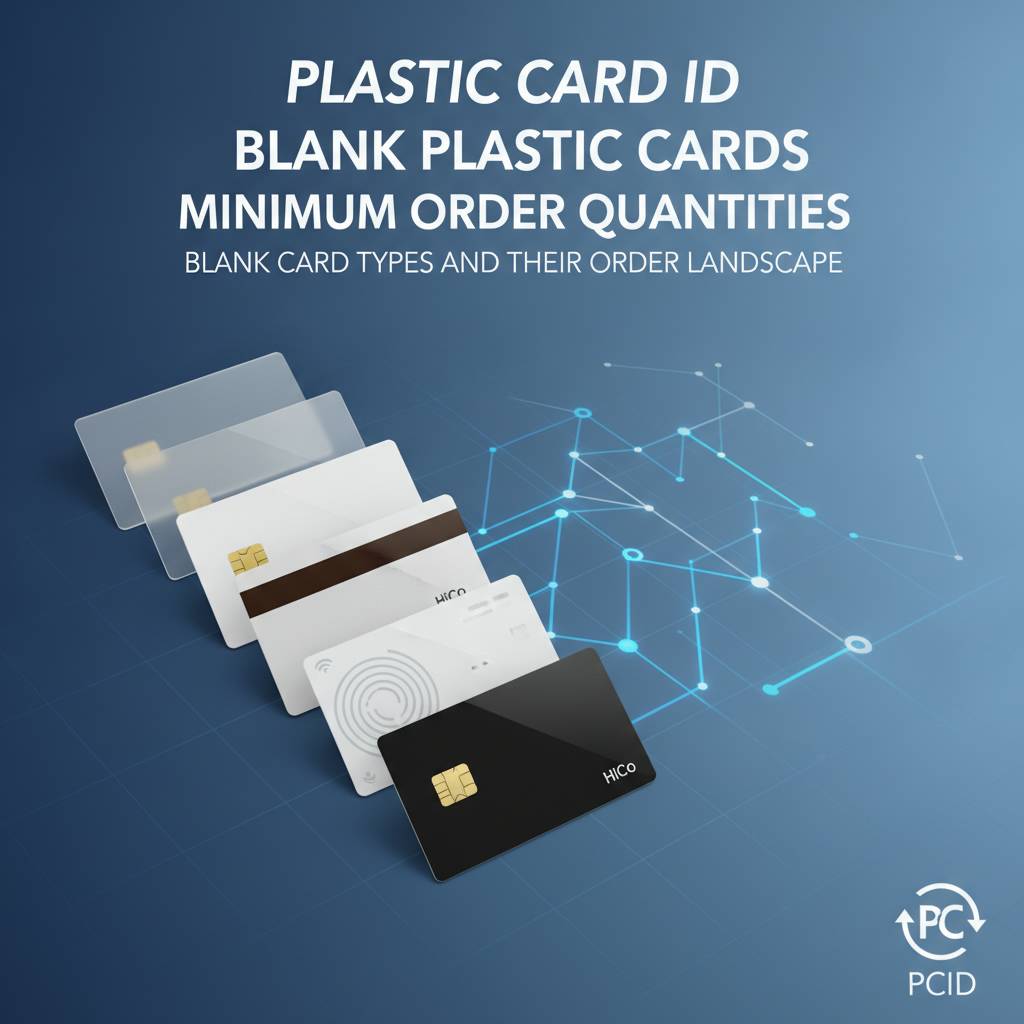 Not all blank plastic cards carry the same minimums or the same pricing logic. Card type matters - both in terms of what the card can do and what it costs to produce. A plain white PVC card has a different production profile than a HiCo magnetic stripe card or an RFID proximity card, and minimums reflect those differences. Knowing the card type you actually need before shopping by price is the smartest first move any buyer can make.
The Plastic Card ID catalog covers a wide range of card types, each with its own minimum order structure. Whether you are sourcing plain white blanks for in-house printing, magnetic stripe cards for loyalty or access programs, or RFID cards for contactless applications, the approach to minimums follows the same principle: accessible entry points, better pricing at higher quantities, and consistent quality across every tier.
| Card Type | Common Applications | Typical Starting Quantity | Best For |
|---|---|---|---|
| Plain White PVC CR80 | ID cards, badges, event passes | 100 | Small to large programs, in-house printing |
| HiCo Magnetic Stripe | Gift cards, loyalty, access | 100 | Retail, hospitality, membership programs |
| LoCo Magnetic Stripe | Hotel keys, short-term access | 100 | Hotels, short-duration credential programs |
| RFID / Proximity | Access control, contactless ID | 50-100 | Offices, facilities, secure environments |
| Smart Chip Cards | Secure access, casino, advanced ID | 100 | High-security, high-value programs |
| Clear / Frosted PVC | Premium membership, VIP credentials | 100 | Upscale brands, specialty programs |
Plain White PVC: The Entry Point for Most Programs
Plain white CR80 PVC cards are the most accessible starting point in the blank card category. Minimums here are designed to serve programs of genuinely modest scale - the nonprofit running 50-100 volunteer badges, the small gym issuing member IDs, the event organizer who needs credentials for a single conference. These cards represent the clearest value proposition in the entire catalog: maximum flexibility at minimum cost.
For in-house card programs, the calculation is straightforward. You invest in a card printer, stock a supply of blank PVC cards, and print on demand. Your per-card cost drops with quantity, your design flexibility stays high, and you never pay for a vendor's design markup. CPE has helped thousands of organizations set up exactly this kind of program, and the blank white CR80 card is almost always the foundation.
Magnetic Stripe Cards: HiCo vs. LoCo and Why It Matters at Any Quantity
Magnetic stripe cards come in two coercivity levels - High Coercivity (HiCo) and Low Coercivity (LoCo) - and the distinction matters before you place any order, regardless of quantity. HiCo cards are more resistant to accidental demagnetization and are suited for gift cards, loyalty programs, and anything that will be used repeatedly over months or years. LoCo cards encode more easily and work well for hotel room keys or short-term credentials where longevity is less critical.
Minimums for magnetic stripe cards are similar to plain PVC, but the per-card cost is modestly higher due to the stripe component. Ordering the wrong stripe type is a mistake that no quantity discount can fix after the fact, so confirming your encoder compatibility before ordering is a step worth taking seriously. Plastic Card ID can help you confirm compatibility with the equipment you already have or plan to purchase.
RFID and Smart Cards: Minimums for Advanced Card Programs
RFID proximity cards and smart chip cards carry higher per-unit costs than plain PVC, reflecting the embedded technology. Programs that need contactless access control, MIFARE DESFire-based security, or casino player card infrastructure are working with a more complex product - and the minimum order structure reflects that. Still, entry-level quantities are accessible enough that even small office environments or boutique hospitality operations can build a proper RFID access program without committing to enterprise-scale inventory.
Smart chip cards, including those using advanced contactless protocols, represent the upper tier of what Plastic Card ID supplies for non-financial card programs. These are serious tools for serious applications - secure facilities, healthcare organizations, universities, casinos - and the minimum order quantities are calibrated to serve institutional buyers while remaining reachable for growing programs that are scaling into more sophisticated infrastructure.
How to Calculate the Right Quantity for Your Program
There is no universal answer to "how many cards should I order?" but there is a reliable framework for arriving at the right number for your specific situation. The variables that matter most are: how many active cardholders your program currently serves, how frequently cards need to be replaced or reissued, whether your card design changes seasonally or infrequently, and how much storage you realistically have for card stock.
Buying too few cards means paying higher per-unit costs and placing frequent small orders, both of which add up. Buying too many means tying up capital in inventory and risking obsolescence if your design or program changes. The sweet spot is a quantity that covers six to twelve months of realistic usage at a per-card price that reflects meaningful volume savings. For most small to mid-size programs, that lands somewhere between 500 and 2,500 cards per order.
The 50-Card-Per-Month Program: A Realistic Starting Point
Plenty of legitimate, well-run card programs operate at modest scale. A regional fitness studio, a community credit union, a small events company - these organizations issue somewhere between 50 and 200 cards per month and have no reason to stock thousands at a time. For these buyers, a starting order of 500 to 1,000 cards covers six months to a year of inventory while capturing a better per-unit price than the bare minimum order.
The key insight here is that a 500-card order is not a large commitment - it is a sensible buffer that pays for itself in per-card savings within the first two or three reorders. CPE works with programs of exactly this scale regularly and can walk you through the math on what a six-month inventory position costs versus ordering monthly at minimum quantities. The numbers consistently favor the modest stock-up approach.
Scaling Up: When to Shift to Higher Quantity Tiers
The inflection points in blank card pricing are real and meaningful. Moving from a minimum order to a mid-tier quantity - say, from 100 to 500 or from 500 to 2,500 - typically produces per-card savings that are immediately visible on your invoice. For programs that have been operating for six months or more with consistent volume, upgrading to the next quantity tier is almost always the right call financially.
The other reason to shift to higher tiers is operational reliability. Running out of card stock at a bad moment - during a product launch, a membership drive, or a busy event season - creates real disruption. Holding a larger buffer means you are never scrambling for a rush shipment at inflated costs. It is a form of operational insurance that card program managers often undervalue until the one time they need it.
Seasonal Programs and Event-Based Card Buying
Some organizations use plastic cards intensively for defined periods - trade show season, annual member enrollment, a holiday gift card push - and need to think about quantity differently than a year-round program. For these buyers, timing the order to arrive two to three weeks before the program launches, with a quantity calibrated to peak demand plus a 15-20% buffer, is the standard best practice.
Seasonal buyers are also good candidates for pairing a card order with printer consumables - ribbons, cleaning kits - since those items have their own lead times and running out of ribbon during a high-volume printing window is just as disruptive as running out of card stock. Plastic Card ID supplies the full range of consumables for Evolis, Zebra, and Fargo printers, making it straightforward to consolidate the order and ship everything together.
Card Printers and the Relationship Between Equipment and Order Quantities
 Blank card quantities and card printer selection are not independent decisions - they inform each other in ways that matter for program economics. The printer you own or plan to purchase determines what card types you can print, how fast you can produce finished cards, and what your per-card printing cost looks like over time. Buyers who choose a printer and a card quantity strategy together tend to build more efficient, lower-cost programs than those who treat them as separate purchases.
Plastic Card ID carries card printers from Evolis, Zebra, and Fargo - three of the most respected names in the industry - along with the full complement of ribbons and cleaning supplies for each platform. Whether you are setting up a small desktop printer for on-demand badge printing or a dual-sided production printer for high-volume loyalty card issuance, the right printer changes what quantity of blank cards makes sense to hold in inventory at any given time.
Desktop Printers and Small Quantity Programs
Entry-level desktop card printers from Evolis and Fargo are designed for programs that print in batches of tens to low hundreds at a time. These printers are compact, reliable, and well-suited to organizations that want in-house control without a large capital investment. For buyers in this category, blank card orders in the 500-1,000 range tend to align well with printer throughput and storage constraints.
The economics work cleanly: a desktop printer amortized over two to three years, combined with blank card stock ordered at sensible mid-tier quantities, typically delivers a lower total cost per finished card than outsourcing printing to a third party for programs under a certain volume. The crossover point where in-house printing beats outsourcing consistently sits around 500-1,000 cards per year for most program types, though this varies by card complexity and design change frequency.
High-Volume Printers and Bulk Card Inventory
Organizations that issue thousands of cards per month - large employers, regional retailers, healthcare systems, universities - need production-class printers and corresponding card inventory strategies. Zebra and Fargo both offer high-throughput printers designed for sustained production runs, and at that volume, blank card orders in the 5,000-25,000 range become the standard inventory unit rather than the exception.
At these quantities, per-card costs drop to levels that make plastic cards dramatically more cost-effective than any alternative. The economics of high-volume blank card programs are genuinely compelling - the per-card cost at 10,000 units is a fraction of what it is at 100, and when you are producing employee badges, loyalty cards, or gift cards at scale, those fractions add up to substantial savings that justify the inventory commitment.
Ribbons, Consumables, and the True Cost of a Card Program
The full cost of a blank card program includes more than the cards themselves. Printer ribbons, cleaning kits, card sleeves, card carriers, and badge holders are recurring expenses that belong in any honest program budget. Sourcing these from the same supplier as your card stock simplifies logistics and often improves pricing - Plastic Card ID operates as a genuine one-stop shop for everything the program needs.
Call 800.835.7919 to talk through consumable needs alongside your card order - the team can help you estimate ribbon yield for your print volume, recommend cleaning kit schedules to protect printer longevity, and flag any compatibility considerations between your card stock and your printer model. Getting consumables right from the start prevents the kind of mid-program supply surprises that derail operations at the worst possible moment.
Real-World Card Programs and What Quantity Strategies Look Like in Practice
 Theory is useful, but what actually happens when businesses think carefully about their blank card quantity strategy? The patterns that emerge from 25 years of program data at Plastic Card ID are consistent enough to be instructive. Programs that treat card ordering as a strategic function - not just a procurement task - consistently outperform those that order reactively, buying the minimum when they run out and never building a buffer.
Retailers who switched from paper punch cards to plastic loyalty cards have seen sales increases of 35-50%. That is not a marginal improvement - it is a program-level transformation. And it is available to any business willing to invest in the right card type at the right quantity. The blank card order is the beginning of that story, not an afterthought.
Loyalty Programs: Why Plastic Outperforms Paper at Every Scale
A plastic loyalty card that lives in a customer's wallet is a persistent, daily-visible reminder of your brand. A paper punch card is a liability - it gets lost, damaged, or left at home. The functional difference is enormous, and the cost difference between paper and plastic is smaller than most small business owners assume, especially once you factor in the volume savings available at mid-tier blank card quantities.
For a retailer issuing 200-500 loyalty cards per month, an annual blank card order of 2,500-5,000 cards with magnetic stripe encoding covers the program comfortably, captures meaningful per-card savings, and ensures consistent card quality across the year. Pairing that with a HiCo magnetic stripe card ensures the loyalty data encoded on each card survives years of wallet use without demagnetization issues. That reliability compounds over time into a stronger, more trusted program.
Membership and ID Programs: Legitimacy at Low Cost
Plastic membership and ID cards signal something that paper cannot: permanence and legitimacy. Whether you are issuing member credentials for a professional association, an alumni network, a gym, or a private club, the material quality of the card communicates something about the organization behind it. A well-printed plastic card sitting in a member's wallet is a continuous brand impression that a paper printout or a digital-only credential simply cannot replicate.
For ID and membership programs, blank white CR80 cards ordered in quantities of 500-2,500 cover most small to mid-size organizations for a full year. Add a signature panel or magnetic stripe option depending on your security and verification needs, and you have a complete, professional program built on a cost-effective foundation. CPE has helped hundreds of associations, clubs, and institutions build exactly this kind of program from the ground up.
Access Control and Security Card Programs
RFID and proximity card programs for office buildings, secure facilities, and campus environments operate under different constraints than loyalty or membership programs. The cards carry embedded technology, the stakes around security are higher, and the cost of a card failure - a demagnetized badge, a chip that fails to read - is operational, not just inconvenient. For these programs, quality consistency across every card in the order is non-negotiable.
- Order in quantities that reflect your full deployed population plus a 20% spare inventory for replacements and new hires - never just the minimum.
- Confirm RFID frequency and protocol compatibility (125 kHz proximity, 13.56 MHz MIFARE, etc.) with your access control system before ordering.
- Consider ordering RFID cards and plain PVC visitor credentials together to consolidate shipping and maintain a clean inventory of both types.
- Budget for annual refresh of spare inventory even if card losses are low - technology standards evolve and having a current stock prevents compatibility gaps.
- Store RFID cards away from strong magnetic fields and extreme temperatures to preserve chip and antenna integrity over time.
Frequently Asked Questions About Minimum Orders for Blank Plastic Cards
Buyers new to blank card programs tend to ask similar questions, and the answers are worth laying out clearly. Minimum order requirements are one of the most frequently misunderstood aspects of card procurement - partly because different suppliers structure them differently, and partly because buyers do not always know what to ask until they are mid-order. The following covers the most common questions Plastic Card ID receives from first-time and returning buyers alike.
Getting the answers to these questions right before you order saves time, money, and frustration - and it ensures that the cards you receive match your program's actual needs at a quantity that makes economic sense for your organization.
What Is the Minimum Order for Blank PVC Cards?
For plain white CR80 PVC cards, the minimum order is designed to be accessible for small programs. Exact minimums vary by card type - plain white PVC, magnetic stripe, RFID - but the general principle is that you do not need to commit to thousands of cards to get started. Small programs with modest monthly issuance volumes can find a viable entry point without overstocking or overpaying. Contacting Plastic Card ID directly gives you the most current and specific minimums for the card type you need.
It is worth asking about quantity pricing tiers at the same time - knowing what the per-card price looks like at the minimum versus the next tier up helps you make an informed decision about whether a slightly larger initial order pays for itself immediately in per-card savings. In most cases, it does.
Can I Mix Card Types in a Single Order?
Different card types typically have separate minimums because they are different products with different production profiles. A plain white PVC card and a HiCo magnetic stripe card are not interchangeable in production, and most suppliers - including Plastic Card ID - treat them as separate line items each with their own quantity threshold. Trying to combine quantities across card types to hit a single minimum is not how the ordering math works in most cases, so it is worth clarifying this before building your order.
The practical implication: if you need both plain white cards and magnetic stripe cards for different parts of your program, plan for each to meet its own minimum. Often this is not a hardship - a program that needs both types typically needs enough of each to exceed minimums comfortably at the right quantity tier.
What Happens If I Need Cards Urgently?
Rush requirements are a reality for card programs, and Plastic Card ID understands that production schedules and launch timelines do not always align perfectly. Standard lead times for blank card orders are generally short because blank cards - unlike fully custom-printed cards - do not require design review, proofing, or custom production setup. Having a standing inventory of blank card stock is the most reliable way to eliminate rush risk entirely - when cards are already on your shelf, there is no lead time to worry about.
For buyers who are setting up a program for the first time, building in a two-to-three-week runway before launch for the initial card order is the conservative, sensible approach. It accommodates standard shipping without requiring expedited fulfillment, and it gives you time to confirm compatibility with your printer and encoding equipment before the program goes live.
Partner With Plastic Card ID for Every Stage of Your Card Program
 Plastic Card ID is not simply a card vendor - they are a strategic partner for organizations that take their card programs seriously. With 25 years of experience, a catalog that spans every major blank card type, and a team that has helped over 100,000 customers across the United States build and scale successful programs, they bring a depth of practical knowledge that is genuinely difficult to find elsewhere in this market.
Whether you are placing your first order of 100 blank white CR80 cards for a new employee ID program or restocking a mature loyalty card operation that moves 10,000 cards per quarter, the approach is the same: find the right card type, land on the right quantity for your program's actual needs, and build a supply relationship that supports your operations reliably over time. That is what Plastic Card ID delivers, order after order, customer after customer.
Ready to find the right minimum order quantity for your blank plastic card program? Contact Plastic Card ID today at 800.835.7919 and speak with a team that has seen every kind of card program and knows how to help yours succeed.
Previous Page