Blank Plastic Cards for Security Access Control Systems
Table of Contents []
- Blank Plastic Cards for Security Access Control - Plastic Card ID
- Why Blank Plastic Cards Are the Smart Foundation for Any Access Control Program
- Magnetic Stripe Cards for Access Control: HiCo vs. LoCo Explained
- RFID and Proximity Cards: Contactless Access Control at Scale
- Card Printers That Work Seamlessly With Blank Security Access Cards
- Specialty Access Card Options: Clear, Colored, Die-Cut, and Metal
- Frequently Asked Questions About Blank Plastic Cards for Access Control
- Partner With Plastic Card ID for Your Security Access Card Program
Blank Plastic Cards for Security Access Control - Plastic Card ID
 Walk into any modern office building, hospital, university campus, or government facility and you will notice one thing almost immediately: access is controlled, and it is controlled with plastic cards. Not paper. Not badges printed on cardstock. Plastic cards are the foundation of serious security infrastructure, and if your organization is still cobbling together an access control system without the right card stock, you are leaving both security and efficiency on the table.
Plastic Card ID has spent over 25 years supplying blank plastic cards to businesses and organizations across the United States. With more than 100,000 customers served and over 50 million cards sold, the depth of experience here is not incidental - it is the whole point. Whether you are running a 50-card-per-month employee badging program or scaling into tens of thousands of credentials for a multi-site enterprise, the right blank card is where everything starts.
| Card Type | Best Use Case | Technology | Standard |
|---|---|---|---|
| Blank CR80 PVC Cards | ID Badges, Printed Access Credentials | Print-ready surface | ISO 7810 CR80 |
| HiCo Magnetic Stripe Cards | Access Doors, Time Tracking | High Coercivity Mag Stripe | ISO 7810 CR80 |
| Proximity Cards | Contactless Door Access | 125 kHz RFID | ISO 7810 CR80 |
| MIFARE DESFire Smart Cards | High-Security Access, Multi-Application | 13.56 MHz RFID | ISO 14443 |
| Smart Chip Cards | Logical Access, Secure Authentication | Contact or Contactless Chip | ISO 7816 |
Why Blank Plastic Cards Are the Smart Foundation for Any Access Control Program
The Blank Card Advantage: Control, Cost, and Customization
There is a reason blank CR80 cards - the standard 30 mil, ISO 7810-compliant white PVC card - remain the most widely ordered card type in the industry. They give your organization complete control over design, encoding, and deployment without paying a premium for pre-printed runs you may need to change six months from now. Your logo changes. Your color scheme updates. Your security tier shifts. With blank cards and an in-house printer, none of that stalls your operation.
The per-card economics matter too. Organizations that bring card printing in-house with a desktop card printer and a stock of blank PVC cards consistently reduce their per-credential cost over time - especially when producing more than a few hundred cards annually. The upfront investment in a quality printer pays for itself faster than most managers expect.
Printing In-House Versus Outsourcing: What Makes Sense
The in-house model works well when you need cards on demand - new hire today, badge ready in minutes. For high-volume programs exceeding several thousand cards per cycle, outsourcing the print run may offer economies of scale. But even in those cases, keeping a supply of blank cards on hand bridges the gap for urgent issuance without waiting on external production timelines.
CPE serves both models equally well. Whether you are ordering a case of 500 blank white PVC cards for a small business or coordinating a multi-thousand-card access program across a distributed organization, the catalog and the support structure are built to accommodate either path without fuss or friction.
Card Thickness and Durability in Demanding Environments
Standard CR80 cards at 30 mil thickness are designed for everyday use in wallets, badge holders, card readers, and access control systems. Durability is not an afterthought - it is built into the specification. PVC plastic cards survive the repeated swipes, taps, and handling that paper credentials simply cannot endure for more than a few cycles before degrading.
For environments where cards take more abuse - construction sites, manufacturing floors, hospitality operations with heavy daily use - the physical resilience of a well-made PVC card is a genuine operational asset. Cards that fail in the field create security gaps, and security gaps are never acceptable.
Magnetic Stripe Cards for Access Control: HiCo vs. LoCo Explained

Understanding Coercivity: Why It Matters for Security Applications
If your access control system reads magnetic stripes, the coercivity rating of your card stock determines how reliably data is stored and how resistant the stripe is to accidental erasure. High coercivity (HiCo) cards require a stronger magnetic field to encode and are far more resistant to interference from everyday magnetic sources - elevator buttons, other cards, and similar environmental factors that would corrupt a low coercivity stripe.
For security access applications, HiCo is almost always the right call. LoCo cards cost marginally less and work acceptably for low-risk or short-term applications like event access or temporary visitor passes. But for employees, contractors, or anyone with regular building access, HiCo magnetic stripe cards deliver the consistent read reliability your system needs to function without incident.
Encoding and Compatibility Across Access Control Systems
One of the persistent questions organizations face when sourcing blank magnetic stripe cards is compatibility. Magnetic stripe encoding follows well-established track standards - Track 1, Track 2, and Track 3 - and the blank cards themselves are system-agnostic. What gets encoded onto the stripe depends entirely on your access control software and encoding hardware, not on the card itself. This is an important distinction that prevents unnecessary confusion when purchasing.
Most commercial card printers available through Plastic Card ID - including models from Evolis, Zebra, and Fargo - include optional magnetic stripe encoding modules. This means your printer encodes and prints the card in a single pass, keeping issuance fast, accurate, and fully within your control.
Combining Magnetic Stripe with Visual ID Printing
Many organizations running magnetic stripe access programs also want visible identification on the card - a photo, name, department, and access tier. This is exactly what in-house card printers with encoding capability are designed to do. A single card can serve simultaneously as an employee photo ID and a functional access credential, reducing the number of cards each person carries and simplifying your program administration.
Blank magnetic stripe cards are available in both white and colored stock, allowing visual differentiation by department, clearance level, or location - a practical layer of at-a-glance security that costs nothing extra when you have the right card stock on hand.
RFID and Proximity Cards: Contactless Access Control at Scale

Proximity Cards: The 125 kHz Workhorse
Proximity cards operating at 125 kHz remain the most widely deployed contactless access technology in the United States. They are compatible with the vast majority of commercial access control readers installed across office buildings, parking garages, data centers, and healthcare facilities. For organizations that already have a proximity-based reader infrastructure, sourcing compatible blank proximity cards is the most direct path to a functional, scalable system.
These cards contain an embedded antenna and chip that respond to the reader's field when the card is brought within a few inches of the reader - no physical contact required. The convenience this provides in high-traffic environments - lobbies, server rooms, restricted corridors - is measurable in both seconds per transaction and in reduced wear on the cards themselves.
MIFARE DESFire and High-Security Smart Card Access
When access control requirements go beyond basic door entry - think multi-application platforms, encrypted authentication, logical access to computing systems, or compliance-driven environments - MIFARE DESFire smart cards represent a significant step up in both security and capability. Operating at 13.56 MHz with AES encryption support, DESFire cards are among the most trusted credentials in high-security deployments worldwide.
Government facilities, financial institutions, research labs, and enterprise campuses have adopted DESFire technology because it resists cloning attacks and supports multiple independent secure applications on a single card. CPE supplies these cards to USA-based organizations and can support procurement at quantities appropriate for any program size.
Choosing Between Proximity and Smart Card Technology
- Reader compatibility: Proximity cards work with most legacy readers; smart cards require readers that support ISO 14443 or similar protocols.
- Security level: Smart cards offer encryption and anti-cloning protection; standard proximity cards do not.
- Application complexity: If your card needs to do more than open a door - such as log time, authenticate to a network, or store user data - a smart card is the correct choice.
- Cost per card: Proximity cards are generally less expensive; smart cards carry a premium that is justified by advanced functionality.
- Migration path: Many organizations run dual-technology cards during transitions to avoid replacing all readers simultaneously.
The right technology decision depends on where your organization sits today and where it needs to be in three to five years. Plastic Card ID carries both card types and is well-positioned to help you think through the options without pushing you toward unnecessary complexity or cost.
Card Printers That Work Seamlessly With Blank Security Access Cards
Evolis Printers: Compact, Reliable, Widely Trusted
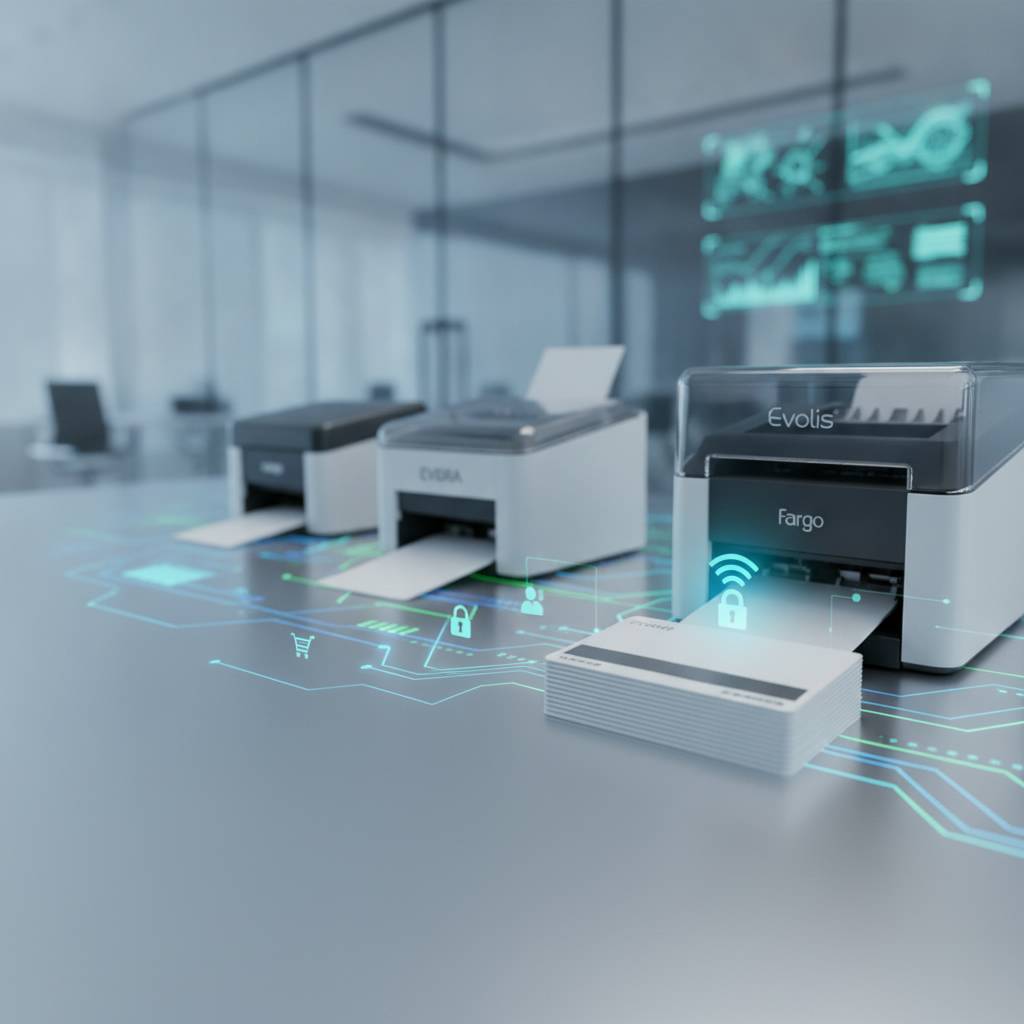
Evolis card printers have earned a strong following in small-to-midsize organizations running in-house card programs. Their compact footprint, intuitive operation, and consistent print quality make them a practical first printer for organizations stepping into in-house credential production. Models with optional magnetic stripe encoding or lamination modules scale as your program grows without requiring a full equipment replacement.
Blank PVC cards ordered through Plastic Card ID are tested to be compatible with Evolis printers, which eliminates guesswork from your supply chain. Ribbons, cleaning kits, and consumables are also available, keeping everything you need under one vendor relationship.
Zebra and Fargo: High-Volume and Enterprise-Grade Production
For organizations with higher card volumes, tighter security requirements, or more complex encoding needs, Zebra and Fargo printers deliver the throughput and feature depth that enterprise programs demand. Dual-sided printing, lamination, smart card encoding, and proximity programming are available across these product lines, making them the preferred choice for corporate campuses, healthcare networks, and government programs.
The investment in a quality printer pays dividends quickly when calculated against the cost of outsourcing credential production or managing card failures in the field. Call 800.835.7919 to discuss which printer model aligns with your volume, card type, and encoding requirements - the team at CPE has matched hundreds of organizations with the right equipment.
Ribbons, Cleaning Kits, and Supplies That Keep Your Program Running
A blank card program is only as reliable as its consumables. Printer ribbons degrade over time, cleaning rollers collect debris that affects print quality, and skipping maintenance cycles shortens the life of expensive equipment significantly. Building a consistent consumables budget alongside your card stock order is the mark of a well-managed credential program.
Card carriers, sleeves, and badge holders round out the supply catalog at Plastic Card ID. These finishing touches protect printed cards from scratches during handling and distribution, extending the useful life of each credential and keeping your program looking professional from issuance to daily use.
Specialty Access Card Options: Clear, Colored, Die-Cut, and Metal
Clear and Frosted Plastic Cards for Distinctive Credentials
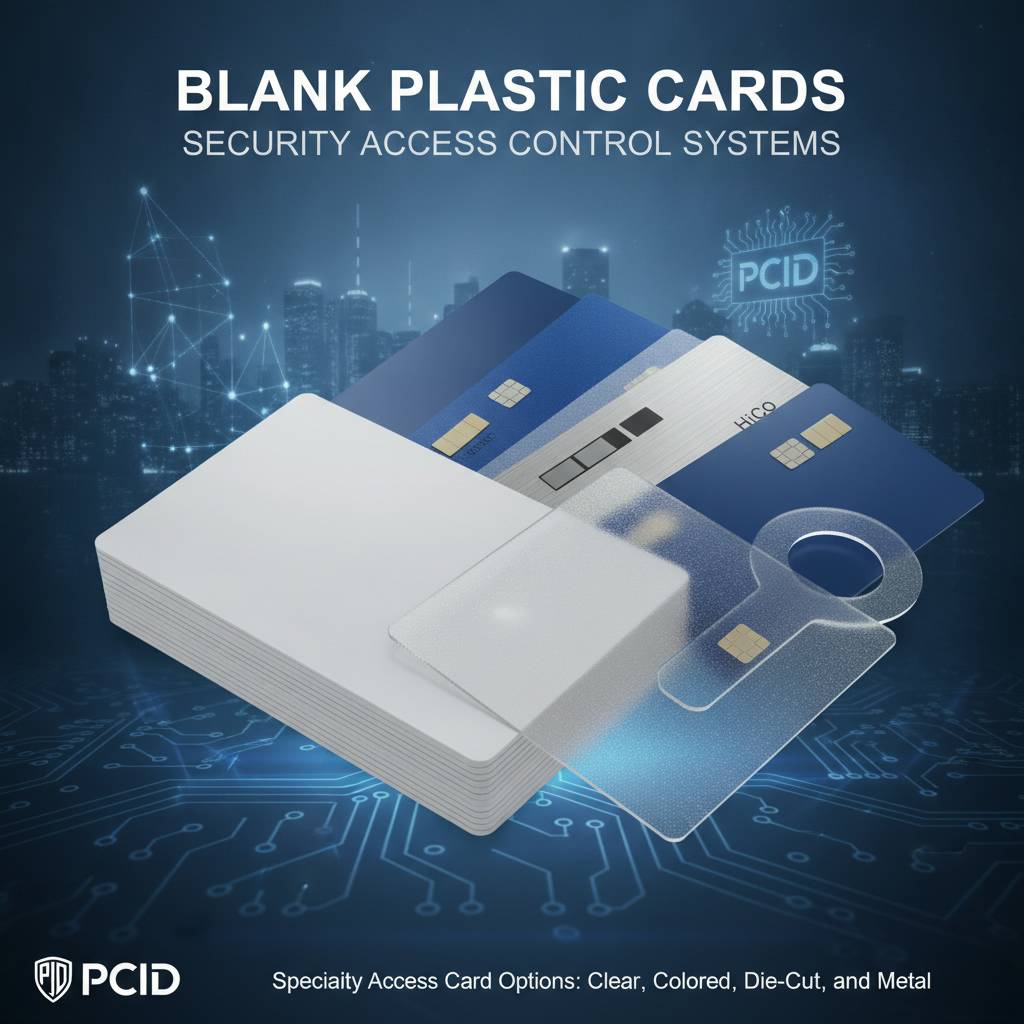
Not every access program wants or needs a standard white card. Clear and frosted plastic cards offer a visually distinctive credential that stands out immediately in a badge holder or wallet. These specialty card stocks work with most standard card printers and accept dye-sublimation printing with excellent results when handled correctly.
Organizations that want their security credentials to carry a premium appearance - corporate headquarters, executive floors, technology firms, private clubs - often find that clear or frosted cards accomplish dual duty: they function as access credentials while projecting a sense of quality and intentionality that a plain white card does not.
Custom Die-Cut Shapes and Colored Card Stock
Standard CR80 dimensions work for the vast majority of access control applications, but there are programs where a custom die-cut shape adds genuine value - events, promotional access passes, VIP credentials, or specialty membership programs layered onto an existing security infrastructure. Die-cut cards can carry the same magnetic stripe or RFID technology as standard cards, so the format change does not compromise function.
Colored card stock - available in a range of base colors - simplifies visual access tiering across large organizations. Color-coded credentials by department or clearance level allow security staff to identify authorization at a glance without reading the card, adding a fast, low-tech verification layer that works even when electronic readers are unavailable.
Luxury Metal Cards: Stainless Steel, Brass, and Gold
At the top of the specialty spectrum, metal cards in stainless steel, brass, and gold finishes deliver a credential that communicates exclusivity, permanence, and prestige without ambiguity. Metal access cards are particularly popular for executive-level programs, VIP membership tiers, and high-end hospitality applications where the physical card is as much a brand statement as it is a functional credential.
These are not novelty items. Metal cards are durable, carry visual security features that are difficult to replicate, and create an immediate impression that differentiates high-tier members or employees from standard credential holders. Plastic Card ID supplies metal card options to USA-based organizations looking to elevate a specific tier of their access or membership program.
Frequently Asked Questions About Blank Plastic Cards for Access Control
What Quantity Should I Order to Start?
Most organizations new to in-house card programs start with quantities of 500 to 1,000 blank cards to establish baseline consumption before committing to larger orders. Ordering in larger quantities reduces per-card cost meaningfully, but carrying excess inventory of a card type you later need to change is its own cost. Start conservatively, establish your consumption rate, and scale your reorder quantities accordingly.
For programs already running at a known volume - say, an organization that issues 200 new employee badges per month - ordering in 2,500 or 5,000 card quantities almost always makes financial sense. CPE works with organizations at every scale and can help identify the order quantity that balances cost efficiency against inventory flexibility.
Do Blank Cards Work With Any Card Printer?
Standard blank white CR80 PVC cards at 30 mil are compatible with virtually all major card printer brands and models, including Evolis, Zebra, Fargo, Matica, and others. Specialty card stocks - clear, frosted, colored, or cards with embedded chips or stripes - have specific compatibility considerations that vary by printer model and ribbon type. It is always worth confirming compatibility before combining new card stock with existing printing equipment.
When you purchase cards and printers together through Plastic Card ID, compatibility is handled as part of the conversation - not something you discover after the fact when cards are jamming or printing poorly. That integration of card and equipment knowledge is one of the practical advantages of working with a supplier that carries both.
How Are Access Cards Different From Credit or Debit Cards?
- Access cards control physical or logical entry - they open doors, log time, authenticate to systems, or identify individuals.
- Credit and debit cards process financial transactions and are issued by financial institutions under strict regulatory frameworks.
- Plastic Card ID supplies access, identity, loyalty, membership, and event cards exclusively - not financial payment cards.
- Magnetic stripe cards from CPE encode access data, not payment credentials.
- RFID and smart cards from CPE are credential and authentication tools, not payment instruments.
This distinction matters because the technology, compliance requirements, and use cases are fundamentally different. Organizations shopping for access control card stock do not need to navigate the financial card regulatory landscape - and with Plastic Card ID, they never will, because that is not a product category the company serves.
Partner With Plastic Card ID for Your Security Access Card Program
 Plastic Card ID is not simply a card vendor - it is a strategic supply partner that has helped more than 100,000 USA-based organizations build, scale, and sustain card programs that actually work. From the first case of blank white PVC cards to a multi-site RFID access deployment using MIFARE DESFire credentials, the depth of product knowledge and program experience here is genuinely difficult to replicate elsewhere.
Access control is too important to treat as an afterthought. The cards your employees, contractors, and visitors carry are the physical expression of your security policy - and they need to perform reliably, look professional, and work seamlessly with your reader infrastructure every single day. Getting the card selection right from the start saves time, money, and security headaches down the road.
Call 800.835.7919 today and speak with the team at CPE about your specific access control card requirements. Whether you need guidance on card technology, printer selection, order quantities, or specialty formats, the conversation starts with one call and ends with a card program that works exactly the way you need it to.
Plastic Card ID - call 800.835.7919 and let's build your access control card program the right way, with the right cards, from a partner that has been doing this longer than most.
Previous Page