Blank Plastic Cards for School ID Cards: Complete Guide
Table of Contents []
- Blank Plastic Cards for School ID Cards - Plastic Card ID
- Why Schools Are Moving Away From Paper ID Cards
- Blank CR80 PVC Cards - The Foundation of Every School ID Program
- Magnetic Stripe Cards for School Programs With Added Functionality
- RFID and Proximity Cards for School Access Control
- Card Printers and Supplies for In-House School ID Production
- Frequently Asked Questions About Blank Plastic Cards for School ID Cards
- Partner With Plastic Card ID for Your School ID Card Program
Blank Plastic Cards for School ID Cards - Plastic Card ID
 School ID programs have a problem that most administrators underestimate until it bites them: inconsistency. Paper IDs fade, laminate peels, and students treat them like scratch paper. The moment a school switches to blank plastic cards for school ID cards, something shifts - students take the credential seriously, staff can verify identity at a glance, and the whole program runs with less friction. That shift matters.
Plastic Card ID has supplied blank and custom plastic cards to schools, districts, colleges, and educational organizations across the United States for over 25 years. With more than 100,000 customers served and over 50 million cards sold, the expertise here is not theoretical - it is institutional, tested, and continuously refined to serve real programs at every scale.
| Card Type | Best Use in Schools | Encoding Option |
|---|---|---|
| Blank CR80 PVC Cards | Student and staff ID cards | None - print-ready |
| Magnetic Stripe Cards (HiCo) | Library access, meal plans | HiCo magnetic stripe |
| Proximity / RFID Cards | Building access control | 125kHz or 13.56MHz |
| Smart Chip Cards | Multi-function campus cards | MIFARE / contact chip |
| Colored PVC Stock | Grade-level or department color coding | None - color-ready |
Why Schools Are Moving Away From Paper ID Cards
 There is a quiet but steady migration happening in K-12 schools and university campuses nationwide. Paper-based identification systems - whether laminated pouches or printed cardstock - are being replaced with durable plastic cards. The reasons are not abstract. Paper credentials warp in backpacks, fade in sunlight, and offer minimal resistance to even casual tampering. Plastic does not.
A school's ID card is more than a photo and a name. It is an access credential, a safety tool, a library card, and sometimes a meal plan token - all in one. When the card is flimsy, the entire system feels flimsy. Plastic cards command a different level of institutional authority, and students and staff respond to that authority with appropriate behavior.
The Durability Factor
Standard CR80 blank PVC cards are 30 mil thick, matching the ISO 7810 international standard for credit card-sized IDs. That thickness is not accidental. It is the result of decades of consensus around what a durable, functional card feels like in the real world. A card that survives a school year in a teenager's wallet is a card that earns its per-unit cost many times over.
Unlike laminated paper, PVC plastic does not absorb moisture, does not curl at the edges, and does not delaminate when exposed to temperature swings. For schools in humid climates or with outdoor campus movement, this is not a minor advantage - it is a critical one. Durability is not a luxury in school ID programs; it is a baseline requirement.
Safety and Identification Integrity
When a substitute teacher or a security guard needs to verify that a student belongs on campus, the ID card is often the first and only tool available. A plastic card with a clear photo, printed name, and school branding communicates legitimacy instantly. A crumpled paper card with faded ink communicates the opposite - uncertainty.
Schools with robust ID programs report fewer incidents of unauthorized access, faster visitor check-in processing, and higher compliance rates when students are required to display credentials. The card itself becomes part of the safety culture, not just a bureaucratic requirement. That is a measurable, real-world benefit.
Cost Efficiency Over Time
The upfront cost of blank plastic cards is higher than printing on cardstock - no question. But the total cost picture is different. Paper IDs that need replacement two or three times per year cost more cumulatively than plastic cards that survive the full academic year. When you factor in staff time for reprints, the economics shift further in favor of plastic.
Many schools running in-house card programs with a desktop card printer and a stock of blank CR80 cards find their per-card cost drops to well under a dollar over time. At volume pricing from CPE, the savings compound quickly. Investing in plastic card infrastructure pays dividends every semester.
Blank CR80 PVC Cards - The Foundation of Every School ID Program
Every school ID program, regardless of complexity, starts with the same fundamental component: a blank card. The CR80 format - 3.375 inches by 2.125 inches, 30 mil thick - is the universal standard that fits every desktop card printer on the market and every ID holder, lanyard clip, and card sleeve available. Starting with the right blank card means everything downstream works correctly.
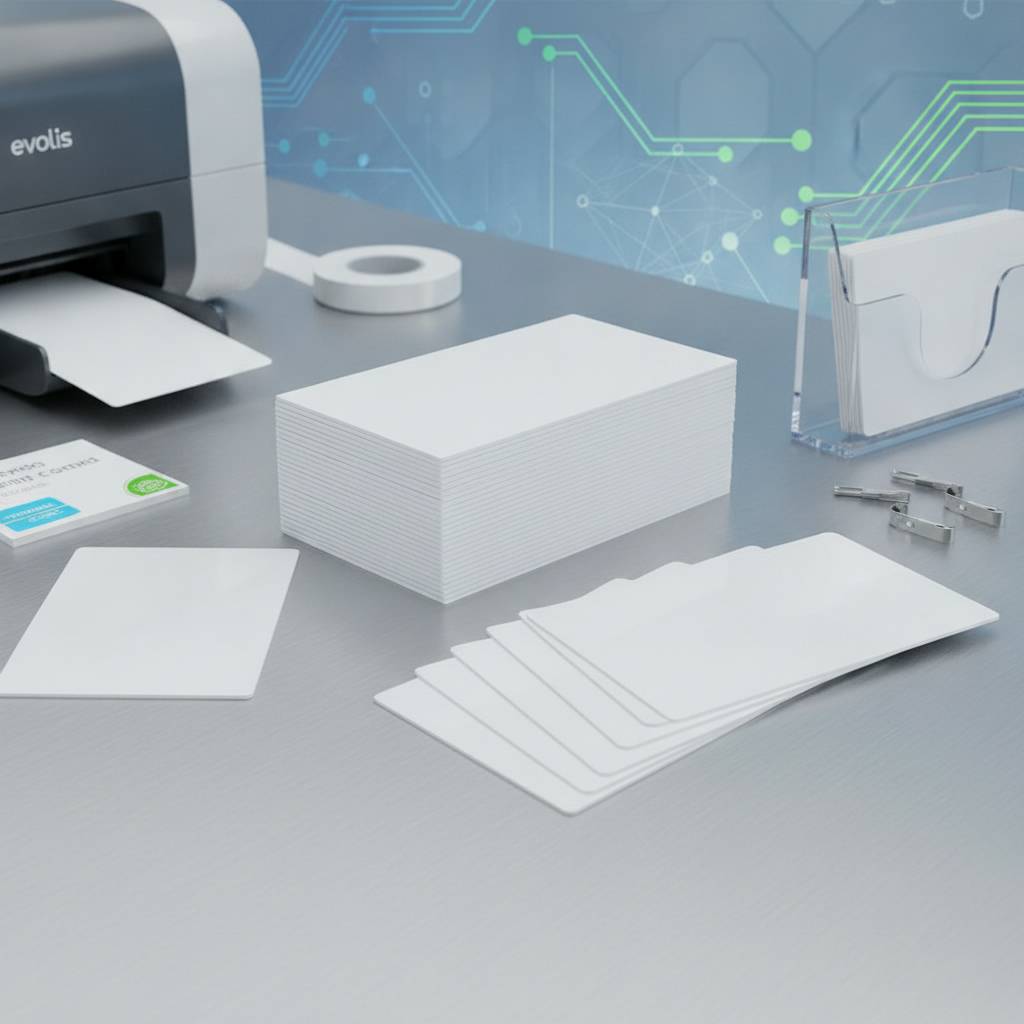
CPE stocks blank white PVC cards in quantities ranging from small starter packs to bulk pallets suitable for district-wide programs. Whether a school needs 50 cards for a small staff ID run or 10,000 cards for a full student body rollout, the catalog has a solution scaled to that need. There is no minimum that is too small and no order that is too large.
White Gloss PVC - The Universal Choice
White gloss blank cards are the most common choice for school ID programs because they accept dye-sublimation and direct-to-card printing with exceptional color fidelity. Photos reproduce with sharp detail, school logos pop with vibrancy, and text remains crisp even at small font sizes. This matters when the card needs to be read quickly in a real-world school environment.
When ordering blank white PVC cards for a school, the key spec to confirm is 30 mil thickness. Some suppliers offer thinner cards - 20 mil or less - that print adequately but feel insubstantial and wear down faster. The 30 mil standard is worth insisting on, and it is what CPE ships as default stock.
Colored PVC Stock for School Organization Systems
Many schools use color coding as a quick visual management tool. Blue cards for 9th graders, red for 10th, green for 11th, yellow for seniors. Or colors assigned by department for staff - administration in white, custodial in yellow, security in red. Colored PVC stock makes this possible without printing colored backgrounds, which saves ribbon usage and speeds up card production.
The colored stock available from CPE includes standard and specialty colors in the same CR80 30 mil format. Colors are consistent across batches, which matters when ordering refills mid-year - a card printed in March should match visually with one printed in September. Batch consistency is a quality standard that serious suppliers maintain as a matter of course.
Frosted and Clear Plastic Cards for Specialty Applications
Some school programs - particularly at the university level - want a more premium credential aesthetic. Frosted PVC cards offer a semi-transparent, sophisticated look that prints beautifully with reverse-print designs. Clear cards create a fully transparent effect that can be striking when used with careful graphic design. These are specialty applications, but they are worth knowing about for the right program.
Both frosted and clear cards are available in CR80 30 mil format and are compatible with most desktop card printers. The visual impact of a clear student ID card with a dark overlay design is genuinely striking - the kind of credential that students actually want to carry rather than leave stuffed in their locker.
Magnetic Stripe Cards for School Programs With Added Functionality
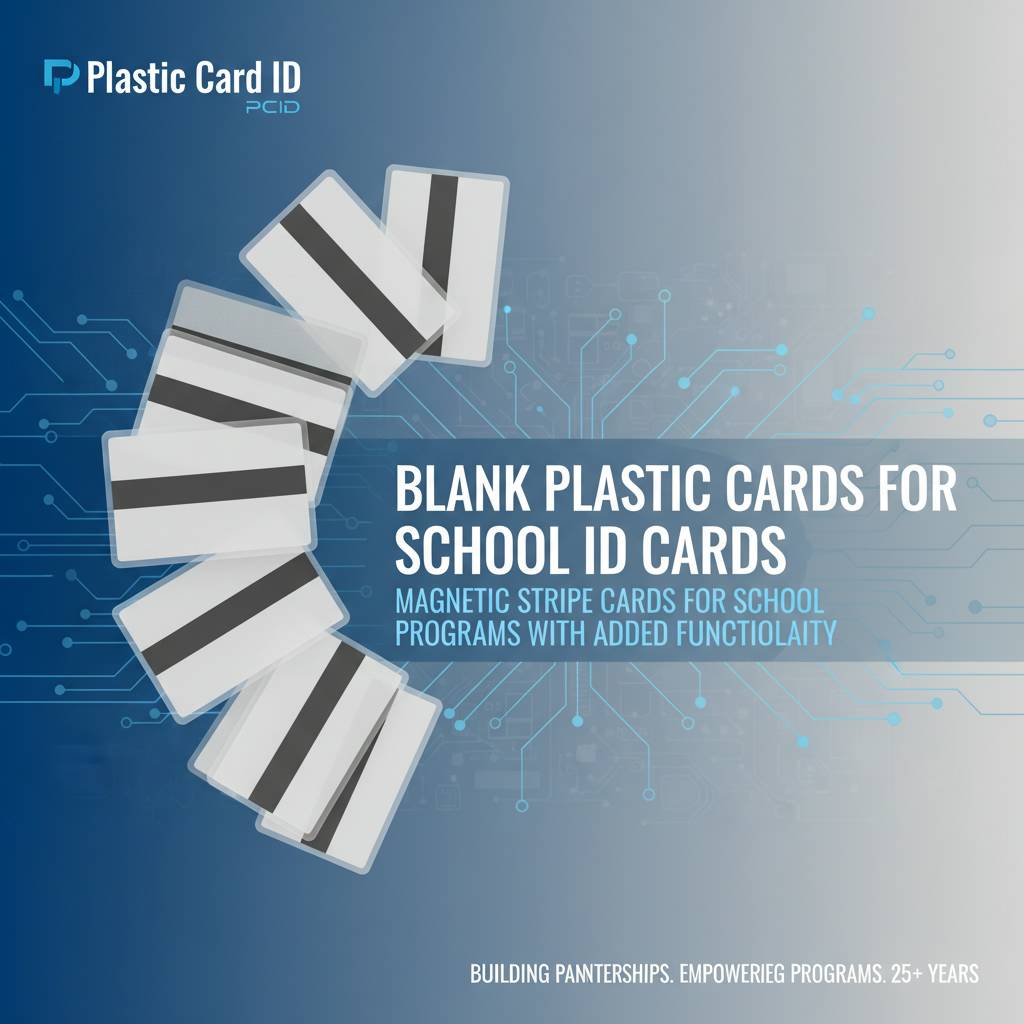 Many schools need their ID cards to do more than identify - they need them to function. Library checkouts, cafeteria meal plans, vending access, bus passes, and computer lab login are all functions that a magnetic stripe-equipped school ID card can handle. The card becomes a multi-function tool, reducing the number of separate credentials students need to manage.
Magnetic stripe cards come in two flavors: HiCo (high coercivity) and LoCo (low coercivity). For school applications, HiCo magnetic stripe cards are almost always the correct choice. HiCo stripes are more resistant to demagnetization from everyday interference - phones, magnetic closures on bags, other cards in a wallet - which means fewer lost-data complaints and fewer reprints over the course of a school year.
HiCo vs. LoCo - What Schools Need to Know
The distinction between HiCo and LoCo matters practically, not just technically. A LoCo card in a student's backpack near a phone or another card can lose its encoded data within weeks. A HiCo card in the same environment will retain its data reliably for years. For a program that encodes student ID numbers, meal plan balances, or library accounts, reliability is non-negotiable.
HiCo stripes require a compatible encoder - either a card printer with an integrated magnetic stripe encoder or a standalone encoder - to write data onto the stripe. The encoding itself is straightforward, and most school information systems can generate the data export needed to drive batch encoding. The CPE team can advise on compatible hardware for specific encoding needs. Contact 800.835.7919 to discuss which magnetic stripe card is right for your school's program.
Cafeteria and Library Card Applications
The cafeteria ID card use case is one of the most compelling arguments for magnetic stripe technology in schools. A swipe-to-pay lunch system reduces cash handling, speeds up line movement, and integrates with most modern point-of-sale systems used in school food service. The same card that identifies a student at the front door can process their lunch payment in the cafeteria.
Library card integration follows the same logic. Rather than issuing a separate library card, the student ID serves as the borrowing credential. The magnetic stripe stores the student's library account number, which links to the circulation system. Fewer cards for students to track, fewer systems for librarians to manage. Integration through a single credential simplifies operations at every level.
Encoding and Compatibility Considerations
Before ordering magnetic stripe cards, schools should verify that their existing hardware - whether card printers, cafeteria POS systems, or library software - is compatible with the stripe format and encoding standard they plan to use. The most common format is ISO Track 1, 2, and 3, with Track 2 being the standard for most school applications.
The blank magnetic stripe cards from CPE are supplied un-encoded, ready for in-house encoding through a compatible printer or encoder. This gives schools full control over the data written to each card and allows for easy reprinting and re-encoding as student rosters change. Flexibility in the encoding process is an underappreciated operational advantage.
RFID and Proximity Cards for School Access Control
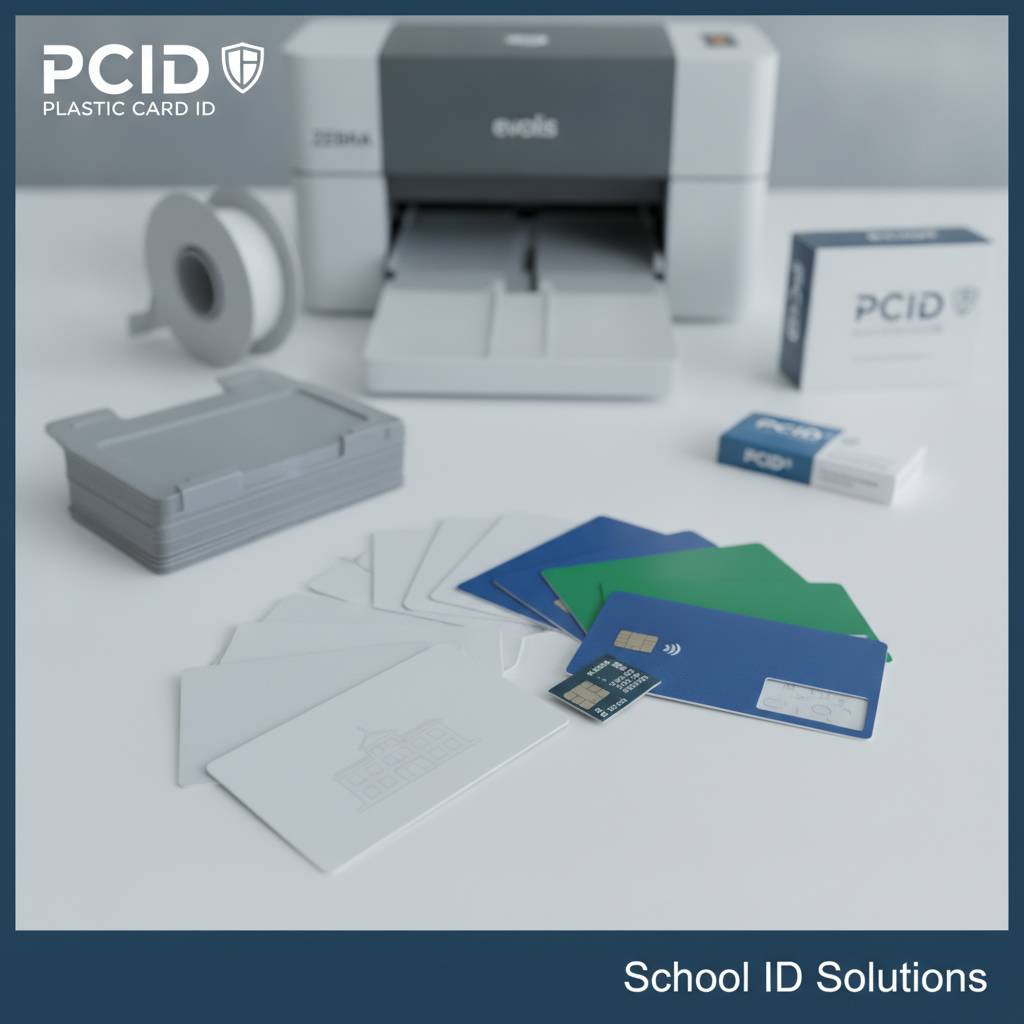 Access control is increasingly central to school safety planning. Controlled entry points, restricted staff-only areas, server room protection, and laboratory access are all use cases where a contactless RFID or proximity card adds genuine security value over a physical key. And when the access credential is also the student or staff ID card, the program is both elegant and cost-effective.
Proximity cards operating at 125kHz are the workhorses of school access control - compatible with most legacy reader systems, simple to manage, and available at a price point that makes district-wide deployment feasible. RFID cards at 13.56MHz, including those supporting MIFARE DESFire technology, offer more sophisticated access control with encrypted communication and multi-application capability.
Proximity Cards - 125kHz Standard
For schools already equipped with HID-compatible or similar 125kHz reader infrastructure, proximity cards are a direct drop-in credential solution. They function through a wallet, a lanyard pouch, or a card holder - no need to remove the card to scan. Tap-and-go access keeps hallway traffic moving and reduces bottlenecks at controlled entry points.
Proximity cards can be combined with visual ID printing on the same card face, creating a dual-function credential. The access control reader interacts with the embedded antenna, while humans verify identity visually using the printed photo and name. One card, two functions, zero confusion for students or staff navigating the facility.
Smart RFID Cards for Advanced Campus Programs
University campuses and larger K-12 districts with multi-building campuses increasingly look to smart RFID cards for their ability to handle multiple applications on a single credential. A MIFARE DESFire card can simultaneously manage building access, library borrowing, meal plan payments, event entry, and parking validation - all with encrypted, contactless communication.
The smart card ecosystem requires compatible readers, card management software, and a clear integration plan - but for institutions ready for that investment, the operational payoff is substantial. Students carry one card for everything. Administrators manage one credential system rather than four or five separate ones. CPE can supply the cards; the integration work is handled by the school's IT and facilities teams with their chosen system vendors.
Choosing the Right Card for Your Access Control System
The most important step before ordering RFID or proximity cards is confirming compatibility with existing reader hardware. Different access control systems support different card technologies, and ordering the wrong card format is an expensive mistake. Key questions include: What frequency do your readers support? What is the card technology standard (HID Prox, EM4100, MIFARE Classic, MIFARE DESFire)? Does the system require pre-programmed facility codes?
The team at CPE has deep experience helping schools navigate these questions. Getting the card specification right before ordering saves time, money, and frustration. A quick consultation before placing an order can prevent a costly mismatch between cards and readers - an outcome that benefits nobody.
Card Printers and Supplies for In-House School ID Production
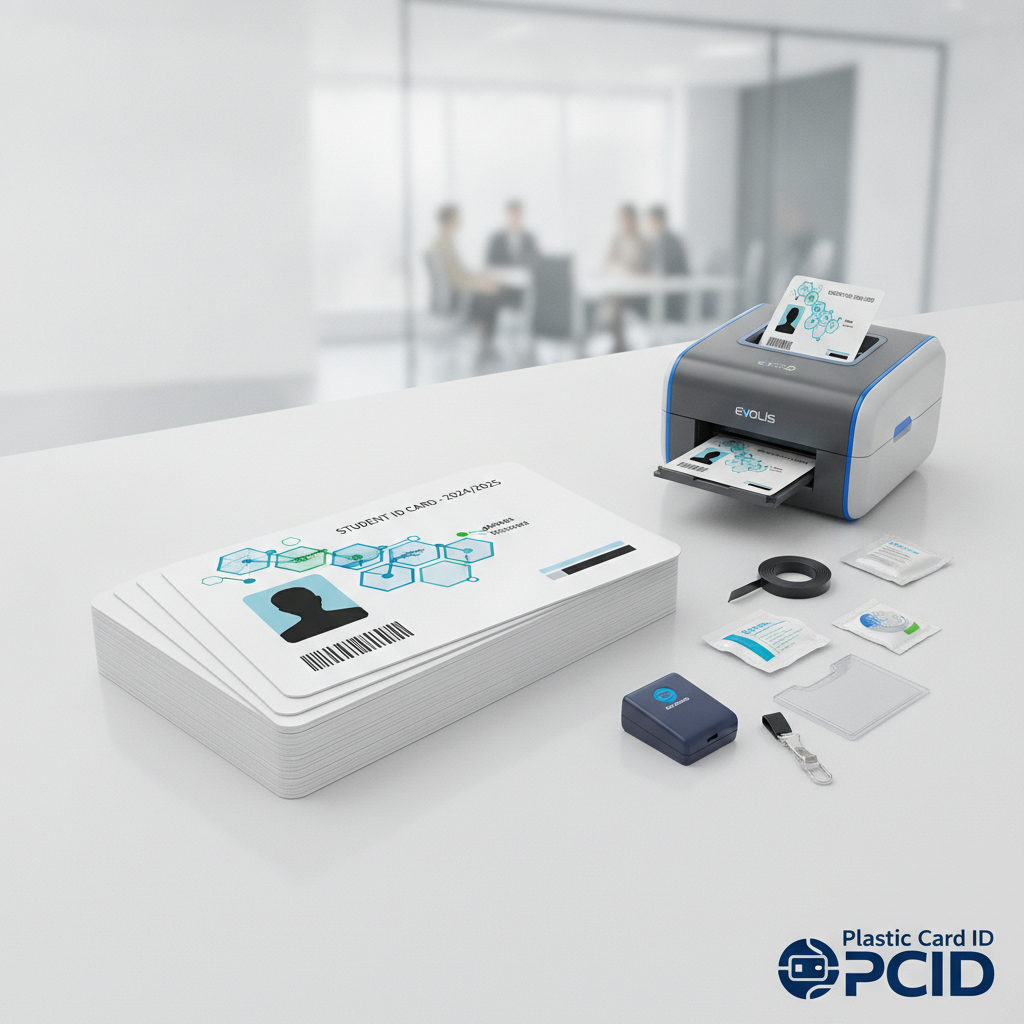
Running an in-house school ID program means having the right printer on the desk and the right supplies in the cabinet. The combination of blank PVC cards, a quality card printer, and the appropriate ribbon produces professional-grade IDs that rival anything sent to an outside vendor - often at a lower cost per card, with faster turnaround, and without handing student data to a third party.
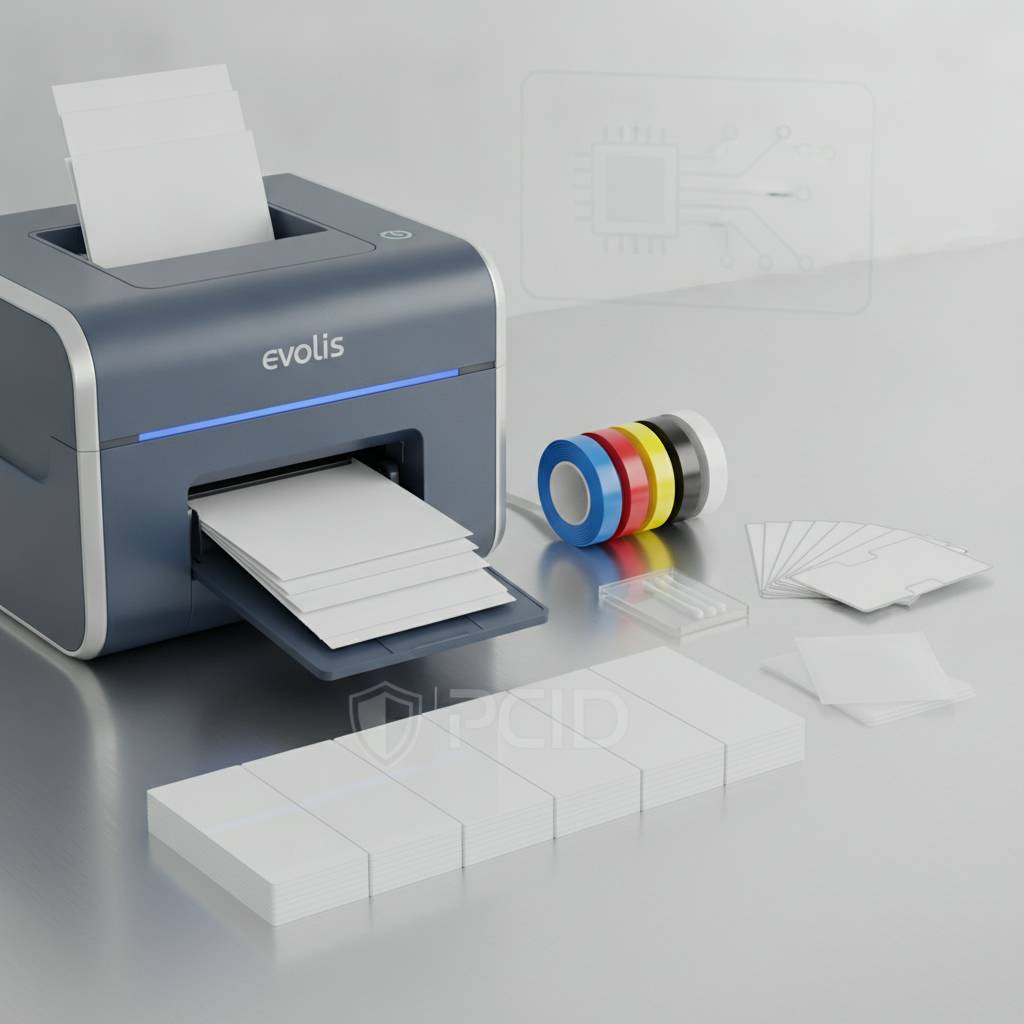
Plastic Card ID carries a full lineup of desktop card printers from Evolis, Zebra, and Fargo - three of the most trusted names in ID card printing. Each brand offers models spanning entry-level single-sided printers suitable for small staff programs all the way to dual-sided, high-volume printers for large student bodies. Pairing the right printer with the right blank card stock is something the CPE team helps customers get right every time.
Choosing a Card Printer for Your School
The primary variables in selecting a school card printer are print volume, single versus dual-sided printing, and encoding requirements. A small private school printing 200 cards per year has very different needs than a public high school printing 1,500 cards at the start of each school year. Volume directly drives the appropriate printer tier and the expected ribbon cost per card.
- Entry-level printers (Evolis Badgy, Zebra ZC100): Ideal for programs under 500 cards per year, simple single-sided printing, compact footprint.
- Mid-range printers (Evolis Primacy, Fargo HDP5000): Dual-sided printing, optional magnetic stripe encoder, retransfer printing for edge-to-edge coverage.
- High-volume printers (Zebra ZC350, Fargo HDP6600): Designed for 1,000 cards per month, faster throughput, integrated encoding modules, stackers.
- Encoding-capable printers: Models with built-in mag stripe encoders or RFID writers allow simultaneous printing and encoding in a single pass.
Ribbons, Cleaning Kits, and Card Supplies
A card printer without the right ribbon produces poor results no matter how good the blank card stock. CPE stocks printer ribbons for all major printer brands and models - YMCKO full-color ribbons for photo-quality ID printing, monochrome ribbons for fast text-only passes, and specialty ribbons including UV and overlay panels for added card security.
Cleaning kits are an underappreciated part of printer maintenance. Dust and debris inside a card printer cause print defects, premature printhead wear, and eventually hardware failure. Regular cleaning with manufacturer-approved cleaning cards keeps printers running at spec and extends hardware life significantly. Pairing a printer purchase with a cleaning kit supply is a best practice CPE recommends to every school customer.
Card Accessories - Holders, Sleeves, and Lanyards
Once the card is printed, it needs to be worn, displayed, or stored safely. Card holders, sleeves, and lanyards are the accessories that complete a functioning school ID program. A card without a holder gets scratched, bent, and lost. A card in a quality holder on a retractable lanyard clip is accessible, visible, and protected through a full school day of activity.
The CPE catalog includes card carriers and sleeves that complement the blank card and printer supply ecosystem, making it a genuine one-stop shop for everything a school ID program needs from blank card to finished, wearable credential. A complete program solution means fewer vendors, simpler ordering, and more consistent results.
Frequently Asked Questions About Blank Plastic Cards for School ID Cards
 Schools evaluating a transition to plastic ID cards or upgrading an existing program tend to have similar questions. The answers are straightforward, but getting them in one place saves time for the administrators and IT coordinators making these decisions.
The questions below represent the most common inquiries the CPE team fields from school customers. If a specific question is not addressed here, the team is available to discuss program details directly and provide recommendations tailored to the school's specific needs and existing infrastructure.
What Quantity Should a School Order to Start?
There is no single right answer, but a useful starting framework is: order enough to cover your current enrollment or staff count, plus 10-15% extra for replacements, new enrollees, and errors. For a school of 800 students plus 80 staff, an initial order of 1,000 cards is reasonable. Blank PVC cards have a long shelf life when stored properly - cool, dry conditions away from direct sunlight - so ordering ahead does not create waste.
Schools that are new to plastic ID programs sometimes underestimate replacement card demand. Cards get lost, stolen, damaged, or rendered unreadable. Having buffer stock on hand means a student can get a replacement card the same day rather than waiting for a reorder. Building buffer stock into initial orders is a best practice for any school ID program manager.
Can Schools Print Cards In-House or Do They Need to Send Them Out?
In-house printing is absolutely viable for schools and is the approach most schools with ongoing ID programs eventually adopt. A desktop card printer with a stock of blank CR80 cards and the appropriate ribbon produces professional-quality IDs without any outsourcing. The upfront cost of the printer is recouped quickly through per-card savings and operational convenience.
The alternative - sending photo data to an outside vendor for printing and mailing - works for initial program launches but becomes cumbersome for ongoing replacements and mid-year additions. An in-house printer puts control of the ID program where it belongs: with the school's administrative staff. Call 800.835.7919 to discuss printer options that fit your school's volume and budget.
How Long Do Plastic School ID Cards Last?
A properly printed 30 mil PVC card, carried in a card holder or sleeve, typically lasts 2-5 years under normal daily use conditions. For a school issuing new cards each academic year, durability is rarely a limiting factor. For programs that issue cards meant to last through a student's full enrollment - 4 years in high school, for example - card longevity is a real consideration, and laminate overlays during printing can extend surface life significantly.
The encoding on magnetic stripe and RFID cards is similarly durable. HiCo magnetic stripes retain data reliably for years in normal use. RFID and proximity card antennas embedded in the card laminate are sealed from the environment and maintain function through the lifetime of the card under typical conditions.
Partner With Plastic Card ID for Your School ID Card Program
 Running a school ID program is one of those administrative tasks that feels small until it goes wrong - and when it goes wrong, it affects every student, every staff member, and every safety system that depends on reliable identification. Getting the card foundation right means choosing a supplier who understands the specific demands of school environments, not just card specifications on a data sheet.
Plastic Card ID brings over 25 years of card program experience to every school customer relationship. From the first conversation about card types and quantities to ongoing supply of blank cards, ribbons, and accessories throughout the school year, the team operates as a strategic partner invested in the program's success. Schools that partner with Plastic Card ID do not just get cards - they get a program ally.
Whether you are launching a new student ID program from scratch, upgrading an existing paper-based system, or expanding an ID infrastructure to include access control and meal plan functionality, the resources and expertise to make it work are here. Contact Plastic Card ID today at 800.835.7919 to speak with a card program specialist and take the first step toward an ID system your school can rely on.
Previous Page