Blank PVC Cards Explained: Everything You Need to Know
Table of Contents []
- Blank PVC Cards Explained: What Every Business Needs to Know - Plastic Card ID
- What Exactly Is a Blank PVC Card?
- Types of Blank PVC Cards and Their Applications
- Building an In-House Card Program With Blank Cards
- Specialty and Premium Blank Card Options
- Blank PVC Cards in Action: Common Program Types
- Frequently Asked Questions About Blank PVC Cards
- Partner With Plastic Card ID for Your Card Program
Blank PVC Cards Explained: What Every Business Needs to Know - Plastic Card ID
 Walk into almost any office, retail store, gym, or hotel and you will find them: small, rigid, wallet-sized cards that carry identity, access, or value. Most people never stop to wonder where those cards begin. The answer, more often than not, is a blank PVC card - a deceptively simple product that quietly powers some of the most important programs in modern business operations.
Understanding blank PVC cards is not complicated, but there is more nuance here than most buyers expect. Card thickness, encoding capability, print compatibility, and substrate quality all determine whether your card program thrives or frustrates. This guide breaks it all down - clearly, practically, and without the fluff.
| Specification | Standard Value | Notes |
|---|---|---|
| Card Size | CR80 (3.375" x 2.125") | ISO 7810 standard; same as a credit card |
| Thickness | 30 mil | Industry-standard; compatible with most card printers |
| Material | PVC (Polyvinyl Chloride) | Durable, rigid, and print-receptive |
| Print Surface | Glossy or Matte | Optimized for dye-sublimation card printers |
| Available Options | Plain, Mag Stripe, RFID, Smart Chip | Selectable based on program requirements |
| Minimum Order | As low as 50 cards | Scales to tens of thousands for larger programs |
What Exactly Is a Blank PVC Card?
 The term sounds almost too plain. Blank. PVC. Card. But behind that simplicity is a precisely engineered product. A blank PVC card is a pre-manufactured substrate - CR80 size (3.375 inches by 2.125 inches), 30 mil thick, built from polyvinyl chloride - that serves as the raw material for card programs of every type. Before it is printed, encoded, or personalized, it is just a card. After? It can become almost anything.
Think of it the way a professional chef thinks about high-quality ingredients. The blank card is your flour, your canvas, your foundation. The quality of that foundation determines how well everything built on top of it holds up over time. A low-quality blank card will produce low-quality results no matter how good your printer is. That relationship between substrate and output is critical and frequently underestimated by first-time buyers.
The CR80 Format and ISO 7810 Standard
CR80 is the global standard card size, governed by ISO 7810. It is precisely 3.375 inches wide and 2.125 inches tall - exactly the same dimensions as your bank card, your driver's license, your hotel key. This standardization matters enormously. It means your cards will fit in wallets, cardholders, badge reels, and printer input hoppers without any adaptation or custom tooling.
Deviating from this size is possible - custom die-cut shapes do exist - but for the overwhelming majority of card programs, CR80 is the right choice. It is universally recognized, immediately trustworthy in appearance, and compatible with essentially every card printer on the market. Standardization is the quiet foundation of a reliable card program.
Why PVC and Not Something Else?
PVC dominates the card industry for good reason. It is rigid enough to hold its shape through daily use, yet flexible enough to avoid cracking under normal wallet or badge-holder stress. Its surface accepts dye-sublimation printing with exceptional clarity and color saturation. It bonds reliably to magnetic stripes, RFID inlays, and smart chip modules during manufacturing.
Alternatives exist - composite PVC, ABS plastic, even metal - but plain PVC remains the sweet spot for most programs. It offers outstanding durability at a per-card cost that makes large programs economically viable. For niche applications like luxury membership or VIP programs, metal cards in stainless steel, brass, or gold represent a premium tier with their own compelling use cases.
The 30 Mil Thickness Explained
Card thickness is measured in mils (thousandths of an inch). The standard 30 mil card - what CPE stocks as its workhorse product - is the correct thickness for virtually all card printer brands and models, including those from Evolis, Zebra, and Fargo. Thinner cards (10 mil, 20 mil) are flexible and used for specific insert applications; they will not feed correctly through standard ID card printers.
Choosing the right thickness is not a trivial decision. Loading a printer with off-spec cards damages the feed mechanism, produces misaligned prints, and generates costly waste. When in doubt, 30 mil is the answer. It is the specification that every printer manufacturer engineers around, and it is what CPE supplies as the default for every standard card program.
Types of Blank PVC Cards and Their Applications
Not all blank PVC cards are the same, even if they look identical in the box. The substrate you choose dictates what your program can do. A plain white card is versatile and cost-effective. A card with a high-coercivity magnetic stripe opens the door to encoded value and access data. An RFID card enables contactless interaction. Knowing which type fits your use case is the first real decision in building a card program.
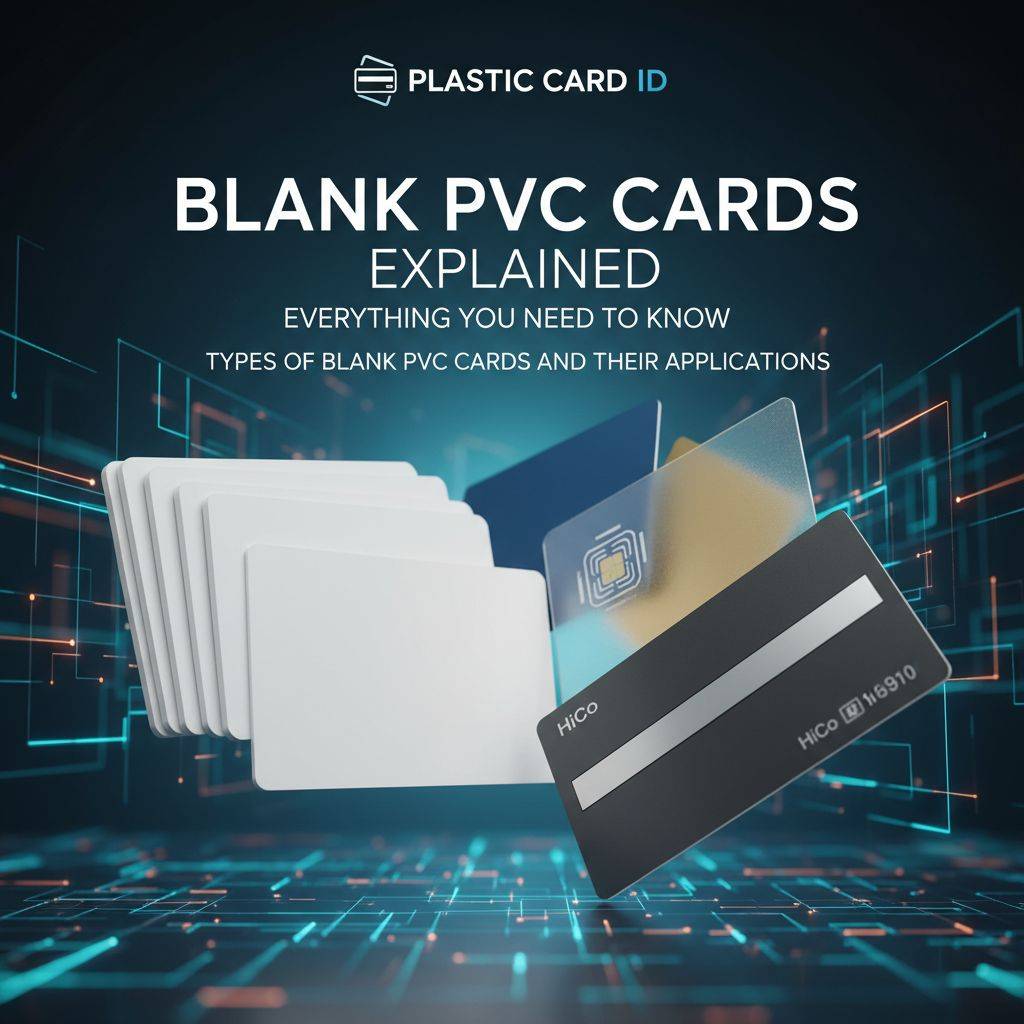
The range is wider than most buyers initially realize, and CPE carries all of it. From simple white stock to MIFARE DESFire smart cards capable of complex contactless transactions, the catalog covers every legitimate card application in the U.S. market. Choosing the right card type from the start saves significant time and money downstream.
Plain White Blank Cards
The simplest entry point. A plain white CR80 PVC card with no pre-applied features is the ideal choice for any program where all functionality will be applied through printing alone - employee ID badges with photos and barcodes, event credentials, membership cards that rely on visual verification, or loyalty cards tracked by card number rather than encoded data.
Plain cards offer the lowest per-unit cost and the greatest design flexibility. Because there is no magnetic stripe or chip to work around, both faces of the card are fully printable. Organizations running in-house card programs on tight budgets find that plain white blank cards deliver remarkable value per dollar spent, particularly when paired with an efficient card printer and ribbon supply.
Magnetic Stripe Cards: HiCo vs. LoCo
Magnetic stripe cards carry encoded data on a strip of magnetic material bonded to the back of the card. They come in two coercivity ratings: High Coercivity (HiCo, 2750 Oe) and Low Coercivity (LoCo, 300 Oe). HiCo stripes are more resistant to accidental erasure from everyday magnetic fields - phones, clasps, bag closures - making them the standard choice for access control, loyalty programs, and gift cards.
LoCo cards are appropriate for short-term applications like hotel key cards or event passes where the card will be discarded quickly. The encoding equipment must match the coercivity of the card; mismatches produce encoding errors and reader failures. If you are unsure which to choose, HiCo is almost always the safer default. The durability of a HiCo stripe is simply unmatched for long-term card programs.
- HiCo Magnetic Stripe Cards: Resistant to accidental erasure; ideal for loyalty cards, gift cards, and long-term access credentials
- LoCo Magnetic Stripe Cards: Cost-effective for short-term use cases such as hotel keys or temporary event badges
- Encoding Compatibility: Your card printer or standalone encoder must match the coercivity rating of the card
- Tracks Available: Most cards include three encoding tracks; most applications use Track 1 and Track 2
- Read Distance: Contact-based; card must swipe through or press against a reader
RFID, Proximity, and Smart Chip Cards
Contactless cards represent the advanced tier of blank PVC card options. Proximity cards (125 kHz) are the classic choice for door access control - simple, reliable, and widely supported by access control systems from major security vendors. They are passive (no battery required) and read at short distances, typically a few inches from the reader antenna.
Smart chip cards, including those utilizing MIFARE DESFire technology, operate at 13.56 MHz and support encrypted data transactions far more sophisticated than simple ID lookups. These are the cards powering casino player programs, hotel guest services, transit systems, and secure facility access. MIFARE DESFire smart cards represent the current gold standard for contactless card security. Selecting between these options requires clarity on what your card readers support - a conversation CPE is well-equipped to help navigate.
Building an In-House Card Program With Blank Cards
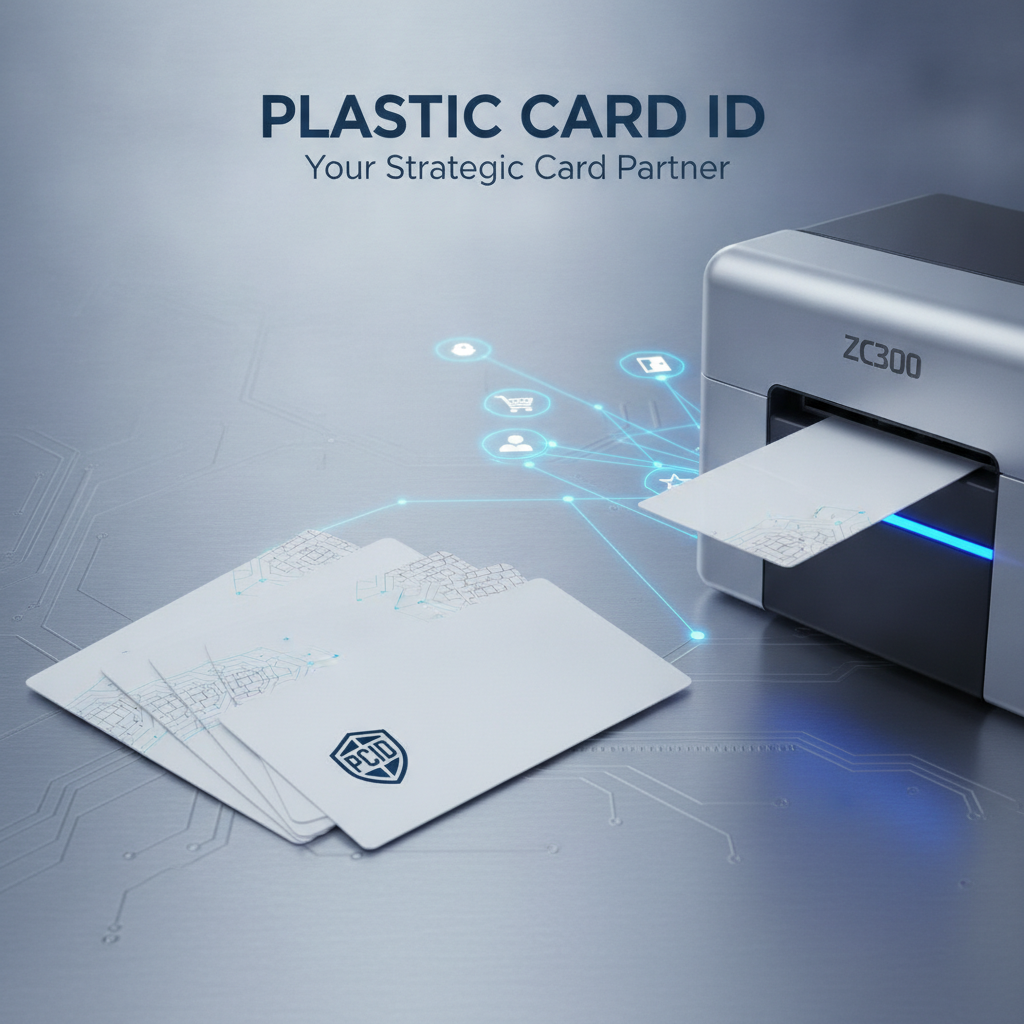 The economics of in-house card production are compelling. When you buy pre-printed cards, you pay for design, production, and shipping on every order - and you wait. When you invest in a card printer and stock of blank cards, you gain the ability to print on demand, personalize each card with a unique name or number, and respond to changes in your card design without throwing away obsolete inventory.
This shift from outsourced to in-house is not just a cost play. It is a control play. Organizations that print their own cards can issue replacements in minutes, update designs without minimum order quantities, and maintain a tighter chain of custody over credentials. In-house card printing transforms a recurring expense into a core operational capability.
Choosing the Right Card Printer
The printer is the engine of any in-house card program. CPE supplies printers from three of the most trusted names in the industry: Evolis, Zebra, and Fargo (HID Global). Each brand offers a range of models suited to different production volumes, encoding requirements, and organizational budgets.
Entry-level single-sided printers handle simple badge and loyalty card programs with ease. Mid-range models add dual-sided printing, magnetic stripe encoding, and lamination capabilities. High-volume, high-security environments call for enterprise-grade printers with built-in smart card encoding and advanced security features. The right printer depends entirely on your volume, your card type, and your encoding needs - not on which model looks most impressive in a brochure.
Ribbons, Supplies, and Consumables
A card printer is only as good as the ribbon loaded into it. Dye-sublimation ribbons transfer color to the card's surface through heat, producing vibrant, photo-quality output that is integral to the card rather than sitting on top of it. YMCKO ribbons (yellow, magenta, cyan, black, overlay) are the standard for full-color personalized cards. Monochrome ribbons in black or other single colors offer higher yield for simpler single-color applications.
Beyond ribbons, a well-managed card program requires cleaning kits to maintain printer performance, card sleeves to protect finished cards during handling and mailing, and card carriers for professional presentation. Neglecting printer maintenance is the single most common cause of print quality decline in established card programs. CPE stocks the full range of supplies to keep every program running at peak performance. Contact us at 800.835.7919 to discuss your supply needs.
Volume Planning and Inventory Management
One of the most underappreciated aspects of running a card program is supply chain management. Running out of blank card stock during a high-demand period - a seasonal gift card push, a membership renewal cycle, a new employee onboarding wave - creates real operational problems. Ordering in quantities that reflect actual usage patterns, with a comfortable buffer, is essential.
Programs can start as small as 50 cards and scale to tens of thousands. The per-card cost decreases with volume, so organizations with predictable usage benefit from ordering larger quantities less frequently. CPE works with clients at every scale to find the ordering rhythm that balances cost efficiency with operational flexibility. Smart inventory planning is as important as smart card selection.
Specialty and Premium Blank Card Options
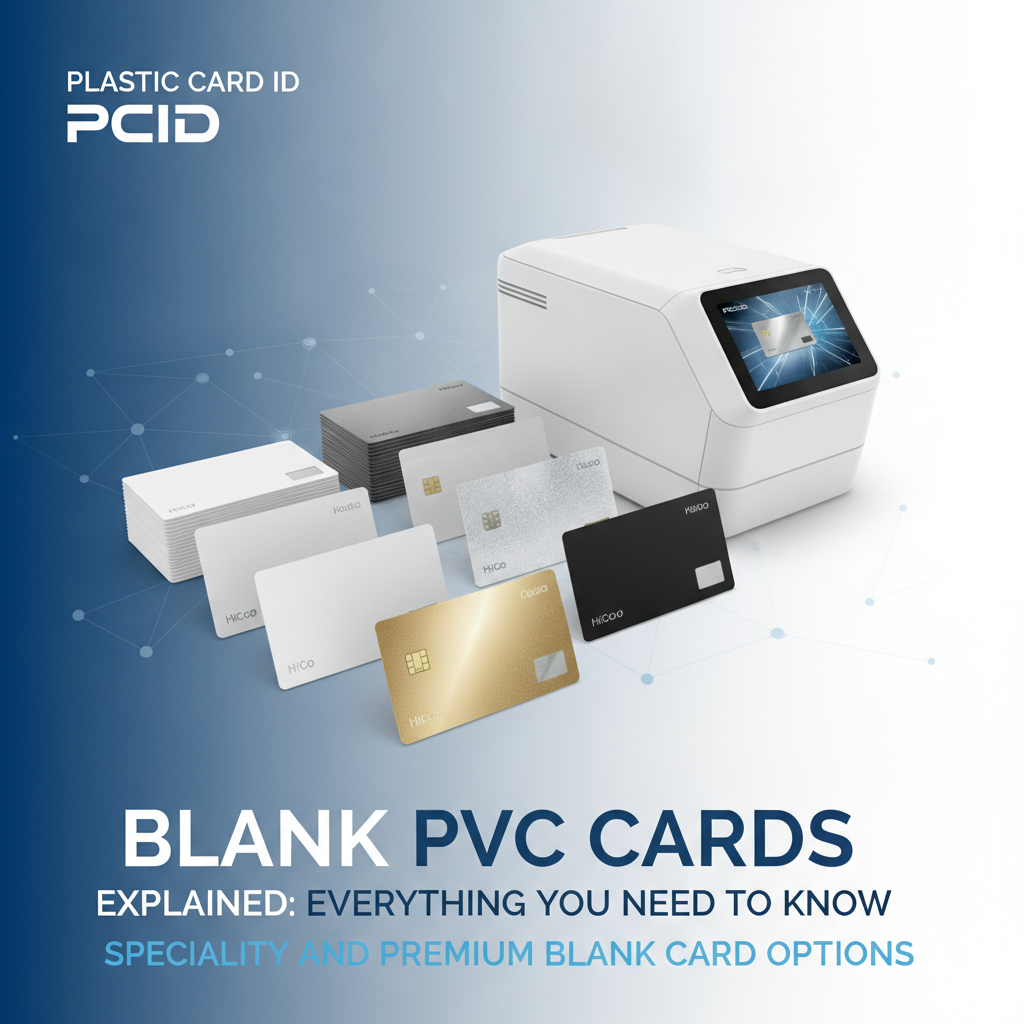 Beyond standard white PVC, the blank card world opens up into a range of specialty options that serve niche programs with specific requirements. Clear cards, frosted cards, colored stock, custom die-cut shapes, and luxury metal cards each occupy a place in the catalog for good reason - because certain programs demand something beyond the ordinary.
Premium card materials communicate premium brand positioning. A clear plastic loyalty card feels different in a customer's hand. A stainless steel membership card makes an immediate impression. These are not frivolous choices - they are strategic decisions that affect how recipients perceive the issuing organization.
Clear and Frosted Plastic Cards
Clear PVC cards are printed on a fully transparent substrate, allowing design elements to interact visually with anything placed behind the card. Frosted cards offer a semi-opaque finish with a tactile texture that distinguishes them immediately from standard glossy cards. Both options are CR80, 30 mil, and compatible with standard card printers - the only difference is the visual and tactile experience they deliver.
These formats are popular for premium loyalty programs, high-end retail gift cards, and membership credentials where differentiation from competitor programs matters. A clear or frosted card communicates sophistication the moment it is handed over. The design possibilities are notably different from white stock; working with a clear substrate requires thinking about what shows through versus what is printed on the surface.
Colored Card Stock
Pre-colored blank cards simplify production for programs that use color coding as an organizational system. Rather than printing a full-bleed colored background on every card - which consumes ribbon and slows throughput - colored stock delivers the base color as part of the card itself. Text, logos, and barcodes are then printed on top with minimal ribbon usage.
This approach is common in access control programs where card color indicates clearance level, in event credentials where color distinguishes attendee categories, and in staff identification where department color-coding is the organizational norm. Color-coded blank stock is an efficiency tool hiding in plain sight for high-volume programs with defined color systems.
Metal Cards and Luxury Credentials
For organizations operating at the premium end of their market - private clubs, luxury hotels, VIP casino programs, exclusive membership organizations - metal cards represent an entirely different tier of credential. Available in stainless steel, brass, and gold finishes, these cards deliver weight, permanence, and prestige that PVC simply cannot replicate.
The practical durability of a metal card is also exceptional. It will not crack, warp, or fade the way a printed card might under heavy use. Recipients rarely discard metal cards - they are kept, displayed, and talked about. A metal card is not just a credential; it is a brand statement that lives in a cardholder's wallet for years.
Blank PVC Cards in Action: Common Program Types
It is one thing to understand what blank PVC cards are. It is another to see clearly how they function within real programs. The same blank card - plain white, 30 mil, CR80 - becomes radically different things depending on what is done with it. This versatility is the core value proposition of the blank card format.
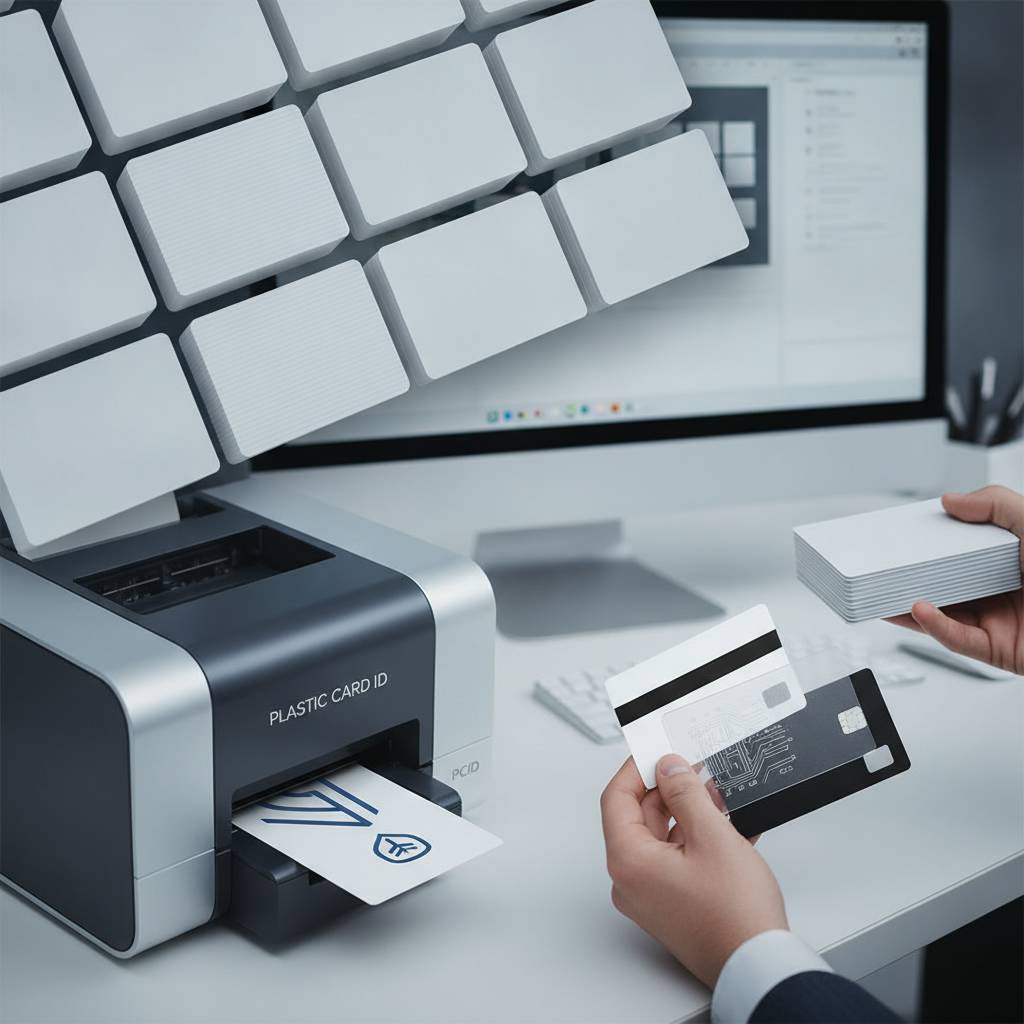
Retailers who switch from paper punch cards or paper gift certificates to plastic consistently see measurable performance improvements. Gift card programs on plastic report sales increases in the 35-50% range over paper equivalents. Loyalty programs on plastic cards outperform paper alternatives because the card lives in the wallet, maintaining brand presence every time the customer reaches for any card at all.
Employee ID and Access Control Cards
The most direct application. A blank card loaded into a printer with an ID card software package and a database of employee photos and data produces a professional, photo-ID badge in under a minute. Add a magnetic stripe or proximity chip and the same card becomes an access credential that controls which doors an employee can open, which systems they can log into, and which areas of a facility they can enter.
This combination of visual ID and encoded access in a single card is the backbone of physical security programs in organizations of every size. The blank PVC card is, at its core, the building block of modern identity management. Schools, hospitals, corporate campuses, government facilities, and manufacturing plants all rely on this same fundamental product.
Loyalty and Gift Card Programs
Retail and hospitality businesses that issue loyalty cards on plastic see retention benefits that paper programs simply cannot match. The physical card maintains brand presence in the customer's wallet between visits. It signals commitment on both sides of the relationship - the business invested in real infrastructure; the customer carries proof of membership. That dynamic changes behavior in measurable ways.
Gift card programs present a particularly compelling case. A plastic gift card displayed in a retail checkout rack drives impulse purchases. A paper gift certificate does not. The difference is not in the value stored - it is in the perceived legitimacy and professionalism that plastic communicates. Switching from paper to plastic gift cards is one of the highest-ROI decisions a retailer can make.
Membership, Event, and Casino Cards
Membership organizations - gyms, clubs, associations, professional bodies - rely on plastic cards to communicate legitimacy and belonging. A member who carries a rigid, printed card feels differently about their membership than one who carries a paper printout. The card signals permanence, seriousness, and investment. For the issuing organization, it also reduces fraud and facilitates faster check-in processes.
Event credentials and casino player cards occupy slightly different territory but share the same underlying logic. Casino player cards are sophisticated instruments - typically RFID-enabled, linked to player accounts and comp programs - but they begin as blank PVC card substrates. Event credentials need to be produced quickly, in volume, with personalization. Blank PVC cards with magnetic stripes or RFID inlays support both applications with equal reliability.
Frequently Asked Questions About Blank PVC Cards
 Buyers new to card programs - and sometimes experienced ones - arrive with a consistent set of questions. Getting these answers right early prevents costly mistakes and helps organizations build programs that perform from day one. Here are the questions CPE hears most often, answered directly.
Are All Blank PVC Cards Compatible With My Printer?
Almost, but not entirely. The critical variables are card thickness (30 mil for standard printers), card surface finish (some printers require specific surface coatings for optimal dye-sublimation transfer), and card feature type (your printer must support magnetic stripe encoding if you are buying mag stripe cards). Cards that are out-of-spec for your printer will produce poor results or damage the device.
CPE recommends specifying your printer brand and model when ordering to ensure compatibility. Evolis, Zebra, and Fargo printers - the brands stocked and supported by CPE - work with standard 30 mil PVC stock without issue. Compatibility is never something to guess about when printer damage is the potential consequence. Call 800.835.7919 to confirm the right card specification for your specific printer model.
What Is the Minimum Order Quantity?
Programs can start with as few as 50 cards. This low entry point makes blank PVC cards accessible to small businesses, nonprofits, startups, and organizations that are testing a new card program before committing to larger volumes. There is no need to order 5,000 cards to get started - though volume discounts make larger orders increasingly cost-effective as usage grows.
The per-card cost at 50 units is naturally higher than at 5,000 units. Organizations that know their long-term usage should think about where they realistically expect to be in six to twelve months and consider ordering to that volume rather than starting at the minimum. Buying ahead of demand, within reason, is almost always the smarter economic decision for established programs.
Can I Store Blank Cards for Long Periods?
Yes, with sensible precautions. PVC cards should be stored in their original packaging, away from direct sunlight, in a climate-controlled environment with moderate humidity. Extreme heat can cause minor warping in large stacks; extreme cold followed by rapid warming can affect the surface slightly. Under normal office storage conditions, blank PVC cards maintain their quality for extended periods without degradation.
The key risk with long-term storage is not the cards themselves but the pre-applied features. Magnetic stripe cards stored near strong magnetic fields can experience partial stripe degradation over very long periods. RFID cards stored near other RFID sources are at minimal risk but should still be kept in their original packaging. Proper storage is a simple discipline that protects your inventory investment.
Partner With Plastic Card ID for Your Card Program
 Twenty-five years and over 50 million cards represent a track record that speaks for itself. But what Plastic Card ID offers is not just a catalog - it is a partnership. From helping first-time buyers choose the right blank card and printer combination, to supplying established programs with the volume and consistency they require, CPE functions as a strategic resource rather than simply a vendor.
Whether your program runs 50 cards a month or scales into mass production in the tens of thousands, the same commitment to product quality, delivery reliability, and knowledgeable support applies. Every card program deserves a supplier that understands what is at stake - and that understands the difference between a card that works and a card program that works.
What Sets CPE Apart
Over 100,000 customers have trusted CPE with their card programs. That number reflects not just volume but diversity - small retailers, national chains, hospitals, schools, casinos, hotels, manufacturers, nonprofits, and government bodies. Each of those organizations had specific requirements, and each found a solution that fit within the CPE catalog.
The product range is comprehensive: plain white stock, magnetic stripe cards in HiCo and LoCo, RFID and proximity cards, smart chip cards including MIFARE DESFire, clear and frosted substrates, colored stock, custom die-cut shapes, and luxury metal cards. Card printers from Evolis, Zebra, and Fargo. Ribbons, cleaning kits, card carriers, sleeves, and card affixing and mailing services. One partner. One catalog. Every card program need, covered.
How to Get Started
Starting is straightforward. Know your card type (plain, mag stripe, RFID, smart chip), your approximate monthly volume, and whether you are printing in-house or outsourcing. With those three pieces of information, CPE can recommend the right blank card product, the right printer if needed, and the right supply package to keep the program running smoothly.
Buyers who are not yet certain of their requirements are equally welcome. Part of what makes CPE a genuine partner is the willingness to work through the decision process alongside the client - not just process an order. The right card program starts with the right conversation.
Ready to build or upgrade your card program? Contact Plastic Card ID today at 800.835.7919 and speak with a card program specialist who can match the right blank PVC card solution to your exact needs. Plastic Card ID - your trusted partner in blank PVC cards, card printers, and card program supplies for U.S. businesses of every size.