What Questions to Ask Before Ordering Plastic Cards
Table of Contents []
- Smart Questions Every Buyer Should Ask Before Ordering Plastic Cards - A Guide from Plastic Card ID
- What Is the Purpose of Your Card Program?
- Do You Understand Card Formats and Standards?
- What Are Your Volume and Timeline Requirements?
- Are You Asking the Right Questions About Card Printers?
- What Specialty Card Options Should You Know About Before Ordering?
- A Practical Pre-Order Checklist: Questions to Ask Before Ordering Plastic Cards
- Partner With Plastic Card ID for Every Card Program Question You Have
Smart Questions Every Buyer Should Ask Before Ordering Plastic Cards - A Guide from Plastic Card ID
 Ordering plastic cards for the first time - or even the fifth time - can feel surprisingly complicated once you get past the surface. Which card type fits your program? What encoding do you actually need? Will your printer handle the stock you choose? These are not rhetorical questions. They are the difference between a card program that runs smoothly for years and one that generates headaches from day one.
Plastic Card ID has worked alongside more than 100,000 customers across the United States, and the pattern is consistent: buyers who ask the right questions before placing their order end up with better cards, lower long-term costs, and programs that scale without friction. This guide exists to arm you with exactly those questions.
| Question Category | Why It Matters | Who Should Ask It |
|---|---|---|
| Card format and size | Ensures compatibility with printers and readers | All buyers |
| Encoding requirements | Magnetic stripe, RFID, and chip options each serve different use cases | Access control, loyalty, membership |
| Volume and timeline | Affects pricing, production method, and shipping lead times | All buyers |
| Printing method | In-house vs. pre-printed determines card stock choice | Organizations with card printers |
| Card finish and material | Gloss, matte, clear, frosted, or metal each serve different brand goals | Marketing and membership programs |
What Is the Purpose of Your Card Program?
 It sounds obvious, but the number of buyers who skip this foundational question is remarkable. The purpose of your card program determines nearly everything else - the card type, any encoding, the finish, the printing approach, and even the quantities you should be ordering. A retail gift card program has radically different requirements than a hospital ID badge or a hotel key card.
Defining your program's purpose sharpens every decision downstream. Employee ID? You likely need a blank PVC card with a photo-capable surface and perhaps a magnetic stripe or proximity chip for door access. Loyalty card? You want something wallet-friendly, visually compelling, and durable enough to survive two years of daily handling. Getting this right at the start saves money and prevents costly re-orders.
Identity and Access Control Cards
Organizations running access control programs - office buildings, schools, healthcare facilities, data centers - typically need cards encoded with specific technology. Proximity cards operate at 125kHz, while RFID smart cards operating at 13.56MHz (such as MIFARE DESFire) offer far greater data security and flexibility. Knowing which frequency your existing readers support before ordering is non-negotiable.
Employee ID programs often combine visual identification with electronic access, meaning the card must support both high-quality photo printing and embedded chip or stripe encoding. Blank CR80 PVC cards printed in-house allow you to update employee photos and data without re-ordering entire batches from a supplier.
Loyalty and Membership Card Programs
Retail and hospitality businesses consistently see measurable ROI from plastic loyalty cards. The data is not anecdotal - retailers switching from paper-based systems to plastic cards report sales increases of 35-50%, and a card that lives in a wallet outperforms a paper punch card in almost every meaningful metric. Visibility drives behavior.
Membership programs for gyms, clubs, and associations benefit from the legitimacy signal that a well-made plastic card sends. Paper credentials feel temporary. A durable, professionally printed plastic membership card signals permanence - and that perception matters to how members engage with your organization.
Gift Cards, Event Credentials, and Marketing Cards
Gift cards are one of the strongest revenue-generating tools in retail. A plastic gift card on a rack or counter invites purchase in a way that digital-only options simply do not replicate. Event credentials - wristbands aside - work beautifully as plastic cards when access control, tiered access, or reuse across multi-day events is required.
Marketing cards, often formatted as business cards but printed on CR80 PVC stock, deliver a tactile premium impression that paper cannot match. A potential client who keeps your plastic card keeps your brand in their wallet. That kind of lingering presence is worth thinking about carefully before you default to paper.
Do You Understand Card Formats and Standards?
The CR80 is the ISO 7810 standard card format - 3.375 inches by 2.125 inches, 30 mil thick - and it is the format used by virtually every card printer, badge holder, wallet slot, and card reader in commercial use. Understanding this standard protects your investment from the start. When you order cards that deviate from CR80 without a specific reason, you risk incompatibility with printers, lanyards, badge holders, and reader hardware.
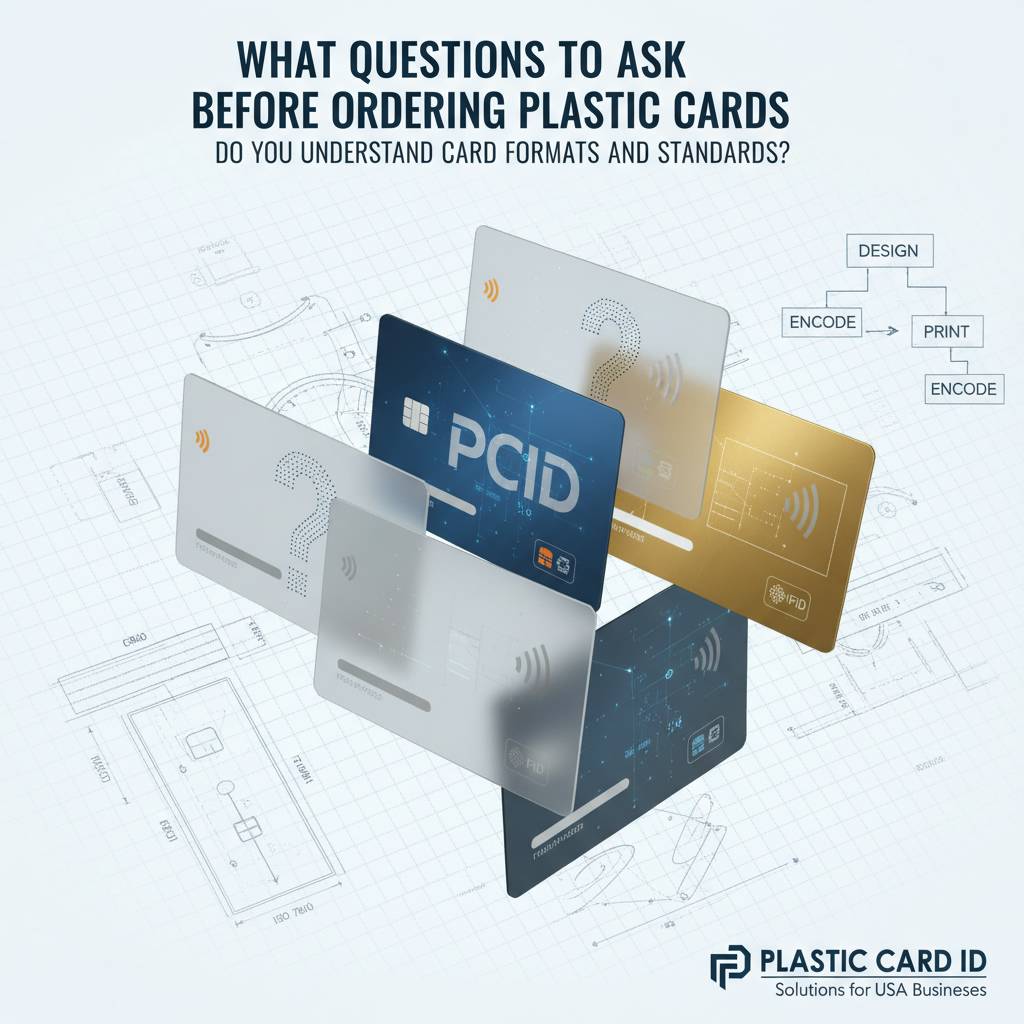
That said, custom die-cut shapes and non-standard sizes exist and serve real purposes - promotional mailers, novelty programs, specialty retail. Just go into those orders with eyes open about what you are giving up in compatibility and what you are gaining in differentiation. CPE carries both standard and specialty formats precisely because different programs have different needs.
CR80 Blank Cards: The Workhorse of In-House Programs
Blank CR80 PVC cards are the foundation of thousands of in-house card programs across the country. A blank card is a canvas - print on it with a card printer and it becomes an employee badge, a loyalty card, a membership card, or a visitor credential. The per-card cost is low, the design control is total, and the program scales at your pace without reordering pre-printed stock.
The 30 mil thickness is the industry standard and ensures cards feed smoothly through virtually any desktop card printer. Thinner cards (20 mil) exist for specific applications like mailers and adhesive-backed cards, but if you are running a standard ID or loyalty program, 30 mil CR80 is the correct choice in almost every scenario.
Magnetic Stripe Cards: HiCo Versus LoCo
Magnetic stripe cards come in two coercivity levels: High Coercivity (HiCo) and Low Coercivity (LoCo). HiCo stripes resist demagnetization far better and are the right choice for cards that will be used daily over months or years - employee access cards, loyalty cards, hotel keys. LoCo cards work fine for short-term applications like single-event credentials or one-use vouchers.
Ordering the wrong coercivity is a common and avoidable mistake. If your card will live in a wallet next to other magnetic cards, near a phone, or in a reader-heavy environment, HiCo is almost always the answer. Ask your supplier explicitly about coercivity before finalizing a magnetic stripe card order.
RFID, Proximity, and Smart Chip Cards
Contactless technology in plastic cards falls into a few distinct categories. Proximity cards (commonly called prox cards) use 125kHz technology and are widely deployed in commercial access control. RFID smart cards at 13.56MHz - particularly those using the MIFARE DESFire platform - support encrypted, multi-application use cases including transit, event access, and high-security identification.
Smart chip cards with contact chips offer additional options for stored-value or secure identification programs. Casino player cards and hotel key cards frequently leverage these technologies. Before ordering any contactless card, confirm that the card's chip frequency and protocol match your existing reader infrastructure. Mismatches here are expensive.
What Are Your Volume and Timeline Requirements?
 Volume and timeline are intertwined, and both have significant pricing implications. A small organization ordering 500 cards once a year has different needs than a retail chain ordering 50,000 cards quarterly. Neither is a problem - but treating them as though they require the same approach is a mistake that costs money and time.
In-house printing with blank card stock makes sense for programs that print cards continuously in small batches - new employee IDs, new members, event walk-ins. Pre-printed or custom-ordered cards make sense when you have a large, defined quantity to deploy at once with consistent design. CPE supports both models and can help you determine which approach delivers better economics for your specific program.
Small Volume Programs: 50-500 Cards Per Month
Small-volume programs are often best served by maintaining a stock of blank CR80 cards and a desktop card printer. The investment in a printer pays back quickly when you factor in the flexibility - print one card or one hundred, on demand, without waiting for supplier lead times. Evolis, Zebra, and Fargo printers cover this range extremely well.
Flexibility at small volume is a genuine competitive advantage. An organization that can print a new employee badge on day one - rather than waiting for a batch order - operates more professionally and securely. Keep a supply of blank cards and printer ribbons on hand and your program runs without interruption.
Medium to High Volume Programs: 1,000-50,000 Cards
Higher volume programs unlock pricing efficiencies that make pre-printed and specialty cards far more accessible. Custom printed cards, RFID-embedded cards, or specialty finishes (clear, frosted, colored stock) become cost-effective at scale. Volume also influences whether you should invest in a higher-throughput printer or continue sourcing pre-encoded cards directly.
Retailers running large gift card programs, hotel chains managing key card inventory, and healthcare systems issuing patient ID cards all fall into this tier. At this volume, the quality and consistency of your card supplier - reliability, lead times, defect rates - matters as much as the unit price.
Questions to Ask About Lead Times Before You Order
- What is the standard production lead time for the card type I am ordering?
- Are rush production options available, and what do they cost?
- Does the lead time include shipping, or is that separate?
- What happens to lead times when I increase my order quantity significantly?
- Can I set up a standing order or subscription to avoid stock-outs?
Asking these questions before you finalize your order prevents the scenario where a card program goes live without cards - a more common problem than it should be. Build buffer time into every order cycle, especially for programs where card availability is operationally critical.
| Volume Tier | Recommended Approach | Key Considerations |
|---|---|---|
| 50-500/month | Blank cards desktop printer | Flexibility, on-demand printing |
| 500-5,000/month | Mix of blank and pre-printed | Balance of cost and customization |
| 5,000/month | Custom pre-printed or encoded cards | Volume pricing, consistency |
Are You Asking the Right Questions About Card Printers?
 If you are printing cards in-house - or planning to - the printer you choose determines the quality of your output, the range of card types you can print, and the total cost of ownership over time. Not every printer handles every card type, and the ribbons, cleaning kits, and maintenance supplies are recurring costs that need to be factored into your program economics from the start.
Evolis, Zebra, and Fargo each manufacture excellent card printers across a range of throughput and feature levels. The right choice depends on your volume, the encoding features you need (magnetic stripe encoding, chip encoding, RFID writing), and whether you need single-sided or dual-sided printing. Do not buy a printer without knowing exactly which cards it is certified to print.
Printer Compatibility With Your Card Stock
Card printers are calibrated for specific card thicknesses and surface finishes. A printer designed for 30 mil CR80 cards may jam or produce poor results with thinner or thicker stock. Clear and frosted cards have different surface characteristics than standard white PVC and may require adjusted printer settings or specific ribbon types.
Before ordering specialty card stock - colored, clear, frosted, or pre-printed - confirm compatibility with your printer model. Most manufacturers publish approved card stock lists. When in doubt, call your supplier and provide your printer model. CPE can advise on compatibility based on your specific hardware.
Ribbons, Cleaning Kits, and Consumables
The cost of printer ribbons and cleaning supplies is a recurring expense that surprises many buyers. Ribbon yield - how many cards you get per ribbon panel set - varies significantly between models and printing modes. A full-color YMCKO ribbon might yield 250 cards; a monochrome black ribbon might yield 1,000 or more. Understanding your ribbon economics before you commit to a printer model is genuinely important.
Cleaning kits are not optional. They are the difference between a printer that lasts five years and one that fails after eighteen months. Regular cleaning prevents print head damage, reduces roller contamination, and maintains print quality over time. Ask your supplier whether cleaning supplies are bundled or available as add-ons when you purchase a printer.
When to Call for Printer Guidance
If you are comparing two or three printer models and cannot determine which one fits your program, a phone conversation with a knowledgeable supplier will resolve it in minutes. Describe your card type, monthly volume, encoding needs, and budget range. A good supplier will point you to the right hardware without upselling you into features you do not need.
Reach out to Plastic Card ID directly at 800.835.7919 for printer recommendations tailored to your specific program. The team has decades of experience matching buyers with the right equipment and can prevent the costly mistake of purchasing a printer that does not serve your actual requirements.
What Specialty Card Options Should You Know About Before Ordering?
The plastic card catalog extends well beyond standard white PVC, and buyers who do not know the full range of options sometimes settle for less than what would actually serve their program best. Specialty cards - clear, frosted, colored stock, custom die-cut, and luxury metal - exist because different programs have genuinely different brand and functional requirements.

A hotel that issues premium membership cards to its loyalty tier should probably not be handing out the same white PVC stock used for a visitor badge. The card is a brand touchpoint. What it looks and feels like communicates something about your organization every time it is handled. Specialty options allow you to align that communication with your brand's actual positioning.
Clear, Frosted, and Colored Card Stock
Clear PVC cards offer a striking visual that standard white stock cannot replicate. Used for overlay-printed designs, they allow for creative card presentations where the card's transparency is part of the aesthetic. Frosted cards deliver a soft, premium feel that photographs well and photographs differently depending on the light angle - a subtle but real differentiator for upscale membership or loyalty programs.
Colored card stock - available in a range of solid colors - provides an instant visual coding system for organizations that need to differentiate card holders by department, access level, or membership tier. It is faster to read at a glance than text alone and reduces errors in high-traffic card-check environments.
Luxury Metal Cards and Custom Die-Cut Shapes
Metal cards in stainless steel, brass, and gold occupy the top tier of card program prestige. Casino loyalty programs, exclusive membership clubs, and premium corporate gifting programs use metal cards specifically because of the impression they make. The weight, sound, and finish of a metal card is unmistakably different from any plastic alternative, and that difference carries meaning.
Custom die-cut shapes break the rectangular mold and serve programs where the card itself is a marketing piece - promotional campaigns, product launches, trade show giveaways. The tradeoff is wallet compatibility, but for single-use or display applications, die-cut cards deliver memorability that standard formats cannot match.
Casino Cards, Hotel Keys, and Specialty Program Cards
Casino player cards and hotel key cards are specialized products with specific encoding and durability requirements. Casino cards frequently incorporate smart chip technology, magnetic stripes, and custom printing in combination. Hotel key cards require encoding compatible with specific lock hardware - and the card's durability determines how often guests need replacements, which has real operational cost implications.
If your program falls into one of these specialty categories, ask your supplier explicitly about the encoding standards and hardware compatibility before ordering. These are not programs where ordering first and troubleshooting later is an acceptable strategy. Get the technical specifications confirmed upfront.
A Practical Pre-Order Checklist: Questions to Ask Before Ordering Plastic Cards
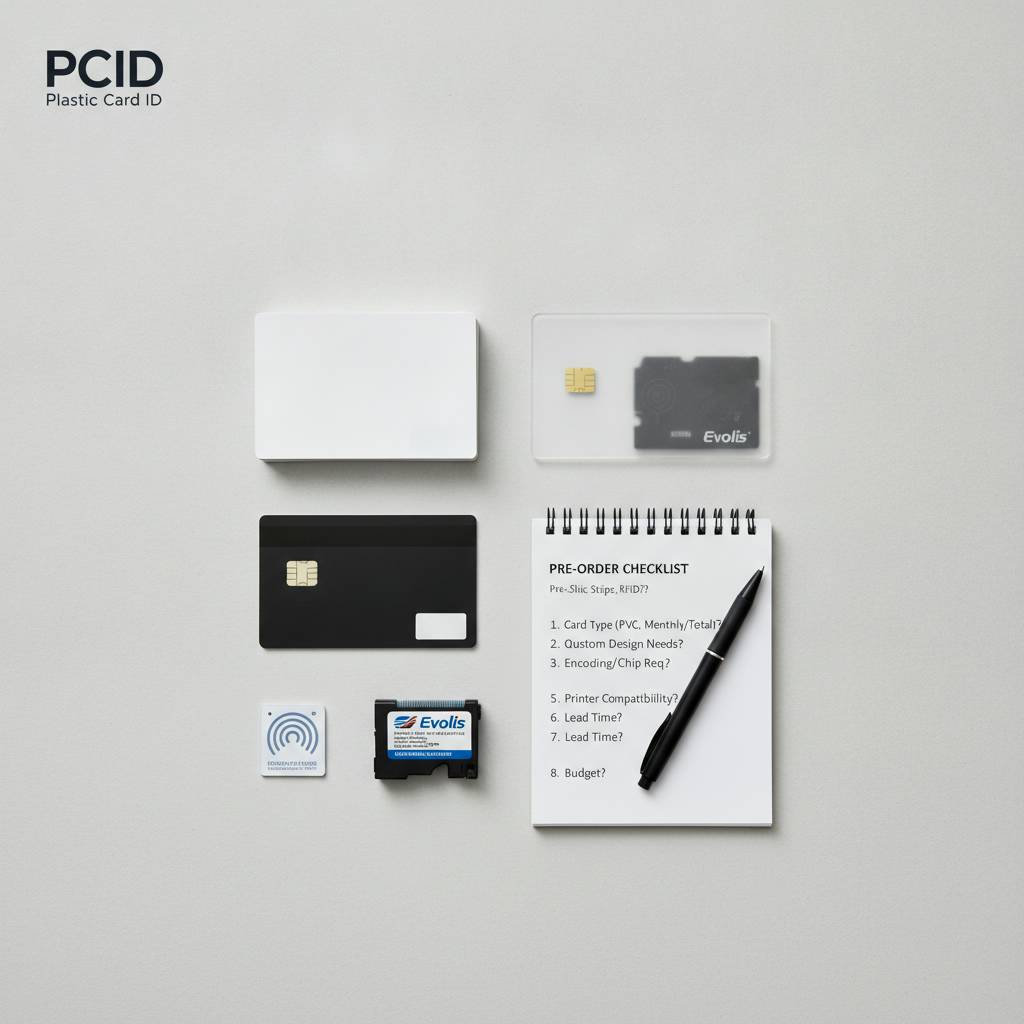 Pulling everything together into a single actionable reference helps prevent the most common ordering mistakes. Whether you are a first-time buyer or an experienced program manager refreshing your card stock, running through this checklist before finalizing any order is worth the few minutes it takes.
The buyers who get the best outcomes consistently are the ones who ask more questions, not fewer. They arrive at their orders with clarity about what they need and why, and they engage their suppliers as partners rather than order-takers. That dynamic produces better cards, better pricing over time, and programs that run without unnecessary friction.
Technical Questions to Confirm Before Ordering
- What card format and thickness do I need - CR80 30 mil, or a specialty size?
- Do I need encoding - magnetic stripe (HiCo or LoCo), RFID, proximity, or smart chip?
- Is the card frequency compatible with my existing reader hardware?
- Does my printer support the card stock I am ordering?
- Do I need single-sided or dual-sided printing capability?
- What finish do I need - gloss, matte, clear, frosted, or colored stock?
- Are there any special handling requirements for the card type I am ordering?
Program and Business Questions to Resolve First
- What is the primary purpose of this card - identity, access, loyalty, gift, marketing, or event?
- How many cards do I need initially, and what is my ongoing monthly volume?
- Will I print cards in-house or order pre-printed cards from a supplier?
- What is my timeline - when do I need cards in hand?
- What does this card need to communicate about my organization's brand?
- Do I need accessory products - card carriers, sleeves, lanyards, or mailing services?
Supplier Questions That Reveal Whether You Have the Right Partner
Not every supplier operates with the depth of experience or the breadth of product range that a serious card program demands. Ask your potential supplier how long they have been in the business, what industries they specialize in, and whether they can support your program as it scales. A supplier who cannot answer specific technical questions about encoding or printer compatibility is probably not the right long-term partner.
Ask whether they offer value-added services like card affixing and mailing - because the ability to receive a complete, ready-to-deploy card package rather than managing multiple vendors separately is a genuine operational advantage. CPE operates as a true one-stop shop, not just a card vendor, and that distinction matters when your program grows in complexity.
Partner With Plastic Card ID for Every Card Program Question You Have
 There is a reason more than 100,000 organizations across the United States have chosen Plastic Card ID as their plastic card supplier. It is not just the catalog - blank cards, magnetic stripe, RFID, proximity, smart chip, clear, frosted, colored, metal, and every printer and consumable to support them. It is the partnership model: a team that answers real questions, solves real problems, and helps programs succeed whether they are ordering 50 cards a month or tens of thousands.
Asking the right questions before ordering plastic cards is not a bureaucratic exercise - it is the foundation of a program that works. From the first order to the thousandth, the buyers who get the most out of their card programs are the ones who treat their supplier as a strategic resource. That is exactly the role Plastic Card ID is built to play.
Ready to get your questions answered by a team with over 25 years of plastic card expertise? Call Plastic Card ID today at 800.835.7919 and let us help you build a card program that delivers real results from day one.
Previous Page